
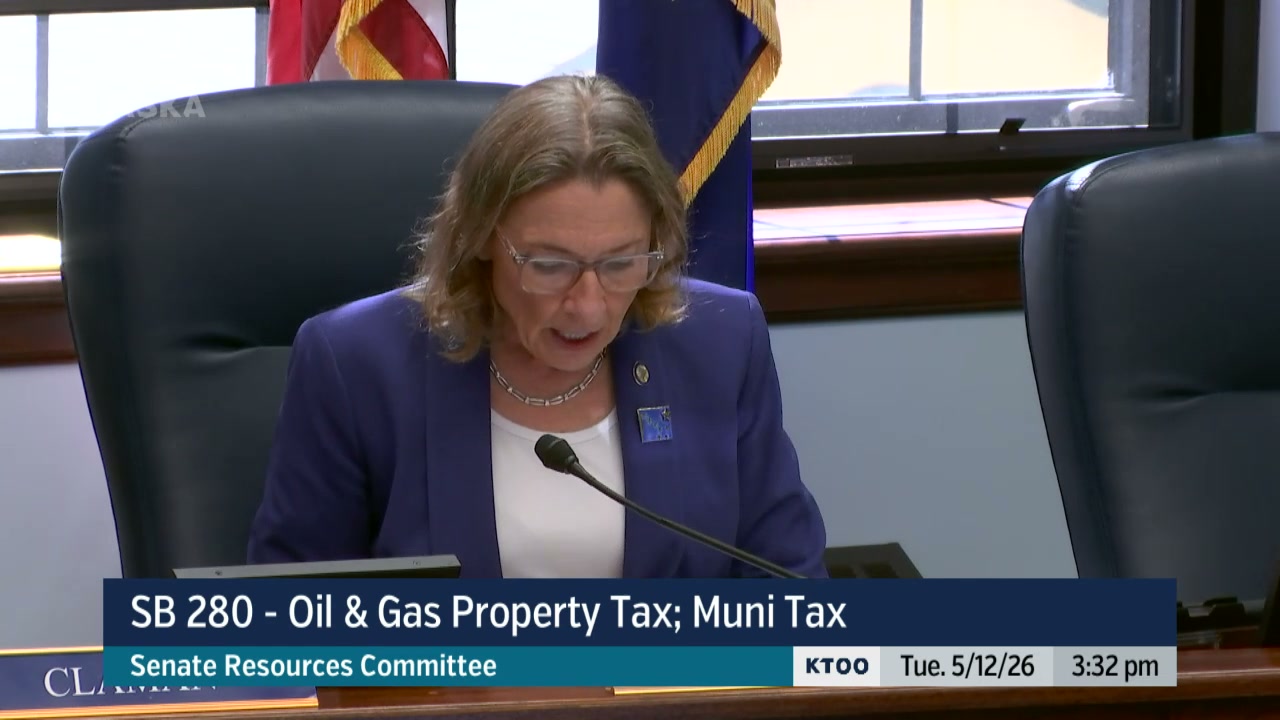
Frame from "Senate Resources, 5/12/26, 3:30pm" · Source
Gas tax hike could net Alaska $590M over pipeline life, analysis shows
The Alaska Senate Resources Committee heard Tuesday that raising the state's gas production tax could generate hundreds of millions of dollars in additional revenue while protecting in-state consumers from price increases under the department's modeling assumptions.
Dan Stickel, chief economist with the Department of Revenue, told the committee that each 1 percentage point increase in the North Slope gas production tax would generate roughly $17 to $20 million per year once exports begin in 2033. Over 30 years, a single percentage point increase would bring in about $590 million in cumulative additional state revenue.
The analysis assumes the Alaska LNG project proceeds as planned, with 32 years of gas sales including 30 years of full export production beginning in 2033. The revenue projections are based on a $1.50 per thousand cubic feet gas purchase price on the North Slope and assume gas prices will increase with inflation at 2.5 percent annually.
Alaska News previously reported that the Senate panel advanced a gas pipeline tax overhaul targeting $610 million in revenue, and that the oil industry has opposed tax provisions in the pipeline bill.
Under the department's modeling, the tax increases would not affect in-state gas prices because of an existing 17.7-cent per thousand cubic feet tax ceiling that applies to gas used within Alaska. Stickel explained that at the assumed $1.50 purchase price, the tax ceiling represents a lower effective tax rate than the current 13 percent gross value tax. The ceiling represents the weighted average gas production tax rate in Cook Inlet that was in place under the ELF tax system in 2006.
"If we assume a $1.50 per thousand cubic feet purchase price, the 17.7-cent tax ceiling is a lower tax rate than the 13 percent of gross value," Stickel said. "And so at any of these 13 to 17 percent gross tax rates for in-state gas, the tax ceiling is going to apply, the 17.7 cents."
Sen. Forrest Dunbar, D-Anchorage, asked for clarification on whether the tax ceiling meant in-state consumers would be protected from price increases. Stickel confirmed that under the modeling assumptions, in-state gas prices would not be affected.
"Until 2032, there is no impact from any of these tax changes, and that's exactly because of that in-state tax ceiling, which governs at 13 percent," Stickel said. "And so whatever increases to the gross tax rate are implemented would not impact in-state gas, assuming the $1.50 per MCF purchase price."
The department modeled cumulative revenue impacts over 10, 20 and 30 years. Over 10 years, each 1 percentage point increase would generate about $174 million in additional state revenue.
Stickel cautioned that while the tax changes would not directly affect project economics through in-state gas pricing, they could have indirect effects. An increase in the upstream tax rate could potentially influence the price that gas producers are willing to accept when selling to the pipeline developer.
This article was drafted with AI assistance and reviewed by editors before publishing. Every claim can be verified against the original transcript. If you spot an error, let us know.
Related Coverage
Senate panel advances gas pipeline tax overhaul with $610M revenue target
Alaska News · 1w ago · 1 views · 87% match
House panel hears tax proposal for Alaska LNG project
Alaska News · 1w ago · 2 views · 86% match
Senate panel debates gas pipeline tax structure in 26th hearing
Alaska News · 1d ago · 4 views · 85% match
House Finance begins review of Alaska LNG tax bill with competing rate proposals
Alaska News · 2d ago · 4 views · 85% match
Alaska LNG tax bill could swing state revenue by hundreds of millions
Alaska News · 2w ago · 1 views · 85% match
Comments
Sign in to leave a comment.
No comments yet. Be the first to share your thoughts.