
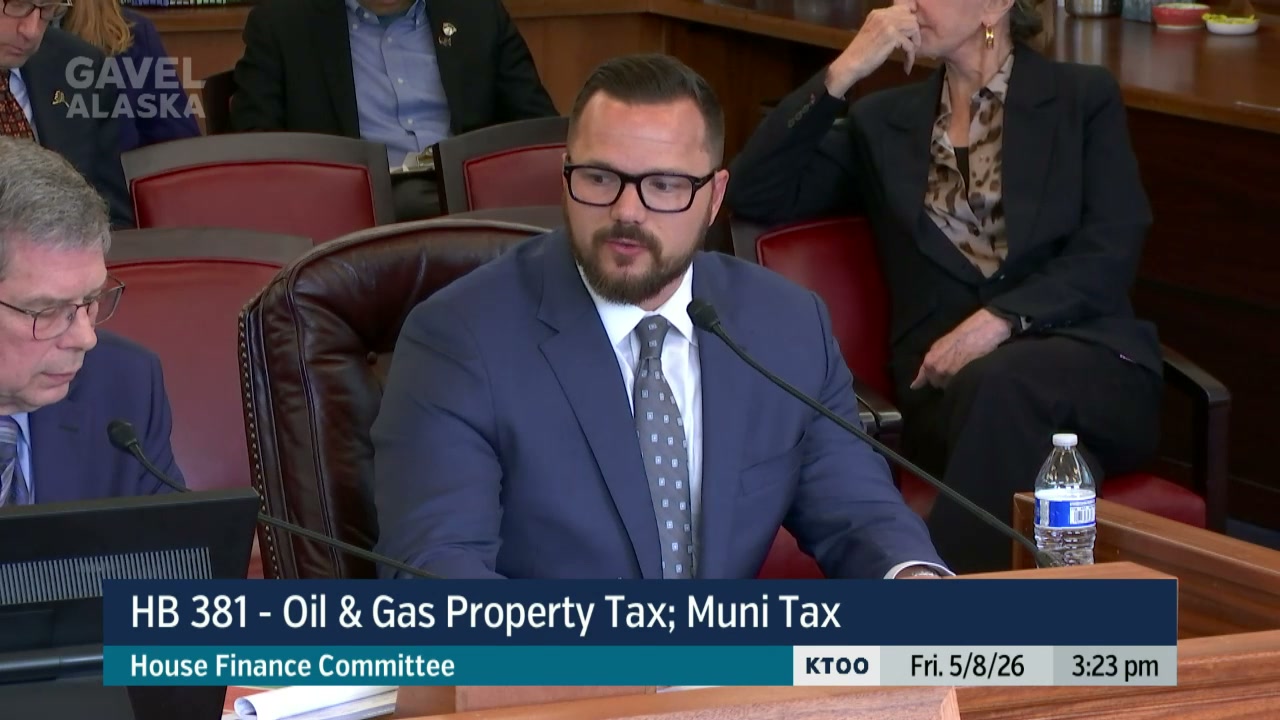
Frame from "HFIN-260508-1330" · Source
House Finance begins review of Alaska LNG tax bill with competing rate proposals
The House Finance Committee on Friday began reviewing legislation that would fundamentally change how Alaska taxes a proposed natural gas pipeline from the North Slope. Competing proposals would have different revenue effects for the state and local governments.
The bill would replace traditional property taxes on the Alaska LNG pipeline with an alternative volumetric tax based on gas throughput. The House Resources Committee version proposes 15 cents per thousand cubic feet. The administration's original proposal called for 6 cents.
"We had proposed 6 cents. So that's a fundamental difference that we have," Co-chair Foster told the committee.
Mark Begich, representing the administration through Northern Compass Group, estimated the state would receive about $800 million annually in combined taxes and royalties over 30 years. Local governments would receive approximately $4 billion during the same period under the new tax structure, he said.
Matt Kissinger, commercial director for the Alaska Gasline Development Corporation, warned that Alaska's current property tax structure threatens the project's viability. He told the committee that independent analysis found Alaska property taxes were "a whole order of magnitude, so 10 times that of the next highest" when compared to competing jurisdictions including Texas, Louisiana and Canada.
Kissinger said AGDC brought in Gas Strategies, a London-based intelligence service, to benchmark Alaska's property taxes against other states and foreign countries. "What they found was that the property taxes in Alaska were a whole order of magnitude, so 10 times that of the next highest," he said.
The House Resources version includes provisions the administration opposes. Section 4 authorizes municipalities to apply local property tax to project properties and adjust the mill rate in negotiation with the project developer. Administration officials called this a problematic two-tier system.
"This element that I'm referring to right now gives it the right to the city or the municipalities of North Slope Borough and the Kenai Peninsula Borough to select their mill levy, which makes it very troublesome," Co-chair Foster said. "Because we will not know that value as we're trying to figure out the cost and some certainty."
Another provision would allow municipalities to take an equity stake in the project instead of collecting property taxes. Administration officials said this would require the project to raise additional cash, increasing costs and interest expenses.
The Resources version also removed a 10-year tax abatement period that was in the original bill. It changed the inflation adjustment from 1 percent annually to the Consumer Price Index. Administration officials recommended a floor of 1 percent and ceiling of 2 percent instead. They argued that natural gas is a commodity product whose price depends on market conditions rather than inflation.
This article was drafted with AI assistance and reviewed by editors before publishing. Every claim can be verified against the original transcript. If you spot an error, let us know.
Related Coverage
House panel hears tax proposal for Alaska LNG project
Alaska News · 5d ago · 2 views · 92% match
Alaska LNG Tax Bill Walks Tightrope Between Project Viability and Local Needs
Alaska News · 1w ago · 5 views · 90% match
Senate panel examines regulatory questions on gas pipeline tax plan
Alaska News · 2w ago · 10 views · 90% match
Senate panel debates $1B tax break for Alaska LNG amid cost secrecy
Alaska News · 5d ago · 3 views · 89% match
Senate panel examines LNG project economics, megaproject risks
Alaska News · 2w ago · 11 views · 88% match
Comments
Sign in to leave a comment.
No comments yet. Be the first to share your thoughts.