
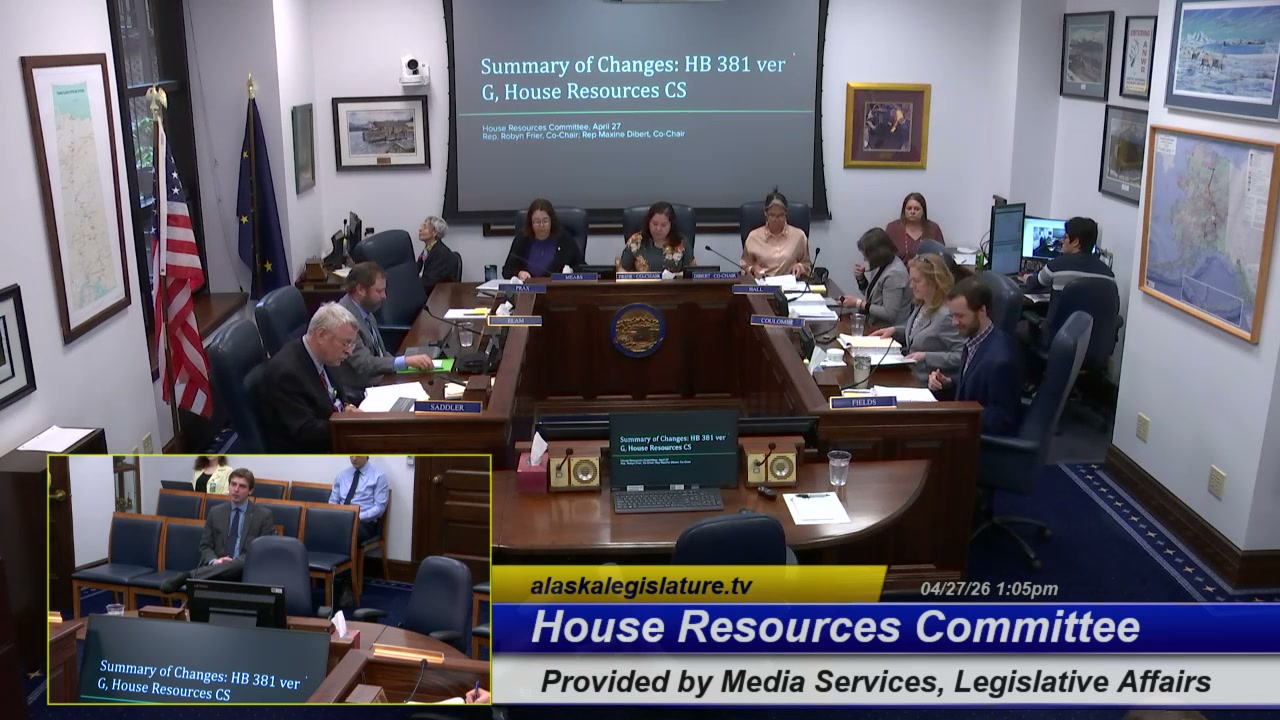
Frame from "House Resources, 4/27/26, 1pm" · Source
Alaska LNG Tax Bill Walks Tightrope Between Project Viability and Local Needs
The House Resources Committee's latest approach to taxing the Alaska LNG project places the state at a crossroads familiar to jurisdictions worldwide: how to structure levies that attract investment in capital-intensive energy infrastructure while ensuring communities bear neither the costs nor the risks of development.
The committee substitute adopted Monday creates a three-part volumetric tax system. It sets 5 cents per thousand cubic feet on pipeline throughput, 5 cents on the gas treatment plant, and 10 cents on the LNG facility, with a six-year abatement period. The structure diverges sharply from Governor Dunleavy's January proposal, which offered a uniform 6-cent rate across all components with a ten-year ramp-up, estimated to generate $26 billion over three decades.
The Senate Resources Committee has moved in the opposite direction. It released a revised bill with volumetric taxes up to 55 cents per thousand cubic feet plus one-time construction fees, approved preliminarily on a 5-2 vote last week. The competing approaches reflect divergent visions of Alaska's gas line future. Dunleavy's framework prioritizes low taxes to enable construction. The Senate version seeks to maximize revenue regardless of project viability.
Globally, LNG export facilities operate under widely varying fiscal regimes. Australia's North West Shelf project pays state royalties plus corporate income tax but received substantial infrastructure subsidies. Qatar's massive LNG operations function under production-sharing agreements that defer significant taxation until cost recovery. Canada's LNG Canada project in British Columbia benefits from a provincial sales tax exemption on construction materials and machinery, a provision Alaska's committee explicitly removed from earlier drafts.
"Any increased taxation, any further taxation stresses this project," Matt Kissinger, AGDC's commercial director, said during the hearing. "We are trying to find the exact right balance between the project moving forward and those needs of the community."
The committee's framework attempts that balance through conditional requirements. The project developer must commit to community benefit agreements with municipalities within 50 miles of the pipeline corridor, establish an impact fund for direct costs, negotiate a project labor agreement, and begin construction on a Fairbanks spur line within two years of completing the first 750 miles of pipeline. The Commissioner of Revenue determines whether commitments are sufficient before the alternative tax structure takes effect.
That approach mirrors strategies in other jurisdictions where large-scale resource projects face community opposition. Norway's petroleum sector operates under a framework requiring companies to submit impact assessments and mitigation plans before development approval, though the government, not individual municipalities, negotiates terms. In British Columbia, the province's Environmental Assessment Office coordinates with First Nations and local governments on benefit agreements, but provincial statute sets the fiscal framework.
This article was drafted with AI assistance and reviewed by editors before publishing. Every claim can be verified against the original transcript. If you spot an error, let us know.
Related Coverage
Senate panel examines LNG project economics, megaproject risks
Alaska News · 2d ago · 5 views · 89% match
Senate panel examines regulatory questions on gas pipeline tax plan
Alaska News · 4d ago · 9 views · 88% match
Alaska LNG tax bill could swing state revenue by hundreds of millions
Alaska News · 4h ago · 87% match
Mayors Oppose Alaska LNG Tax Bill, Cite Revenue Concerns
Alaska News · 2w ago · 4 views · 86% match
House Resources Committee debates LNG equity stakes, rejects wildlife refuge amendments
Alaska News · 2d ago · 2 views · 84% match
Comments
Sign in to leave a comment.
No comments yet. Be the first to share your thoughts.