
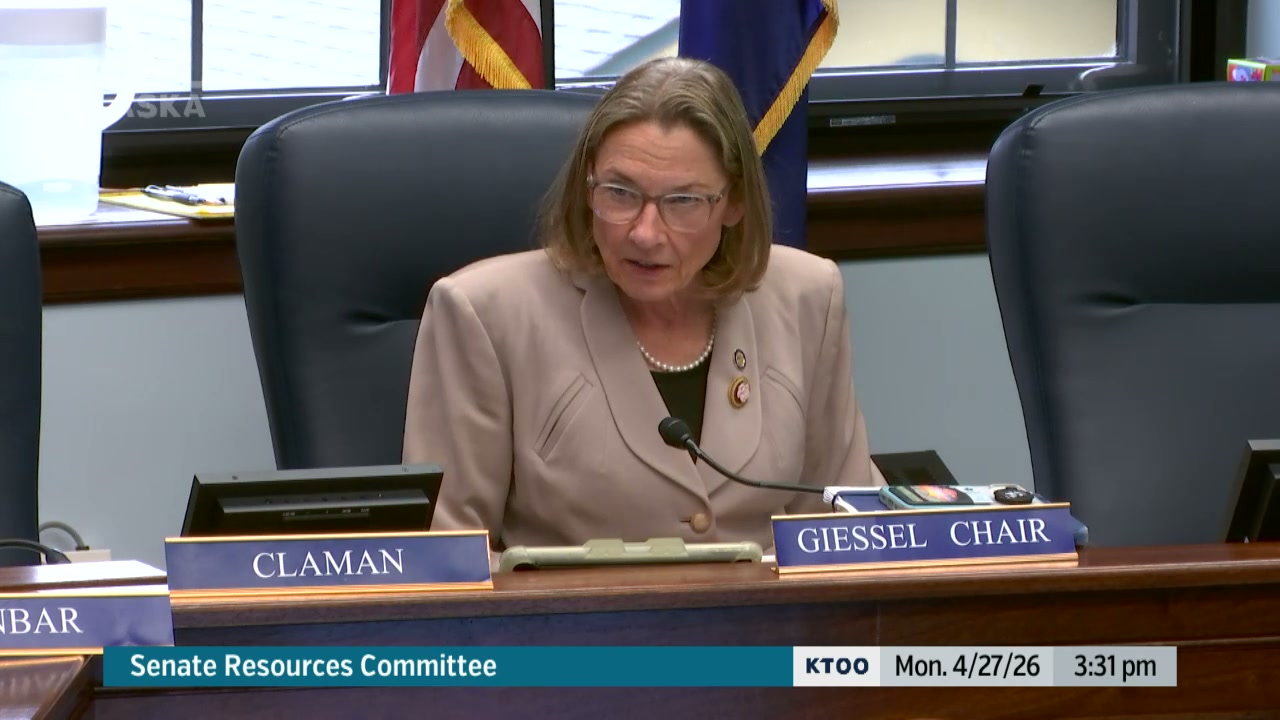
Frame from "Senate Resources, 4/27/26, 3:30pm" · Source
Alaska LNG tax bill could swing state revenue by hundreds of millions
The Alaska Department of Revenue warned Monday that a complex tax bill for the Alaska LNG project could swing state revenue by hundreds of millions of dollars depending on how regulators interpret key provisions.
Senate Bill 280 would exempt the Alaska Natural Gas project from state and local property taxes while creating new volumetric and pass-through entity taxes. But the bill's complexity could trigger years of audits and litigation between the state and oil companies, according to Dan Stickel, chief economist with the Department of Revenue's Tax Division.
"We believe that is a likelihood. Or at least a distinct possibility that there would be increased tax appeals, potential dispute, and potential litigation," Stickel said during a Senate Resources Committee hearing Monday. He pointed to provisions where the department would make regulatory decisions about how lease expenditures are allocated between oil and gas, and requirements to publish detailed field and potentially company-specific prevailing value calculations.
Governor Mike Dunleavy introduced Senate Bill 280 to replace the 20-mill property tax with an alternative volumetric tax. The Senate Resources Committee began hearings on the bill in mid-April and rolled out a committee substitute last week that significantly increased the tax rates and added new revenue mechanisms. The substitute raises the volumetric tax to 15 cents per thousand cubic feet for the treatment plant and pipeline, and 55 cents for the LNG plant, while adding a construction impact fee of $1 million per mile of pipeline installed. Those rates would be fixed for 10 years, then adjusted annually for inflation.
The state would share half the revenue with municipalities where the facilities are located, with pipeline revenue also flowing to communities statewide through revenue sharing. At full operations, the volumetric tax would generate $255 million per year in unrestricted general fund revenue, according to the department's modeling. The construction impact fee would add up to $739 million during the build-out, distributed to affected communities through a grant program.
But the bill's most contentious provision would disallow North Slope gas costs from the oil production tax calculation, retroactive to January 1, 2026. Under current law, any lease expenditures on the North Slope can be applied to the oil tax calculation toward the 35 percent net profits tax, regardless of whether they relate to oil or gas. The bill would disallow any lease expenditures deemed to be for gas, starting retroactively from the beginning of 2026.
That change would require the department to develop regulations determining which lease expenditures relate to oil versus gas. Those decisions could shift revenue by hundreds of millions of dollars. "We would need to develop and implement the methodology for breaking out oil versus gas costs. Again, via regulation, and the decision-making on that regulation could have many millions of dollars of impact depending on which direction we go, potentially hundreds of millions of dollars of impact," Stickel said. "So that is a significant level of discretion that is being left with the Department of Revenue for policymaking there."
This article was drafted with AI assistance and reviewed by editors before publishing. Every claim can be verified against the original transcript. If you spot an error, let us know.
Related Coverage
Senate panel examines regulatory questions on gas pipeline tax plan
Alaska News · 3d ago · 9 views · 88% match
Mayors Oppose Alaska LNG Tax Bill, Cite Revenue Concerns
Alaska News · 2w ago · 4 views · 87% match
Senate panel examines LNG project economics, megaproject risks
Alaska News · 2d ago · 5 views · 86% match
Municipal League urges local control in Alaska LNG tax negotiations
Alaska News · 1d ago · 1 views · 85% match
Senate Finance hears tax modernization bill, sets aside for further review
Alaska News · 3d ago · 1 views · 82% match
Comments
Sign in to leave a comment.
No comments yet. Be the first to share your thoughts.