
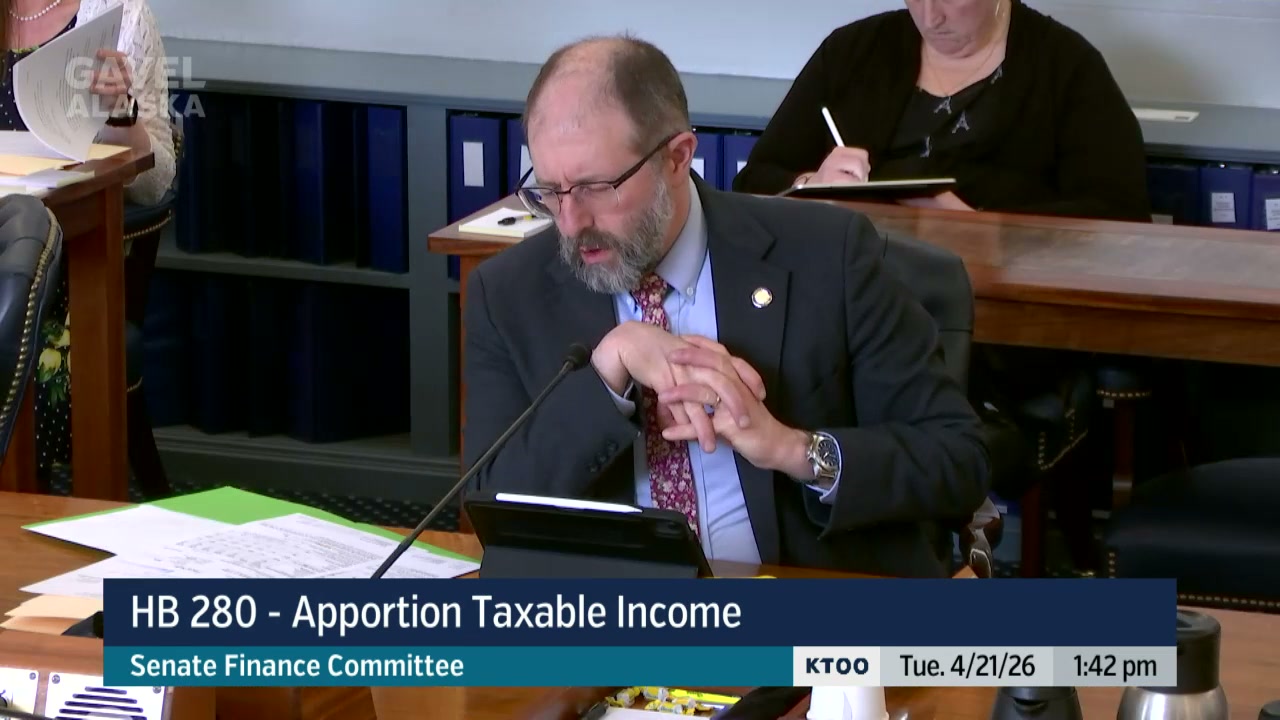
Senate Finance hears tax modernization bill, sets aside for further review
The Alaska Senate Finance Committee heard testimony Monday on legislation that would modernize how the state taxes out-of-state corporations but set the bill aside without a vote.
House Bill 280 would shift Alaska from a cost-of-performance methodology to market-based sourcing for corporate income tax apportionment. Under the change, the state would tax businesses based on where customers receive services rather than where companies perform work. The shift aims to capture revenue from digital-age sales that occur in Alaska but are managed from headquarters elsewhere.
Brody Anderson, staff to the bill's sponsor Representative Neil Foster, told the committee the change would generate approximately $15 million in new revenue annually once fully implemented. The bill would take effect January 1, 2027, giving the Department of Revenue time to develop regulations.
Market-based sourcing is a tax rule that clarifies the state gets to tax a business based on where the customer receives the benefit of service rather than where the company does its work, Anderson said. He cited online retailers based in California but selling to Alaska customers as an example.
Thirty-six other states already use some form of market-based sourcing.
The House Finance Committee version includes three industry exemptions: broadcasters, financial institutions, and telecommunications providers. Those exemptions drew questions from senators.
Brandon Spanos, acting director of the Department of Revenue Tax Division, told Senator Steadman the department is neutral on the bill, though similar language appears in the governor's omnibus tax package.
Senator Keele pressed Spanos on the telecommunications exemption, asking whether it would penalize companies that invested in Alaska infrastructure.
If I understood Mr. Spanos correctly from the tax division, those telecoms that invested in Alaska, built out whether it is wireline or cell sites, would end up effectively more subject to tax than those who do not invest in Alaska, Keele said.
Spanos confirmed that assessment. Under current cost-of-performance rules, telecoms with most costs outside Alaska can allocate zero sales to the state. Market-based sourcing would tax based on customer location instead.
That is why we have for a lot of years suggested that the state move to market-based sourcing, Spanos said. It is a more modernized approach, considering where your customers are located for sales purposes rather than where your costs are.
Senator Kaufman asked about the definition of platform distribution company in the broadcaster exemption, questioning whether it would include streaming services like YouTube or individual content creators on such platforms. Spanos said he would need to verify the specifics but noted the plain reading of the language appeared to include streaming services.
This article was drafted with AI assistance and reviewed by editors before publishing. Every claim can be verified against the original transcript. If you spot an error, let us know.
Related Coverage
Senate Finance hears corporate tax shift targeting online sales to Alaskans
Alaska News · 17h ago · 1 views · 94% match
Senate panel examines regulatory questions on gas pipeline tax plan
Alaska News · 20h ago · 8 views · 83% match
House Advances Corporate Tax Bill, Rejects AI and Nuclear Amendments
Alaska News · 1w ago · 2 views · 82% match
Mayors Oppose Alaska LNG Tax Bill, Cite Revenue Concerns
Alaska News · 1w ago · 4 views · 82% match
Senate committee holds Senate Bill 259 on property tax caps
Alaska News · 2h ago · 79% match
Comments
Sign in to leave a comment.
No comments yet. Be the first to share your thoughts.