
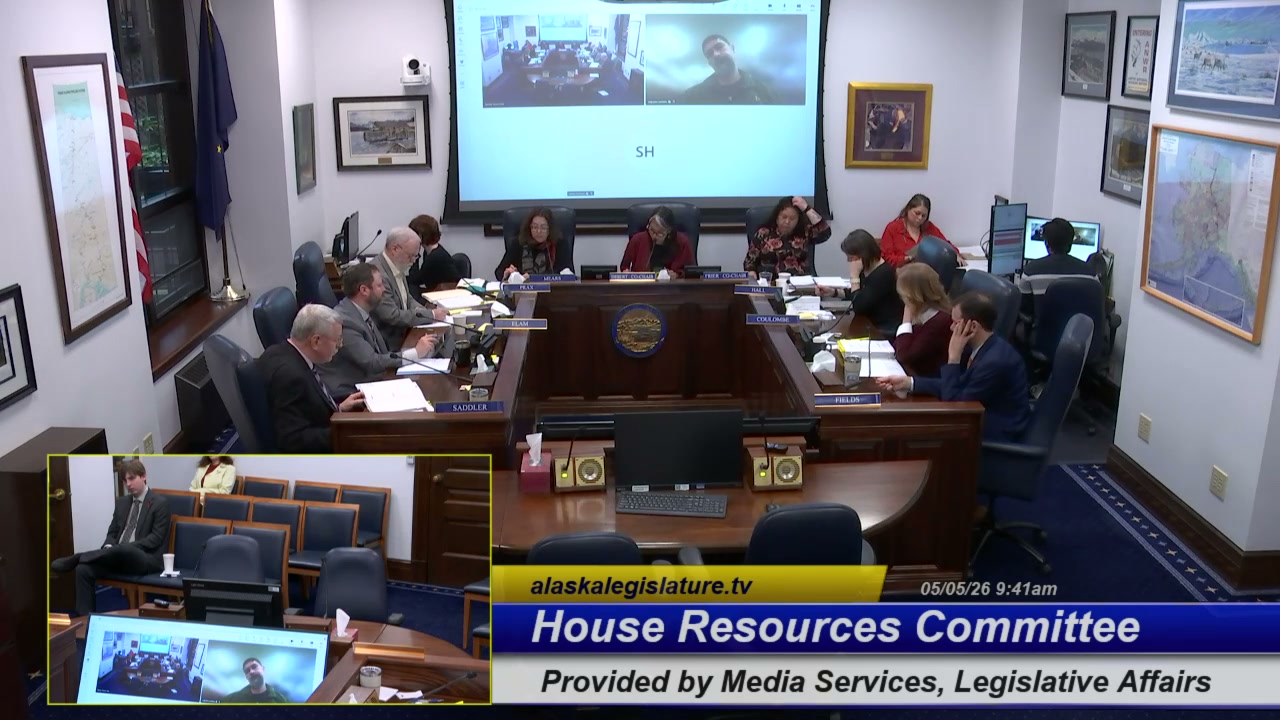
Frame from "HRES-260505-0800" · Source
House panel hears tax proposal for Alaska LNG project
The House Resources Committee heard Tuesday from the Department of Revenue on a proposal to exempt the Alaska LNG project from most property taxes in exchange for a lower alternative tax tied to gas volume.
House Bill 381 would exempt the entire project from state property taxes. That includes the gas treatment plant, pipeline, and LNG facility. The pipeline would also be exempt from municipal property taxes. In place of those levies, the bill would impose a 15-cent per thousand cubic feet volumetric tax on gas moving through the pipeline, beginning with first commercial production.
Dan Stickel, chief economist with the Department of Revenue, said the core purpose is to create a framework for exempting the Alaska LNG project from state property tax and potentially from some municipal property tax, then provide an alternative mechanism for receiving revenue from that project.
Under current law, if the project were to proceed, state and municipal property taxes would total about $50 million in 2029. That would ramp up to nearly $500 million by 2033 for the gas treatment plant and LNG facility alone. State property tax on the pipeline would add another $244 million by 2033, Stickel said.
"You add these two numbers up and in 2033 we are looking at a total property tax burden if the project were to go forward of nearly $750 million per year," Stickel said. "And so that is the burden that is being reduced through this legislation."
The alternative volumetric tax would generate about $10 million in 2029, increasing to nearly $200 million by 2033 when full export operations are underway, Stickel said. About 81 percent of that revenue would be shared with municipalities. Half would be distributed proportionally along the pipeline route based on miles of pipe. Half would be distributed to all communities statewide on a per capita basis. The state would retain the unorganized borough portion of the mileage-based share, resulting in unrestricted general fund revenue of $2 million in 2029, rising to $37 million in 2033.
The bill sets eligibility conditions for the tax relief. The project developer must commit to entering into community benefit agreements with every community within 50 miles of the project. The developer must set aside a portion of project revenue for community impact payments, enter into a project labor agreement, and commit to construction of a Fairbanks spur line before full export operations begin.
Representative Dan Saddler said what the committee hears clearly from project managers and developers is that the project will not proceed without tax modifications. "So to my mind, calculating what the revenue might go to municipalities and the state without tax modifications is hypothetical and not that useful," Saddler said. "We are not forgoing this money. It will not happen without the tax modifications."
This article was drafted with AI assistance and reviewed by editors before publishing. Every claim can be verified against the original transcript. If you spot an error, let us know.
Related Coverage
Energy consultant: Alaska LNG tax bill could cut delivered cost by 20 cents
Alaska News · 5d ago · 4 views · 92% match
Senate panel examines regulatory questions on gas pipeline tax plan
Alaska News · 1w ago · 10 views · 90% match
Alaska LNG tax bill could swing state revenue by hundreds of millions
Alaska News · 6d ago · 1 views · 89% match
Senate panel debates $1B tax break for Alaska LNG amid cost secrecy
Alaska News · 3h ago · 88% match
Senate panel advances gas pipeline tax overhaul with $610M revenue target
Alaska News · 4d ago · 1 views · 88% match
Comments
Sign in to leave a comment.
No comments yet. Be the first to share your thoughts.