
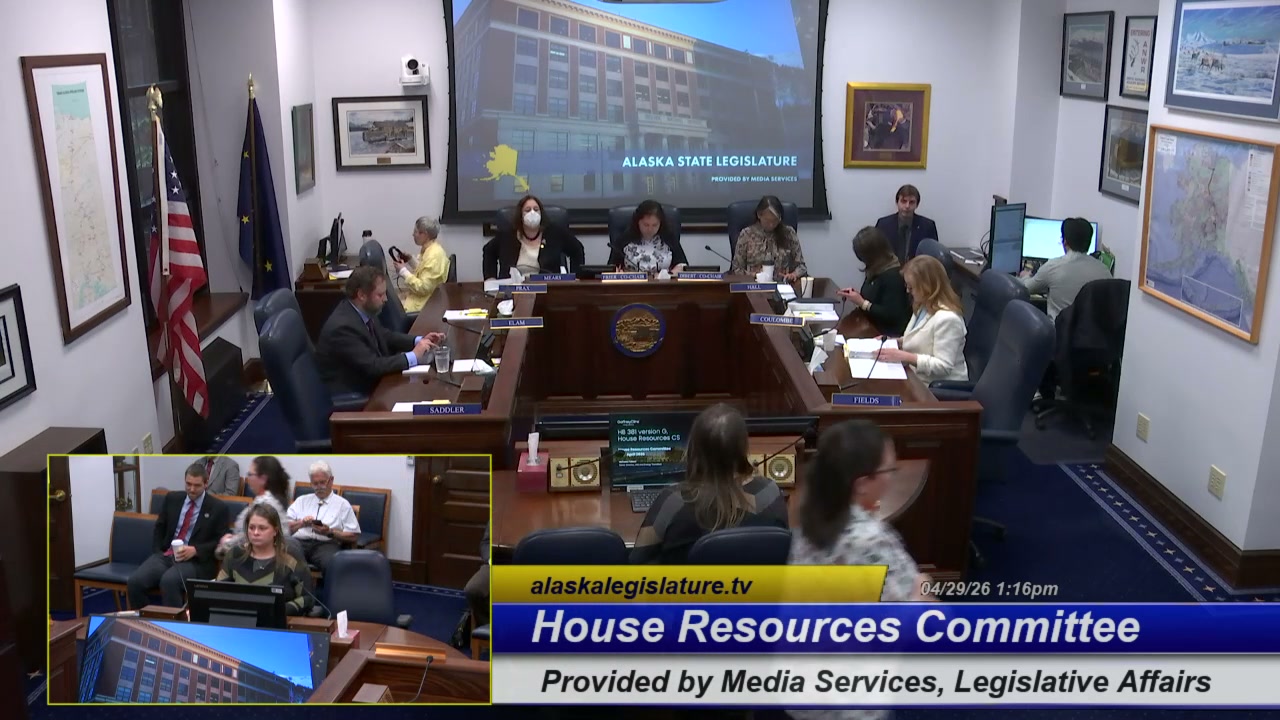
Frame from "HRES-260429-1300" · Source
Energy consultant: Alaska LNG tax bill could cut delivered cost by 20 cents
An energy consultant told Alaska lawmakers Wednesday that a proposed alternative tax structure for the Alaska LNG project could reduce the delivered cost of gas to Asia by roughly 20 cents per million British thermal units compared to the existing property tax system.
Nick Fulford, senior director for LNG and energy transition at Gaffney Klein Energy Advisory, presented analysis of the committee substitute for House Bill 381 to the House Resources Committee. The bill, introduced in March at Governor Mike Dunleavy's request, would replace property tax on the proposed $46 billion liquefied natural gas project with a volumetric tax tied to production volume rather than declining property values.
Fulford said the alternative volumetric tax would provide municipalities with more stable, predictable revenue tied to production volume. "One of the things this mechanism does bring is that kind of long-term stable taxation stream, which from a municipal planning, state planning point of view, obviously is hugely advantageous," he said.
Under the introduced version of House Bill 381, municipalities would receive approximately $65 million annually by 2035, according to Department of Revenue analysis. That compares to $73 million under current property tax in a scenario where only the first phase of the project proceeds. Under current law, municipalities would receive property tax starting in the $50 million range during the first phase of production, ramping up to nearly $500 million per year under the full Alaska LNG project.
The alternative volumetric tax would kick in beginning in 2031 once the project reaches 1 billion cubic feet per day. The tax would then ramp up to about $65 million per year to municipalities by 2035.
However, the Senate Resources Committee approved a preliminary committee substitute in late April with a higher volumetric tax of up to 55 cents per thousand cubic feet and a $1 million per mile construction fee, which could materially change the bill's fiscal impact.
Fulford said incremental cost improvements are critical as global LNG investors compare Alaska to lower-tax jurisdictions. "Globally there's a pool of capital which is considering LNG projects all over the world, whether they be on the Gulf Coast in Canada, Sub-Saharan Africa, Australia, and ultimately the people who deploy this capital, regardless of jurisdiction, they look at risk and return and they will always select the lowest risk and the highest return jurisdiction to invest in," he said.
In British Columbia, the taxation regime is broadly similar and slightly more favorable to what exists in Alaska, not including property tax or the volumetric tax, Fulford said. "So already in looking at a property tax substitute, we're looking at a feature which doesn't really apply in Canada," he said.
This article was drafted with AI assistance and reviewed by editors before publishing. Every claim can be verified against the original transcript. If you spot an error, let us know.
Related Coverage
Senate panel examines LNG project economics, megaproject risks
Alaska News · 3d ago · 5 views · 88% match
Alaska LNG Tax Bill Walks Tightrope Between Project Viability and Local Needs
Alaska News · 1d ago · 2 views · 87% match
Alaska LNG tax bill could swing state revenue by hundreds of millions
Alaska News · 1d ago · 1 views · 85% match
Senate panel examines regulatory questions on gas pipeline tax plan
Alaska News · 5d ago · 9 views · 85% match
Mayors Oppose Alaska LNG Tax Bill, Cite Revenue Concerns
Alaska News · 2w ago · 4 views · 84% match
Comments
Sign in to leave a comment.
No comments yet. Be the first to share your thoughts.