
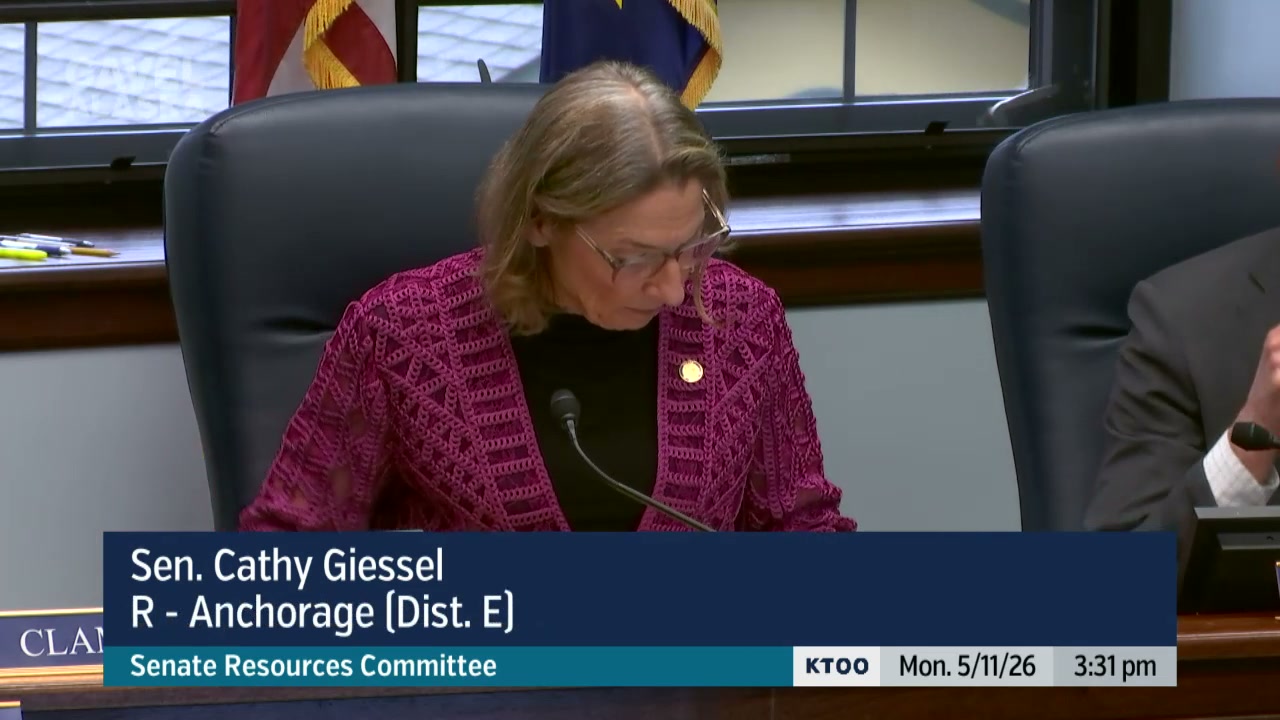
Frame from "SRES-260511-1530" · Source
Senate panel debates gas pipeline tax structure in 26th hearing
The Alaska Senate Resources Committee held its 26th hearing Monday on Senate Bill 280, the proposed tax structure for the Alaska LNG project. Senators focused on technical questions about where gas would be taxed and how the state would collect revenue. The committee has held 26 hearings since March 13 on the legislation.
The bill would replace traditional property taxes on the proposed $46.2 billion Alaska LNG project with a volumetric tax system: 15 cents per thousand cubic feet for the treatment plant and pipeline, and 25 cents for the liquefaction facility. The Department of Revenue estimates the alternative volumetric tax would generate $620 million annually once full export operations begin in 2033, with 81 percent shared with municipalities. However, prior coverage and fiscal analysis found the volumetric tax swap could reduce municipal revenue compared with current property tax, a roughly 90 percent local revenue cut.
Alaska News previously reported that the Senate panel advanced the gas pipeline tax overhaul with a $610 million revenue target and that the House panel heard a competing tax proposal for the Alaska LNG project. The governor's original proposal called for a 6-cent volumetric tax, while the House Resources Committee drafted a 20-cent rate.
Much of Monday's hearing centered on defining the "point of production," where gas ownership transfers and taxation begins. Ryan Fitzpatrick, commercial manager for the Division of Oil and Gas at the Department of Natural Resources, explained that for royalty purposes, the point of production is when gas is severed from the lease or unit boundary.
"For the purposes of royalty, when DNR takes royalty, it does take it at the point of production for the purposes of our leases," Fitzpatrick said. "That's defined as the point in which the oil or gas is severed from the lease or unit."
Senator Bill Wielechowski pressed for clarity on whether gas treatment costs could be deducted before taxation. "My big concern is, is that the point of production is somehow occurring after the gas treatment plant, and that there's going to be an enormously expensive project, and the state value would be diminished tremendously," Wielechowski said.
Fitzpatrick explained that whether gas processing occurs inside or outside the unit boundary determines how royalties are calculated. If processing happens within the unit, the dry gas leaving the treatment plant would be valued separately from natural gas liquids. If processing occurs outside the unit, the wet gas would be valued at the lease boundary.
Dan Stickel, chief economist with the Department of Revenue, told the committee his agency assumes gas would be sold to the project developer at the inlet to the gas treatment plant at Prudhoe Bay, with Point Thompson gas traveling through a feeder pipeline. The department models a $1.50 per thousand cubic feet purchase price from upstream producers to the midstream developer.
This article was drafted with AI assistance and reviewed by editors before publishing. Every claim can be verified against the original transcript. If you spot an error, let us know.
Related Coverage
Senate panel examines regulatory questions on gas pipeline tax plan
Alaska News · 2w ago · 10 views · 92% match
House panel hears tax proposal for Alaska LNG project
Alaska News · 6d ago · 2 views · 90% match
House Finance begins review of Alaska LNG tax bill with competing rate proposals
Alaska News · 1d ago · 4 views · 89% match
Alaska LNG tax bill could swing state revenue by hundreds of millions
Alaska News · 1w ago · 1 views · 89% match
Senate panel advances gas pipeline tax overhaul with $610M revenue target
Alaska News · 1w ago · 1 views · 88% match
Comments
Sign in to leave a comment.
No comments yet. Be the first to share your thoughts.