
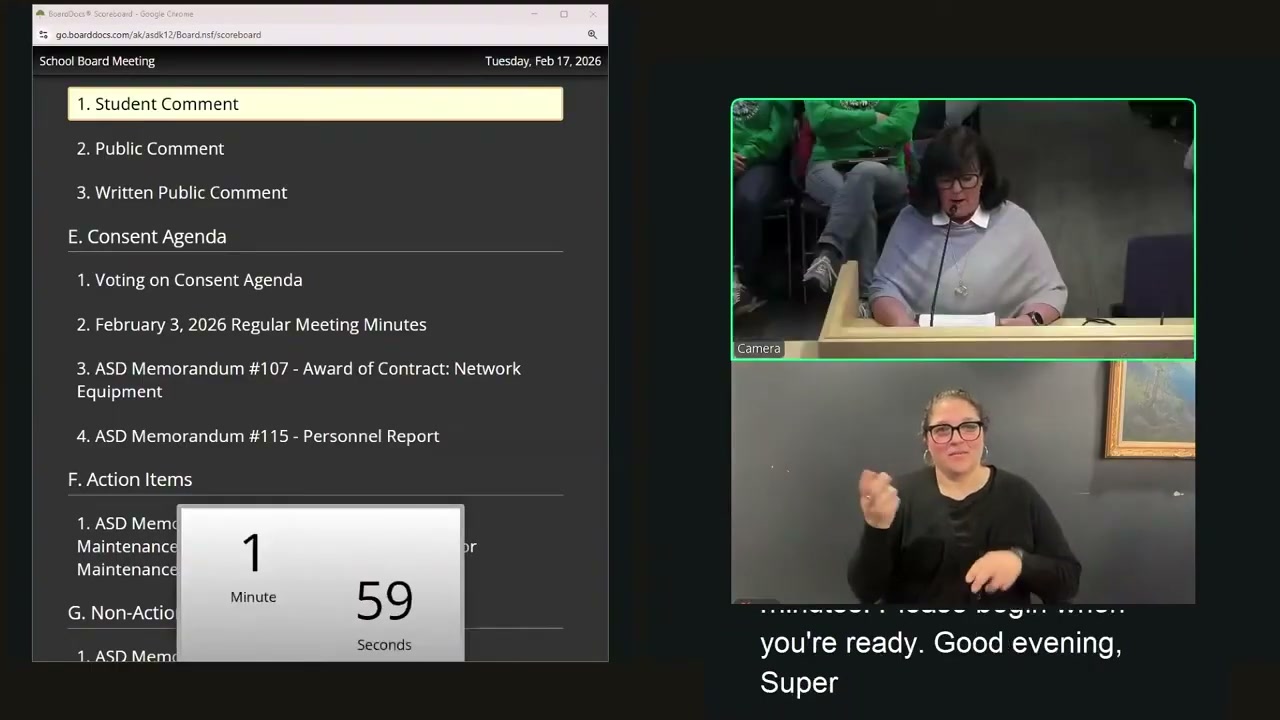
Frame from "2/17/2026 ASD School Board Meeting" · Source
Anchorage budget crisis mirrors national school funding squeeze
The Anchorage School District faces a $90 million structural deficit for fiscal year 2027, with projected shortfalls of $42 million and $30 million in the years after. Superintendent Jharrett Bryantt told the board February 17 that the district operates with purchasing power equal to $1,400 less per student when adjusted for inflation since 2011. The crisis forces consideration of school closures, regional nursing models, and specialist reductions. These decisions place Anchorage alongside districts statewide grappling with similar pressures.
Alaska's base student allocation has stayed flat for a decade while operational costs have climbed. Bryantt noted that last year's BSA increase, though historic, merely matched one-time funding from the previous year. The district has not seen structural revenue changes to match inflation. This pattern mirrors statewide trends where education funding has failed to keep pace with rising costs for healthcare, transportation, and specialized services.
The proposed solutions reflect cost-cutting strategies employed by districts from Juneau to Fairbanks. The district wants to close Fire Lake, Lake Otis, and Campbell STEM elementary schools. It plans to implement a regional nursing model and consolidate elementary specialists from five areas to three. Board testimony revealed that both Juneau and Fairbanks adopted regional nursing models during their own budget crises. The specialist consolidation would cut 25.4 full-time positions. The nursing shift would affect staffing ratios across more than 90 schools. The district estimates each school closure saves roughly $900,000 annually.
The three schools targeted for closure carry recent history. Fire Lake and Lake Otis had been spared in a November 2025 board vote. They returned to the closure list when the administration proposed shuttering them on February 13, 2026. At the February 17 public testimony, parent Cara Freeborn challenged the board directly. "How am I supposed to trust you?" she asked. "As an employee and a mom of the kids at Fire Lake, how could you possibly do this twice in one year, three times in two years, all to kick us out of our neighborhood school full of neighborhood children, low-income families, and three special needs classes to put a charter school in. How could we not think that you're not prioritizing charter school children?"
Kate Hammer raised concerns about the French immersion program. She noted that more than 50 percent of immersion elementary students are zoned for O'Malley neighborhood and have bus access. "Many of our families rely on busing, and it's likely if we lose bus access, some parents will be forced to pull their children out of the French program," Hammer said.
Student voices also emerged in testimony. One speaker observed, "I've also noticed that across the district I've seen many different student-led petitions for keeping swim and tennis sports as well as keeping individual nurses at schools." The petitions reflected concerns about both athletics and the shift away from dedicated school nurses.
This article was drafted with AI assistance and reviewed by editors before publishing. Every claim can be verified against the original transcript. If you spot an error, let us know.
Related Coverage
Residential Schools Seek Doubled Funding Tied to Base Allocation
Alaska News · 4d ago · 1 views · 78% match
Alaska House Weighs $113M Education Funding Overhaul
Alaska News · 3d ago · 7 views · 77% match
Alaska Special Education Crisis: 200 Teaching Positions Unfilled Statewide
Alaska News · 3w ago · 27 views · 77% match
Alaska residential schools seek doubled stipends to cover rising costs
Alaska News · 16h ago · 77% match
House Finance considers multi-year school funding averaging bill
Alaska News · 6d ago · 1 views · 76% match
Comments
Sign in to leave a comment.
No comments yet. Be the first to share your thoughts.