
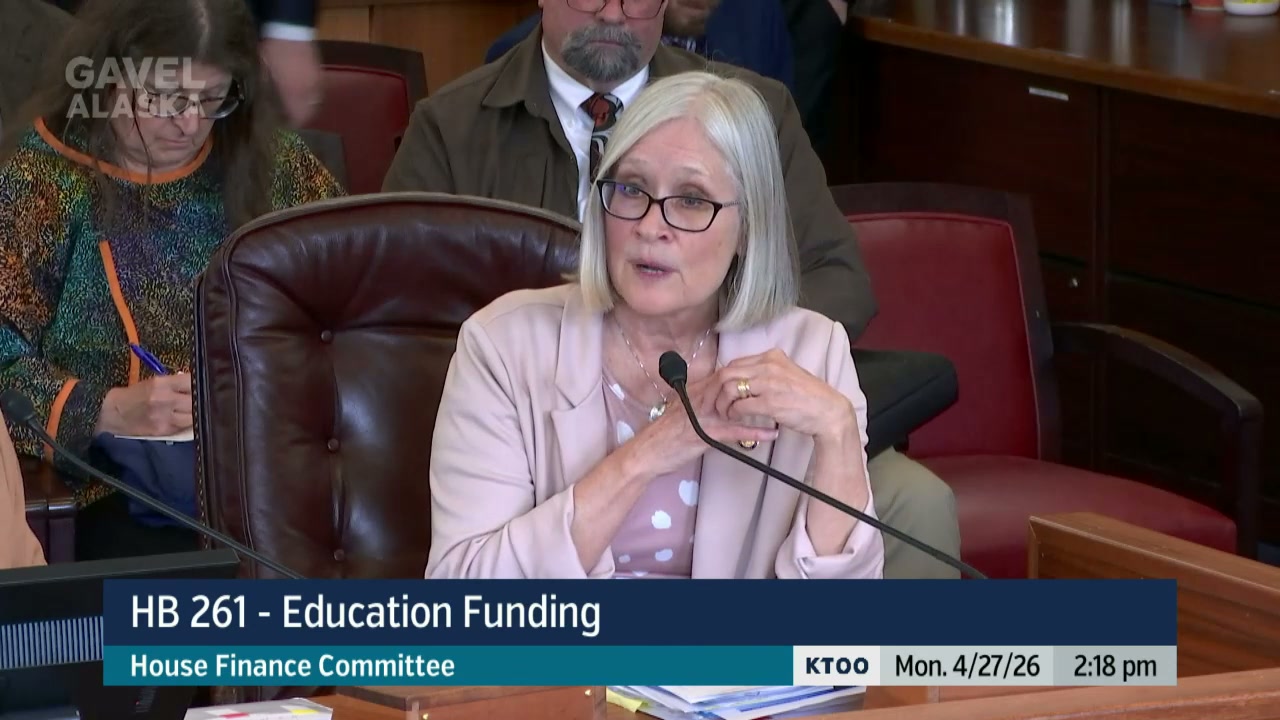
Frame from "House Finance, 4/27/26, 1:30pm" · Source
House Finance considers multi-year school funding averaging bill
The Alaska House Finance Committee heard testimony Monday on a bill that would fundamentally change how the state funds public schools, using multi-year enrollment averaging to give districts earlier budget certainty amid a national teacher shortage.
House Bill 261 would allow school districts to know their student count numbers by July 1 instead of waiting until October, when teacher and staff contracts have already been set for the year. The bill uses a three-year enrollment average, a practice common in 26 other states, to smooth budget volatility caused by fluctuating student numbers.
Representative Andi Story, who introduced the bill, said the current system sets districts up for failure by asking them to improve student achievement while creating uncertainty in the budget process. The bill would let districts offer teacher contracts earlier, when the rest of the nation is recruiting.
"This bill provides stability, supports accountability, and allows communities to really focus on student achievement and again retain their teacher and staff," Story said.
The fiscal note projects costs approaching $1 billion from 2027 to 2032. Representative Jamie Allard questioned whether that money could be better spent directly on programs that keep students in brick-and-mortar schools.
"We're looking at almost in, from 2027 to 2032, which is about 5 years exception, year or two. That's almost a billion dollars," Allard said.
Story explained that 35 percent of Alaska districts are currently in hold harmless status, meaning they receive funding based on previous enrollment even as student numbers decline. The bill would grandfather those districts into the new averaging system once their hold harmless period ends. Story noted that multi-year averaging is commonly referred to as a declining enrollment adjustment and is used by districts across the country to manage reductions while still providing for a system of education.
"What this bill does is it lets them finish out their hold harmless status and then it grandfathers them into, they just would smooth into the averaging," Story said.
The bill includes a provision for districts experiencing sudden growth. If enrollment increases by 5 percent or more in a current year, the Department of Education and Early Development would allow the district to use that higher count for staffing purposes.
Public testimony strongly supported the measure. Lon Garrison, executive director of the Association of Alaska School Boards, said the bill makes an important structural improvement by providing greater predictability in the budgeting process.
"School boards are required to adopt budgets and make staffing decisions months before they have certainty about their revenue," Garrison said. "This bill helps to reduce that instability."
This article was drafted with AI assistance and reviewed by editors before publishing. Every claim can be verified against the original transcript. If you spot an error, let us know.
Related Coverage
House panel debates $113M education funding formula shift
Alaska News · 1d ago · 2 views · 95% match
House Education Committee Advances Bill to Boost Residential School Funding
Alaska News · 2w ago · 2 views · 82% match
House Finance weighs bill to standardize state payment timelines
Alaska News · 2w ago · 9 views · 81% match
Senate Finance adopts operating budget with $150 energy payment, school grants
Alaska News · 3d ago · 1 views · 81% match
House panel questions education fund proposal with no guaranteed revenue
Alaska News · 3h ago · 81% match
Comments
Sign in to leave a comment.
No comments yet. Be the first to share your thoughts.