
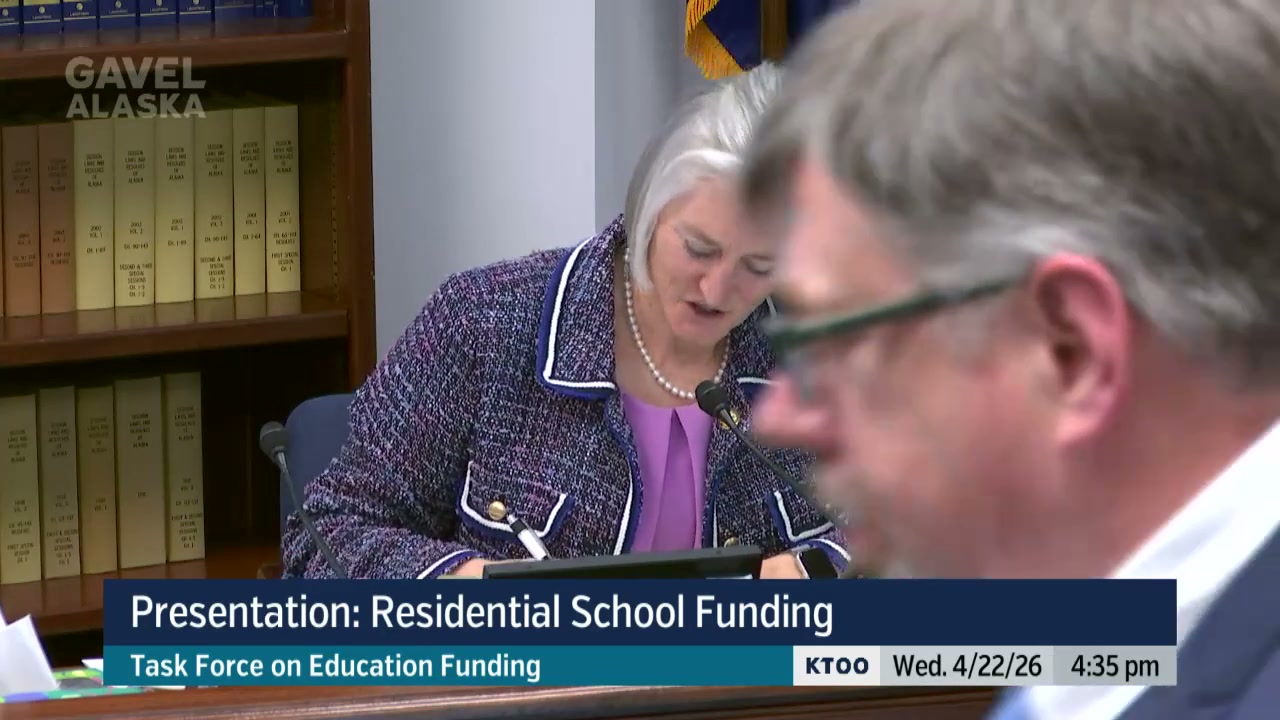
Frame from "Joint Task Force on Education Funding, 4/22/26, 3:30pm" · Source
Residential Schools Seek Doubled Funding Tied to Base Allocation
Alaska's residential boarding schools are backing legislation to double their per-student funding and tie future increases to the base student allocation. They say flat funding since 2015 has left them unable to cover rising costs.
The Alaska Residential Schools Coalition wants the legislature to amend state statute to replace fixed stipend dollar amounts with percentage multipliers of the base student allocation. The change would double current funding from an average of $12,900 per student to $25,700, according to an independent consultant analysis of fiscal year 2024 audited expenses.
Jim Mariner, director of administrative projects for Galena City School District, presented the proposal to the Joint Task Force on Education Funding on Tuesday. The coalition wants to amend Alaska Statute 14-16-200(b) so that fixed stipend amounts for five regions are replaced with language that links each region's stipend to a percentage multiplier of the base student allocation.
The coalition represents seven residential programs across Alaska that serve between 6 and 163 students each. The programs include Northwestern Alaska Career and Technical Center, Kusilvak Career Academy, the NANA Student Living Center, Galena Interior Learning Academy, Voyage to Excellence, Star of the Northwest Magnet School, and Kuskokwim Learning Academy.
Current funding has remained flat except for one-time 25 percent increases during fiscal years 2023, 2024, and 2025. Those increases were at the discretion of the legislature and governor. The current funding structure sits outside the base student allocation, meaning residential school stipends do not increase or decrease when the legislature agrees to increase public school funding.
Residential schools were the only public schools in Alaska that experienced a reduction in funding from fiscal year 2025 to fiscal year 2026, Mariner said.
The programs provide specialized career and technical education, advanced placement, and dual credit pathways that are not available in remote communities. Limitations include facilities, local industry expertise, and the costs of providing resources in the most remote regions of the state. Students access instruction in aviation, healthcare, construction, hospitality and tourism, natural resource development, education, maritime, and information technology.
Conrad Woodhead, career and technical education and residential director for Kusilvak Career Academy, said the programs make a difference. For the past two years, Lower Yukon School District students who attended one or more KCA sessions have had a zero percent dropout rate. During the same time, KCA participant participation among LYSD graduates increased from 43 percent to 52 percent. For the past three years, students who have attended KCA have accounted for 70 percent or more of the district's valedictorians or salutatorians.
This article was drafted with AI assistance and reviewed by editors before publishing. Every claim can be verified against the original transcript. If you spot an error, let us know.
Related Coverage
House Education Committee Advances Bill to Boost Residential School Funding
Alaska News · 2w ago · 3 views · 89% match
Senate panel approves $441 million education budget with teacher incentives
Alaska News · 5d ago · 1 views · 81% match
House Finance considers multi-year school funding averaging bill
Alaska News · 2d ago · 1 views · 78% match
House panel debates $113M education funding formula shift
Alaska News · 4d ago · 2 views · 77% match
Alaska Special Education Crisis: 200 Teaching Positions Unfilled Statewide
Alaska News · 2w ago · 27 views · 77% match
Comments
Sign in to leave a comment.
No comments yet. Be the first to share your thoughts.