
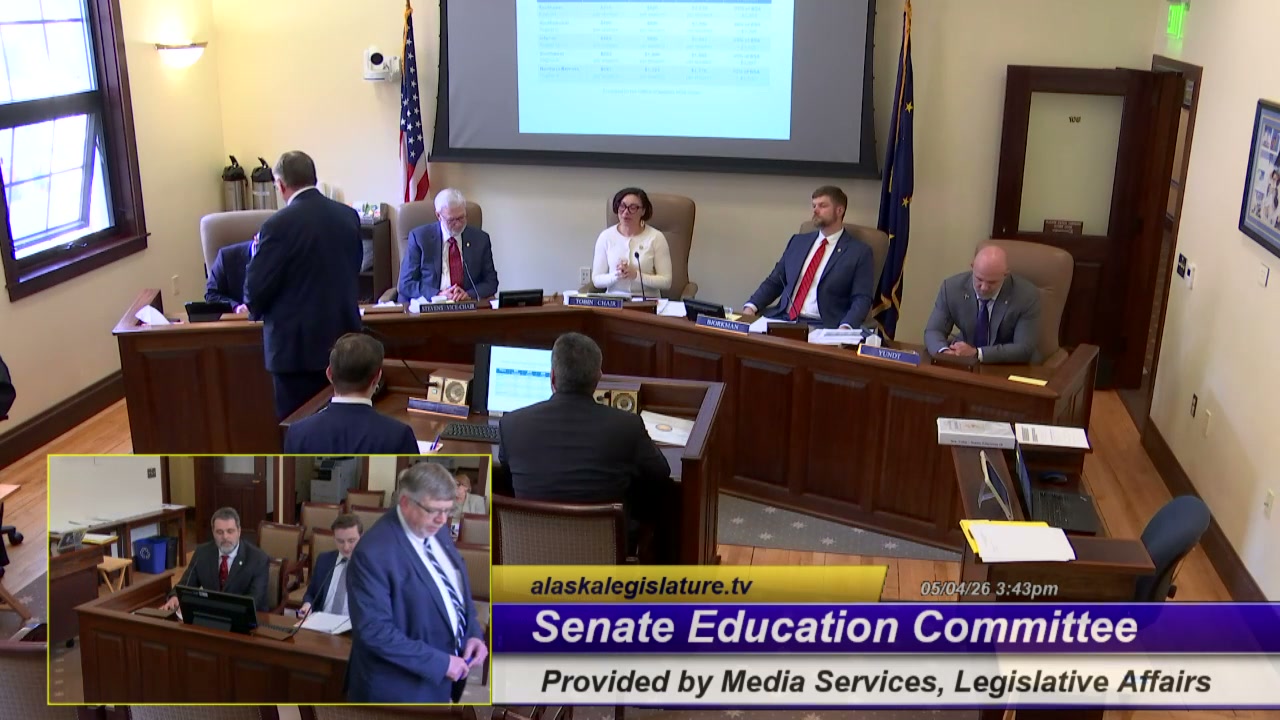
Frame from "SEDC-260504-1530" · Source
Alaska residential schools seek doubled stipends to cover rising costs
The Senate Education Committee heard testimony Monday on legislation that would double state funding for residential school programs serving rural Alaska students, addressing a gap that has forced districts to choose between cutting services and depleting reserves.
Senate Bill 257, sponsored by Senator Mike Cronk, would tie residential school stipends to percentages of the base student allocation and effectively double current funding levels. The bill aims to bring stipends closer to the actual cost of housing, feeding, and caring for students who leave their home communities to access educational opportunities unavailable in their villages.
Alaska's residential school stipend funding statute has remained unchanged since 2014, while the cost of taking care of kids has only gone up, Cronk said. Senate Bill 257 aims to bring the stipend much closer to what it actually costs to feed, house, and care for residential students by effectively doubling the current amount of the residential school stipend and tying it to various percentages of the base student allocation.
Residential programs currently receive about $12,900 per student annually in state stipends, roughly half the $25,700 actual cost to provide room, board, and wraparound services, according to audited data from the Alaska Residential Schools Coalition. Districts have covered the gap through grants, federal funding, and reserve drawdowns, but many of those sources are no longer available.
The funding squeeze comes as Alaska's broader budget crisis has limited state support for rural schools. Lawmakers budgeted only $40 million of the nearly $800 million that districts say is needed to fix and maintain schools. Since 1998, at least 135 rural school projects have waited for state funding for five years or more. Just under half of Alaska's rural schools are owned by the state, which is required by law to pay for construction and maintenance projects.
Conrad Woodhead, career and technical education director for Kuselbek Career Academy in the Lower Yukon School District, said residential schools were the only public school programs that lost funding in fiscal years 2025 and 2026 when one-time stipend increases expired.
Residential schools were also the only public school programs that lost funding in fiscal year 2025 and fiscal year 2026 when the 25 percent one-time stipend increases expired after those years, Woodhead said. So while the state continues to prioritize workforce development, the programs delivering that access to rural students at the K-12 level are operating behind.
Woodhead said Kuselbek Career Academy has served more than 500 students over seven years, filling more than 1,000 session slots. Students who attend the program have had a zero percent dropout rate over the last three years. Roughly 70 percent of the district's top academic performers have participated in one or more sessions.
This article was drafted with AI assistance and reviewed by editors before publishing. Every claim can be verified against the original transcript. If you spot an error, let us know.
Related Coverage
Residential Schools Seek Doubled Funding Tied to Base Allocation
Alaska News · 3d ago · 1 views · 92% match
House Education Committee Advances Bill to Boost Residential School Funding
Alaska News · 3w ago · 3 views · 91% match
Senate panel approves $441 million education budget with teacher incentives
Alaska News · 1w ago · 2 views · 81% match
House Finance considers multi-year school funding averaging bill
Alaska News · 6d ago · 1 views · 80% match
Alaska House Weighs $113M Education Funding Overhaul
Alaska News · 2d ago · 7 views · 79% match
Comments
Sign in to leave a comment.
No comments yet. Be the first to share your thoughts.