
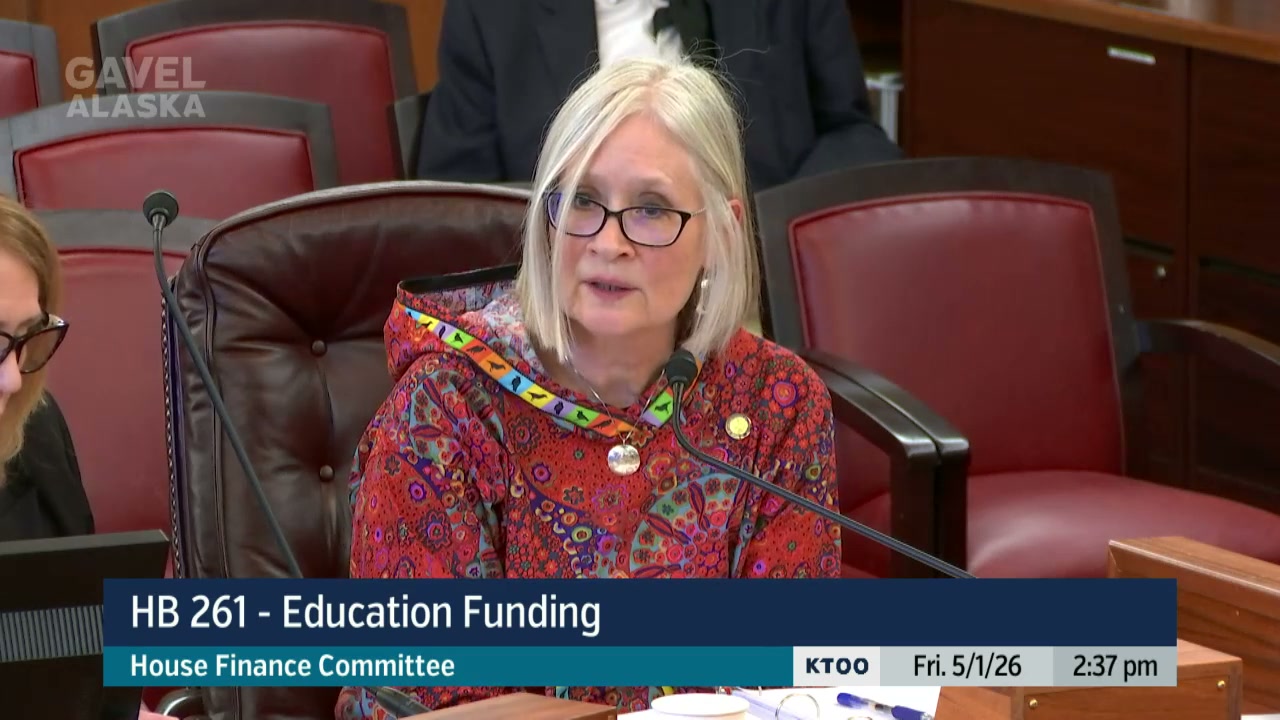
Frame from "House Finance, 5/1/26, 1:30pm" · Source
Alaska House Weighs $113M Education Funding Overhaul
The Alaska House Finance Committee heard testimony Friday on an education funding bill that would use three-year student enrollment averaging to provide budget certainty to school districts. The measure faces scrutiny over its $113 million annual fiscal note and lack of detailed financial modeling.
House Bill 261, introduced by Representative Andi Story of Juneau in February, would allow districts to know their funding by July 1 using either a three-year enrollment average or the previous year's count, whichever is higher. The bill advanced from the House Education Committee on April 1 with revisions to intensive student counting options. It aims to reduce teacher pink slips by providing earlier budget certainty. Lawmakers questioned whether districts would ever use the three-year average given the structure that lets them maximize funding.
"It seeks to give our districts more stability and more confidence in the public education that we provide," Story said. "Our districts would start the year in July knowing their funding number."
The bill has drawn support from NEA-Alaska, the state's largest teachers' union, which submitted a letter backing the measure to the House Education Committee in February.
The Department of Education told the committee it lacks capacity to model the bill's long-term fiscal impacts. The fiscal note shows $113 million for fiscal year 2027. Officials acknowledged the cost could vary significantly in future years as enrollment patterns shift.
"We have not done any projection modeling," said Heather Heineken, director of finance and support services for the Department of Education. "Our fiscal note is based on the FY27 projections, and we are confident in the accuracy for FY27."
Committee members raised concerns about what Representative Allard called "phantom students" being counted in multiple districts through the averaging system. The bill would allow a student who moves from one district to another to be partially counted in both places through the three-year average.
Justin Silverstein of Augenblick, Palaich and Associates, who authored a 2015 study recommending the averaging approach, explained that no student would be fully counted twice. "The example actually shows the averaging approach works as needed," he said. "As District A loses a student, they have a smooth decrease allowing them to reset resource levels as they decline."
Representative Bynum questioned whether districts would ever use the three-year average rather than simply taking the previous year's count, which would typically be higher in a declining enrollment environment. "My assumption would be that I don't think you would ever use the three-year averaging at all," he said.
This article was drafted with AI assistance and reviewed by editors before publishing. Every claim can be verified against the original transcript. If you spot an error, let us know.
Related Coverage
House panel debates $113M education funding formula shift
Alaska News · 4d ago · 3 views · 95% match
House Finance considers multi-year school funding averaging bill
Alaska News · 3d ago · 1 views · 95% match
Alaska House panel hears bill to overhaul school funding timelines
Alaska News · 23h ago · 2 views · 92% match
House panel questions education fund proposal with no guaranteed revenue
Alaska News · 3d ago · 2 views · 83% match
Education Fund Amendment Advances With Key Questions Unresolved
Alaska News · 19h ago · 82% match
Comments
Sign in to leave a comment.
No comments yet. Be the first to share your thoughts.