
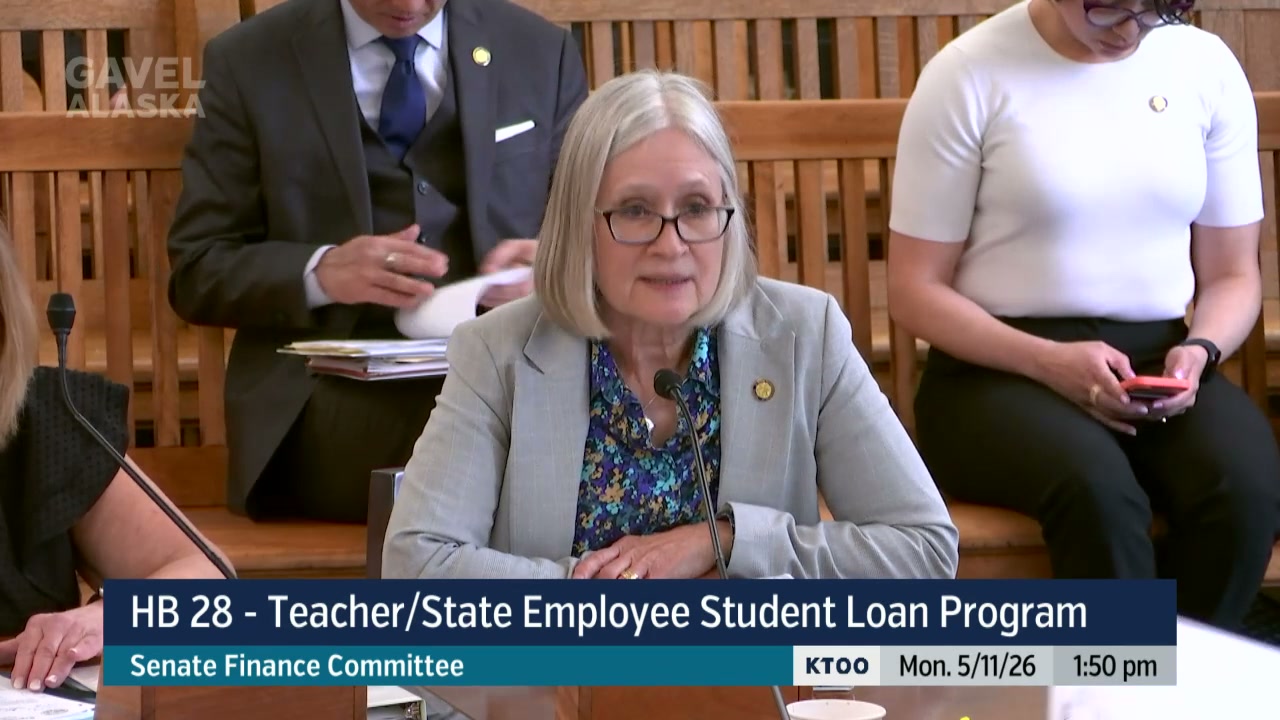
Frame from "Senate Finance, 5/11/26, 1:30pm" · Source
Senate Finance considers $1M teacher loan repayment pilot program
The Alaska Senate Finance Committee heard testimony Monday on legislation that would create a three-year pilot program offering student loan repayment to teachers and state employees, part of a broader effort to address the state's teacher shortage and recruit Alaskans who left the state for college.
House Bill 28 would repay up to $5,000 per year to student loan lenders for up to three years for certified teachers working in special education, English language learner, and science, technology, engineering, and math fields, as well as to state employees. The program would be funded at $1 million annually from the Higher Education Investment Fund and administered by the Alaska Commission on Postsecondary Education.
Representative Andi Story, who introduced the bill in February 2025, told the committee Alaska was nearly 350 teachers short on roughly the first day of school. The state also had 285 teachers with emergency certification and has relied on 573 teachers on international visas. Teacher turnover stands at 28 percent and principal turnover at 35 percent, rates that negatively impact student achievement.
"Our students need talented, committed educators in our classrooms, and teachers are better able to focus on meeting student needs when their own financial burdens are manageable," said Dr. Bridget Weiss, liaison for the University of Alaska College of Education Consortium.
The University of Alaska has invested more than $1 million annually in scholarships to cover tuition, fees, and living expenses during student teaching internships over the past four years. This school year alone, approximately $1.3 million in university-funded scholarships were awarded. While these investments are significant, they are not nearly enough to fully meet the growing needs in Alaska classrooms, Weiss said.
"House Bill 28 addresses several critical workforce challenges in our K-12 system, including the proposed teacher loan forgiveness program. This initiative offers meaningful, relevant support to early career educators, particularly those beginning at the lower end of a salary scale," Weiss said.
Senator Cronk raised concerns about the program's structure, questioning whether teachers could leave after receiving a single year of loan repayment. Under the bill, teachers must complete a full year of service before receiving their first payment, then repeat the process for years two and three.
Story explained that states are moving away from loan forgiveness programs toward repayment programs because Alaska's previous loan forgiveness program lost money when participants did not complete their degrees or repay their debts. The current bill requires teachers to hold their teaching certificate before receiving any loan repayment.
This article was drafted with AI assistance and reviewed by editors before publishing. Every claim can be verified against the original transcript. If you spot an error, let us know.
Related Coverage
Alaska House Weighs $113M Education Funding Overhaul
Alaska News · 1w ago · 7 views · 84% match
House Finance considers multi-year school funding averaging bill
Alaska News · 1w ago · 1 views · 84% match
Alaska House panel hears bill to overhaul school funding timelines
Alaska News · 1w ago · 2 views · 83% match
House Finance Advances Education Funding Bill Despite Fiscal Concerns
Alaska News · 6d ago · 3 views · 82% match
Senate panel approves $441 million education budget with teacher incentives
Alaska News · 2w ago · 2 views · 82% match
Comments
Sign in to leave a comment.
No comments yet. Be the first to share your thoughts.