
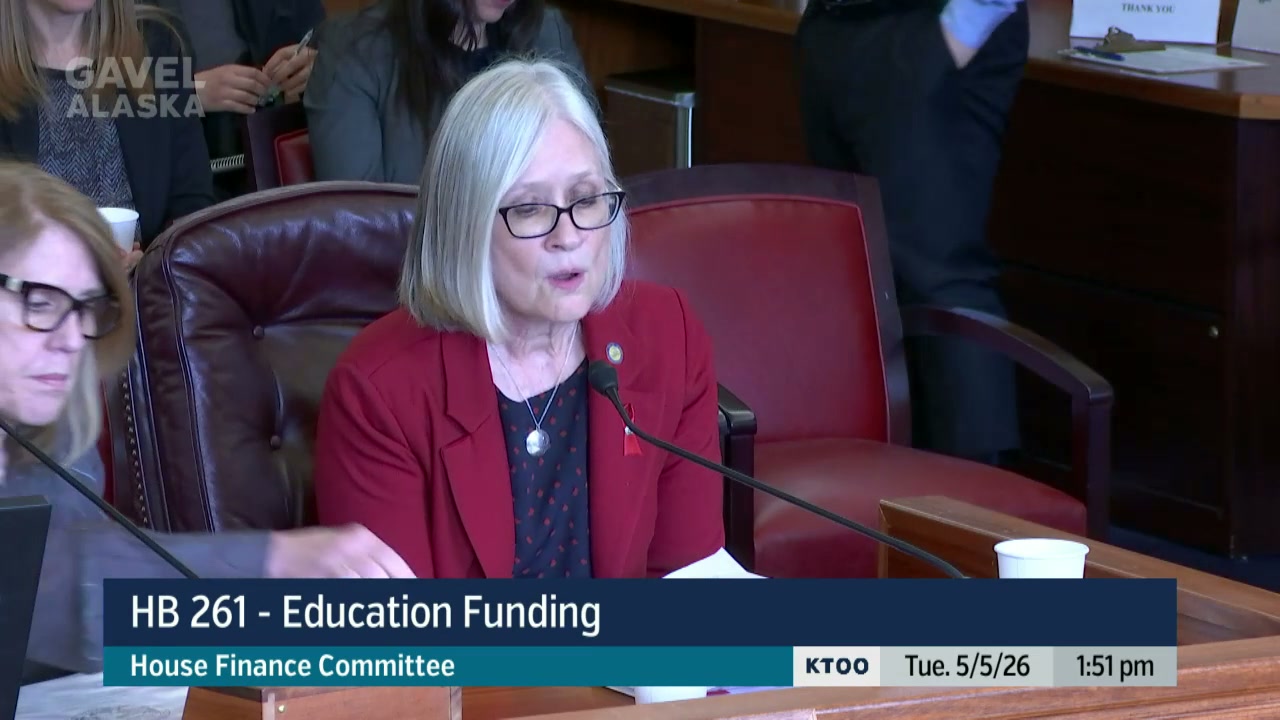
Frame from "HFIN-260505-1330" · Source
House Finance Advances Education Funding Bill Despite Fiscal Concerns
The Alaska House Finance Committee voted 6-5 Tuesday to advance an education funding reform bill that would change how the state calculates school funding, despite concerns about its fiscal impact exceeding $130 million annually.
House Bill 261, sponsored by Representative Andi Story of Juneau, allows school districts to choose between a three-year average or the previous year's student count for funding calculations. The bill also smooths funding transitions at enrollment thresholds of 100 and 425 students and provides districts flexibility in counting intensive special education students.
The bill originated from a 2015 recommendation by the Governor's Education Task Force to improve funding predictability for school districts. Under current law, districts receive funding based on student counts that can fluctuate significantly year to year, making it difficult to plan budgets and hire teachers. The funding stability issue has grown more urgent as Alaska's statewide public school enrollment has declined 3% as of the 2026 legislative session, while the current Base Student Allocation of $6,650 per student has eroded to approximately $4,711 in FY2011 dollars due to inflation.
The committee rejected two amendments that would have simplified the funding formula and imposed cost controls. An amendment by Representative Jeremy Bynum requiring three-year averaging for all students, including those with intensive special needs, failed 5-6. Story opposed the amendment, saying it would cost an additional $47 million and could jeopardize federal maintenance of effort requirements under the Individuals with Disabilities Education Act.
"We know it will cost $47 million, so that's one reason to vote no in addition," Story said. She explained that averaging intensive needs students might leave districts without adequate funding when new students with significant disabilities enroll during the school year.
Bynum argued that three-year averaging would provide predictability for both school districts and the legislature. "This includes not just their regular ADM students, but it also includes the intensive needs students as part of that 3-year averaging," Bynum said.
Representative Hannan spoke against mandatory averaging for intensive needs students, noting that some students require interpreters, aides, physical therapists and specialized medical support costing $80,000 to $100,000 annually. Story added that averaging the intensive needs students might disrupt the federal maintenance of effort requirement, which both local districts and the state must abide by in order to receive the Title I IDEA funds under the Individuals with Disabilities Education Act.
The committee also rejected 5-6 an amendment by Representative Moore capping district-level administrative spending at 15 percent of operating budgets. Story opposed the cap, citing concerns about local control and the burden on small rural districts with high fixed costs.
This article was drafted with AI assistance and reviewed by editors before publishing. Every claim can be verified against the original transcript. If you spot an error, let us know.
Related Coverage
Alaska House Weighs $113M Education Funding Overhaul
Alaska News · 3d ago · 7 views · 92% match
House Finance considers multi-year school funding averaging bill
Alaska News · 1w ago · 1 views · 91% match
House panel debates $113M education funding formula shift
Alaska News · 1w ago · 4 views · 90% match
Alaska House panel hears bill to overhaul school funding timelines
Alaska News · 4d ago · 2 views · 88% match
House Finance advances education fund amendment, rejects gas pipeline revenue tie
Alaska News · 21h ago · 2 views · 84% match
Comments
Sign in to leave a comment.
No comments yet. Be the first to share your thoughts.