AI-powered community news covering local government, public meetings, and community issues across Alaska.
Alaska
Alaska LNG Consultant Flags Potential 50% Return for Developers vs. $1B State Revenue | Alaska News | Alaska News
Alaska LNG Consultant Flags Potential 50% Return for Developers vs. $1B State Revenue
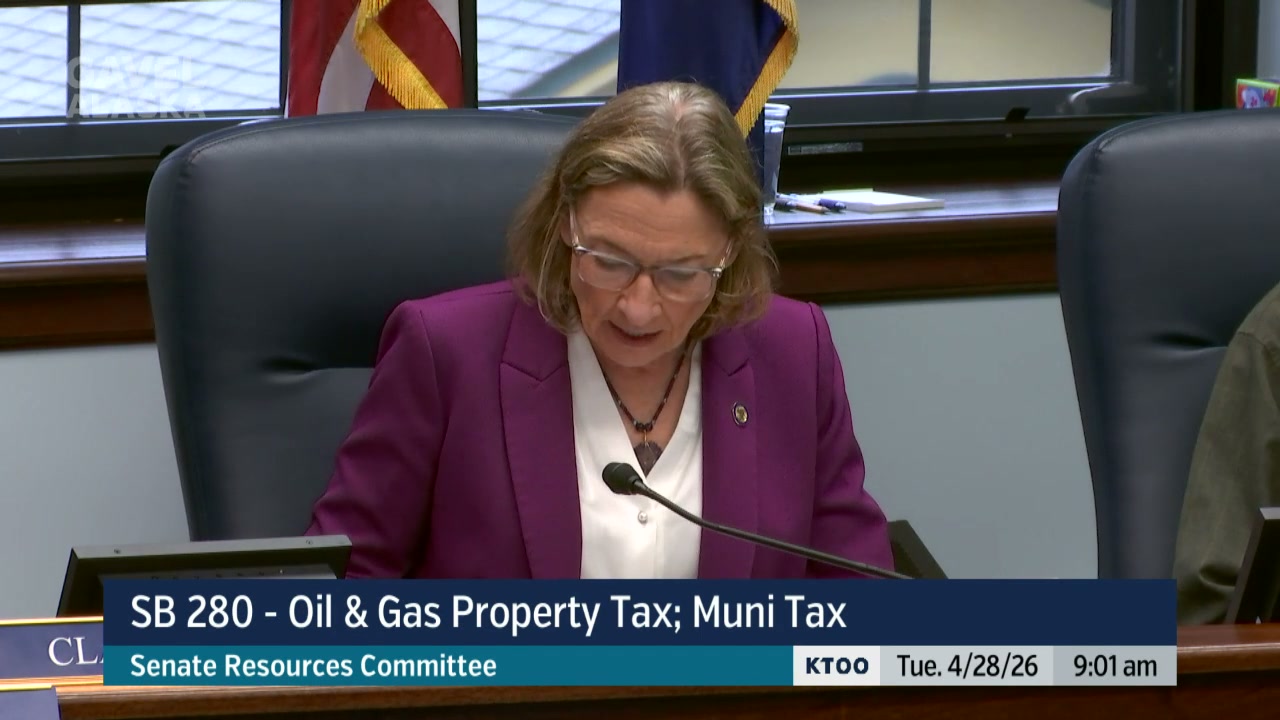
Frame from "Senate Resources, 4/28/26, 9am" · Source
PublishedAI
Alaska LNG Consultant Flags Potential 50% Return for Developers vs. $1B State Revenue
by Alaska NewsMay 6, 2026(1h ago)5 min read1 viewsAlaska, USA
Share
A legislative consultant said Tuesday that rough calculations suggest Alaska LNG project developers could earn about $8 billion annually by 2050 on a $15 billion equity investment, roughly a 50 percent return, while the state receives about $1 billion in combined taxes. The consultant later cautioned the figures were preliminary and may contain errors requiring reconciliation with Department of Revenue data.
Nick Fulford, senior director of gas and LNG at Gaffney Cline Energy Advisory, presented the analysis to the Senate Resources Committee during a hearing on Senate Bill 280. The bill would replace oil and gas property taxes with a volumetric tax for the Alaska LNG project. Fulford acknowledged the model was hastily constructed, focused purely on the midstream segment, and contains potential errors.
The analysis assumes a 70-30 debt-to-equity ratio with a 10 percent target return on equity for project investors. The $15 billion equity investment represents the developers' share of total project costs. Corporate income tax projections in Fulford's model suggest actual returns far exceed that stated goal. By 2050, state corporate income tax collections would reach approximately $900 million annually, Fulford said.
When Senator Bill Wielechowski pressed Fulford on the calculations, the consultant agreed that the $900 million figure, when extrapolated using the state's 9.4 percent corporate income tax rate, implies roughly $8 billion in annual profits for midstream developers.
Fulford later expressed concern about these figures. "With the speed at which this has been put together and the degree to which we have been able to check and look at it, I am concerned that there are some errors in the model which I would prefer to clarify in writing," he said. Fulford indicated he suspects his state corporate income tax projections may inadvertently include federal taxes, which would explain some of the discrepancies. He said the corporate income tax slides should be regarded as needing additional clarification.
Senator Scott Kawasaki referenced Department of Revenue projections showing total state benefits through 2042 at $7.4 billion. Senator Forrest Dunbar noted the disparity between developer profits and state revenue becomes significant when viewed cumulatively.
"So it is not we get $1 billion and they get $8 billion under the governor's plan," Dunbar said. "It is they get $8 billion in a year and Alaska gets $8 billion over 15 years."
Fulford's analysis showed that alternative volumetric tax collections under the committee substitute version of the bill would remain relatively constant over the project lifetime at approximately $400 million annually. Corporate income tax would climb from $157 million in year two of operation to nearly $900 million by 2050. The cumulative revenue to the state over the project lifetime would total approximately $20 billion under the committee substitute version. That version sets volumetric taxes at 15 cents per thousand cubic feet for processing and pipeline segments and 25 cents for liquefaction.
This article was drafted with AI assistance and reviewed by editors before publishing. Every claim can be verified against the original transcript. If you spot an error, let us know.
Fulford said the committee substitute tax structure was marginally higher than current property tax but changed the timing and profile of tax collections. The volumetric tax would replace what is ultimately a reducing revenue stream over a couple of decades with something both sustainable and slightly increasing over time, he said. The tax would also track project volume, so an expansion to an additional train would increase volumetric taxes proportionally higher than additional capital costs.
The potential downsides, Fulford said, are that it is a relatively high rate of taxation with no front-end mitigation during the crucial five to ten years following the start of commercial operations, when investors place much more emphasis on returns.
Senator Kawasaki raised concerns about broader fiscal implications, referencing Department of Revenue projections showing state oil and gas revenue going negative until 2031 as the project ramps up. During the hearing, Kawasaki asked about these projections, though DOR Chief Economist Dan Stickell was not present to confirm them.
"We have shifted a tremendous amount of risk onto the consumers in South Central and frankly on the state of Alaska," Dunbar said. He asked how to protect consumers and state finances during the early years while still allowing the project to proceed.
Fulford suggested that early gas supply through the pipeline, with certainty that the LNG export project would follow, could enable financial mechanisms to spread costs more equitably over time. "Once you are in that scenario, you can collateralize some of the future revenue. You can create financial instruments to create that kind of blended solution," he said. But he emphasized the need for a comprehensive project model that all stakeholders could agree on.
Fulford also presented analysis of the pipeline economics under different scenarios. His analysis showed that if gas flow through the 42-inch pipeline is only 300 million standard cubic feet per day, roughly current South Central demand, the tariff required to sustain a 10 percent return would be $20 to $30 per million BTU, well above the $12 cap included in the committee substitute. The $12 figure originated from public statements by Governor Mike Dunleavy about expected gas prices.
If flow increases to 500 million standard cubic feet per day, including potential industrial suppliers and power generators, and if pipeline capital costs remain at $10 billion, the project could sustain the $12 cap and still generate a 10 percent return, Fulford said. Under the committee substitute's $5 cap for early pipeline operations, gas delivery to South Central at significantly less than $5 is potentially feasible under most scenarios, he said.
Outside the hearing, project backers have reported progress. Over 50 companies have expressed interest in $115 billion in Alaska LNG contracts as the project nears implementation. Glenfarne, the project developer targeting a final investment decision in 2026, awarded Worley a contract for engineering and cost estimates. TotalEnergies signed a letter of intent for 2 million tonnes per annum of LNG offtake over 20 years, pending final investment decision.
Chair Giesel acknowledged the tension between the consultant's call for careful analysis and legislative pressure to move quickly. "We, on the other hand, are being pressured to move quickly on this, to rapidly put into place policy that will last for generations," she said. "So you have articulated exactly our concern as well, that the numbers are being put together very hastily and statements are being made about the cost of gas at the end of this project that may not be actually credible."
Fulford said reconciling his model with Department of Revenue figures is essential before the legislature acts. "I think the necessity around reconciling models, reconciling approach, looking at the holistic effect of upstream and so forth, I think this is an illustration of why that dialogue, forming a project model that we are all comfortable with, I think would be an essential step," Fulford said.
The committee will continue hearings on SB 280 Wednesday at 3:30 p.m., when the Department of Revenue will present part two of its analysis. The legislature has approximately three weeks remaining in the current session.
Stay informed. Support what matters.
Free, permanent access to local news you can verify. Subscribe to support Alaska News and go ad-free.

Comments
Sign in to leave a comment.
No comments yet. Be the first to share your thoughts.