
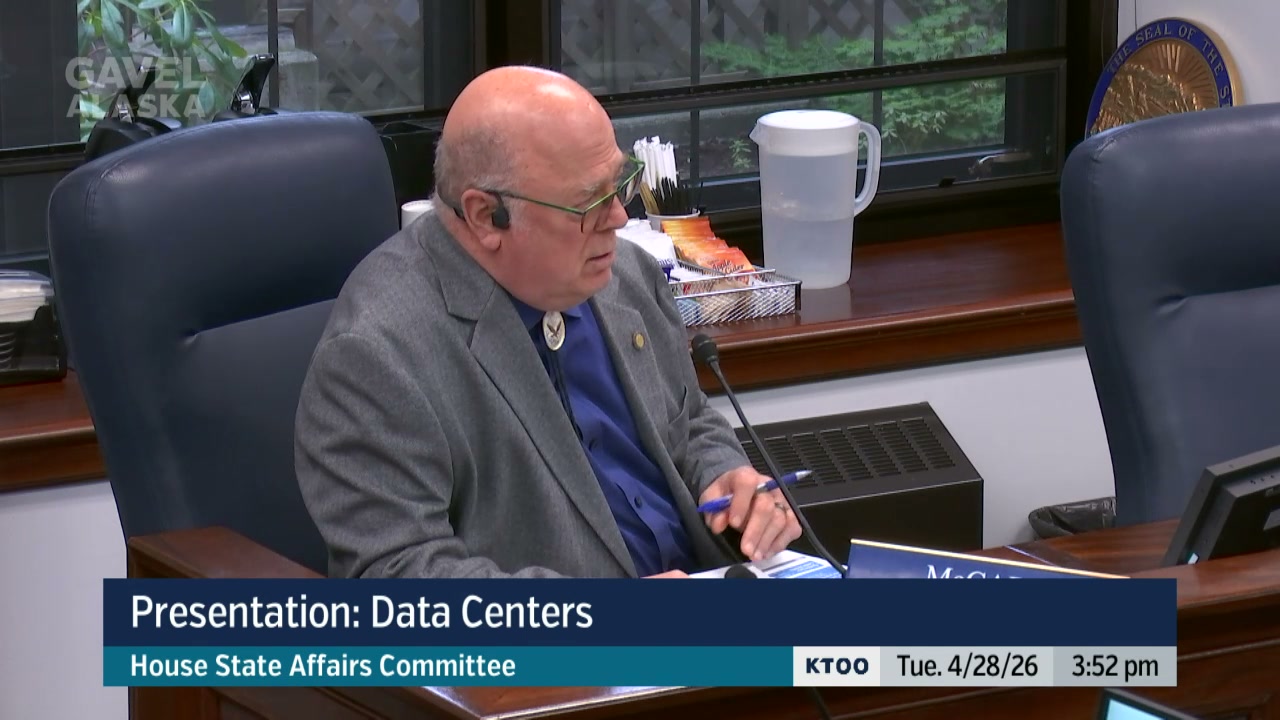
Frame from "House State Affairs, 4/28/26, 3:15pm" · Source
Alaska lawmakers explore data center development as economic opportunity
National experts briefed Alaska lawmakers Tuesday on the economics of data center development as the state explores whether its cold climate and natural gas reserves could attract the energy-intensive facilities.
Nicholas Miller and Alex McWard told the House State Affairs Committee that 38 states now offer tax incentives for data centers. Alaska has no dedicated data center tax incentives, but Miller noted the state's lack of a statewide sales tax already functions as an incentive compared to states that must offer sales tax exemptions. The presentation came as nine states have considered repealing their data center tax breaks this year amid concerns about energy costs and local impacts.
"We have certainly seen more interest in repealing or rolling back data center tax incentives than we have in creating brand new data center tax incentives," Miller said.
Data centers require massive energy, typically 20 to 100 megawatts or more, but create relatively few permanent jobs once operational. Miller said construction can employ up to 1,500 workers, but operating facilities typically need only 10 to 20 full-time positions.
"One data center can be over $1 billion," Miller said, explaining why sales tax exemptions matter to developers.
Alaska's cold climate could eliminate water-intensive cooling systems that have become a flashpoint in western states. Rep. Kevin McCabe noted that Alaska facilities could use closed-loop systems with heat directed to greenhouses rather than consuming millions of gallons annually for evaporative cooling.
Rep. Sara Hannan said the state's natural gas reserves could power data centers locally rather than requiring pipeline construction to move gas south. "We have a ton of natural gas, and rather than, not rather than, if we are unable to build a pipeline to move that natural gas, would not it be great if we could use it where it is and move electrons instead?" Hannan said.
Miller said 13 states have introduced bills to ban or pause data center development, with Maine's moratorium advancing through the legislature before the governor vetoed it last week. The bans typically last one to four years and pair with studies on utility rates, water use, and tax incentive costs.
"Time to connect to the power grid is one of, or if not the most important factor when deciding where to site a datacenter," Miller said.
McWard said states are increasingly requiring data centers to pay for their own infrastructure rather than shifting costs to residential ratepayers. Maryland enacted legislation last year requiring utilities to submit specific rate schedules for large load customers. Minnesota, Oregon, Utah, and Idaho have enacted similar legislation establishing separate customer classes or rate schedules for large energy users.
This article was drafted with AI assistance and reviewed by editors before publishing. Every claim can be verified against the original transcript. If you spot an error, let us know.
Related Coverage
Senate panel hears data center safeguards, tribal education bill
Alaska News · 3d ago · 1 views · 82% match
Senate panel examines LNG project economics, megaproject risks
Alaska News · 3d ago · 5 views · 81% match
Alaska LNG Tax Bill Walks Tightrope Between Project Viability and Local Needs
Alaska News · 7h ago · 1 views · 79% match
Senate panel examines regulatory questions on gas pipeline tax plan
Alaska News · 4d ago · 9 views · 78% match
Alaska Energy Survey Shows Strong Support for Renewables, Mixed Views on Nuclear
Alaska News · 2d ago · 1 views · 77% match
Comments
Sign in to leave a comment.
No comments yet. Be the first to share your thoughts.