
Senate panel hears data center safeguards, tribal education bill
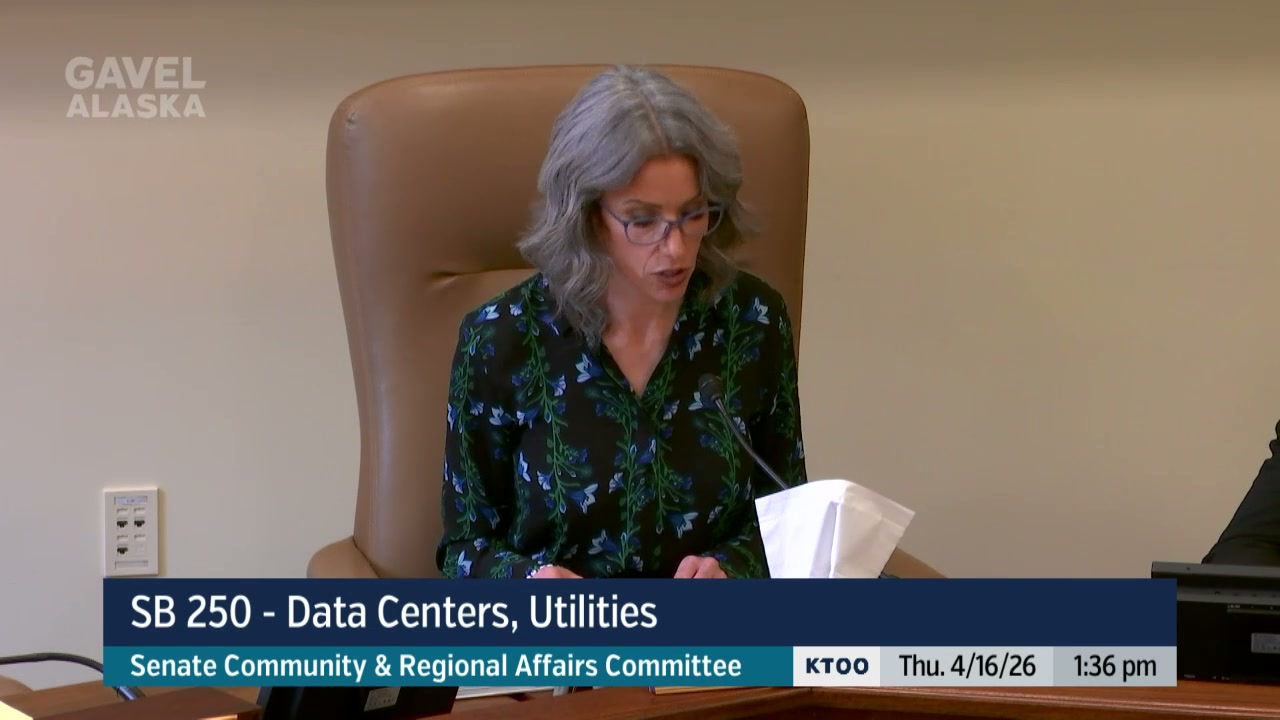
The Senate Community and Regional Affairs Committee heard testimony Thursday on Senate Bill 250, which would require data centers to cover their own infrastructure costs and protect existing ratepayers from fuel supply risks and rate increases.
The bill would mandate community benefit agreements and prioritize renewable energy for data center projects. Senator Lōki Tobin, who sponsored the measure, said the legislation addresses potential impacts from hyperscale data centers while ensuring communities have tools to protect public assets like energy and water.
"The focus of Senate Bill 250 is to address the potential significant impacts that Alaska might experience from hyperscale data centers," Tobin said. "It is simply to ensure that communities have the tools needed to protect these public assets, such as their energy and water without necessarily de-incentivizing private business growth."
The bill comes as both state and local officials grapple with data center policy. Governor Mike Dunleavy has publicly promoted Alaska as a data center destination, highlighting the state's cold climate and planned natural gas pipeline at an industry conference. Meanwhile, the Anchorage Assembly held a nearly two-hour worksession in late February on Ordinance AO 2026-27, which would define data centers as a distinct land use and restrict them to conditional approval in industrial zones.
Sydney Linneman, a data center and energy policy expert, testified in support of the bill. She said states across the country are grappling with unprecedented data center growth and its impact on electric grids.
"These are very, very profitable companies. They can afford to build their own transmission," Linneman said. She added that the bill does not reject data centers but rather rejects hidden subsidies and reliability costs that would be absorbed by Alaskans.
The bill includes provisions to prevent costs incurred from serving a data center from being recovered from other customers. It also prohibits transmission built specifically for a data center from being classified as backbone transmission for cost allocation purposes.
Linneman said community benefit agreements are critical to ensuring data center projects deliver tangible benefits to host communities. "What we have seen in a lot of states is that without this being put into some sort of enforceable form, it can be very easy for the community benefits to sort of flitter away over time," she said.
Nils Andreassen testified about the role of community benefit agreements in large-scale development. He said such agreements are policy frameworks that bundle together expectations between local governments and companies.
"Ultimately, what we want to make sure is that in addition to broader economic impacts, there are benefits in the public interest. And that is what CBAs allow us to do," Andreassen said.
This article was drafted with AI assistance and reviewed by editors before publishing. Every claim can be verified against the original transcript. If you spot an error, let us know.
Related Coverage
Senate panel examines regulatory questions on gas pipeline tax plan
Alaska News · 1d ago · 8 views · 79% match
Senate panel advances property tax cap bill despite state warnings
Alaska News · 1d ago · 1 views · 78% match
Senate committee holds Senate Bill 259 on property tax caps
Alaska News · 12h ago · 1 views · 78% match
House Education Committee Advances Bill to Boost Residential School Funding
Alaska News · 2w ago · 2 views · 78% match
Senate panel hears autonomous vehicle bill requiring human operators
Alaska News · 1d ago · 1 views · 78% match
Comments
Sign in to leave a comment.
No comments yet. Be the first to share your thoughts.