
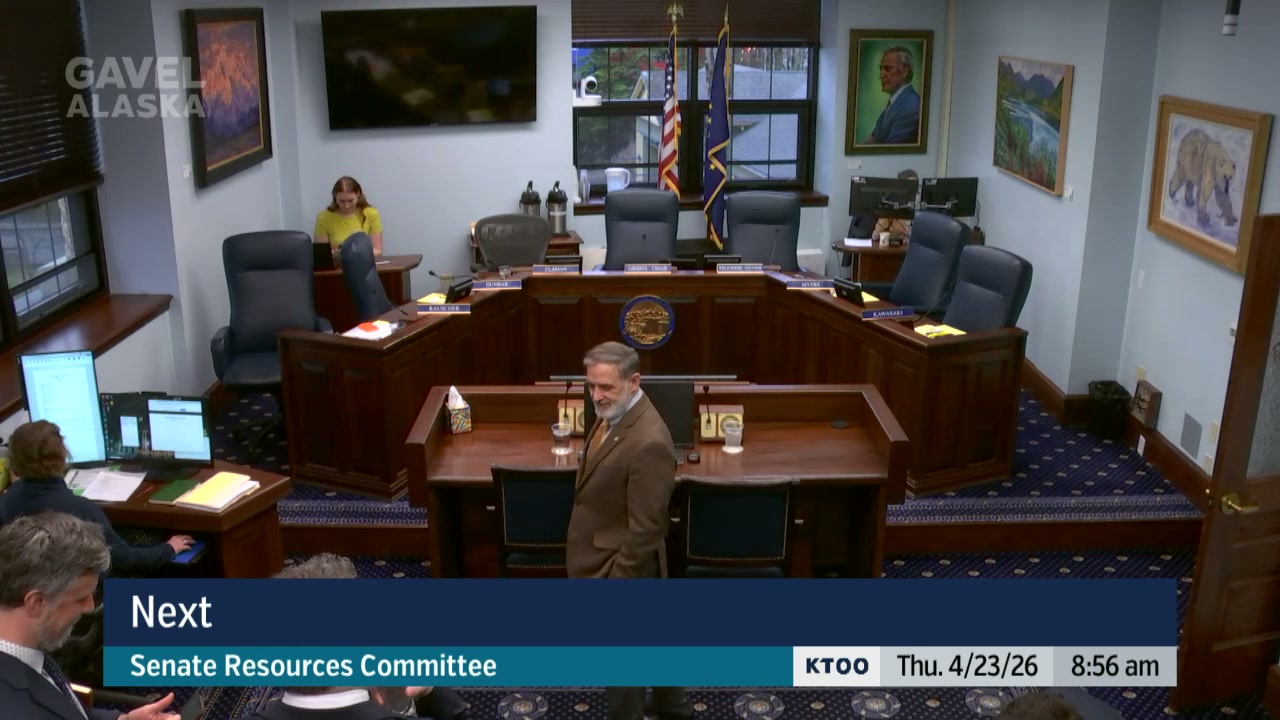
Frame from "SRES-260423-0900" · Source
Oil industry opposes tax provisions in Alaska gas pipeline bill
The Alaska Oil and Gas Association raised antitrust concerns and opposed multiple tax provisions in a gas pipeline bill Thursday. The industry group argued the legislation has expanded beyond its original purpose.
Steve Wackowski, president and CEO of the association, told the Senate Resources Committee that SB 280 version G now includes provisions that would immediately affect current oil and gas operations. This would happen regardless of whether a future gas line project moves forward. The governor introduced the bill to resolve property tax structure challenges for gas pipeline economics. The industry paid nearly $720 million in property taxes to the state in fiscal year 2025. Of that, $576 million went to local communities.
"This committee substitute has expanded beyond the purpose of resolving a long-standing challenge to gas line project economics posed by current oil and gas property tax structure," Wackowski said.
The association opposes sections 20 through 33 of the bill. These include provisions decoupling oil and gas lease expenditures, taxpayer confidentiality changes, prevailing value sections, and an income tax on pass-through entities.
Marie Evans, vice chair of the association's tax committee, warned that sections requiring the Department of Revenue to publish oil and gas prices raised antitrust concerns. "The ambiguity of what Department of Revenue is going to have to do to comply with this gives me a lot of concern," Evans said. "If data is derived from reports of current sales and marketing, we have a concern that the participation and the reporting could be associated with conduct that could lead to antitrust inquiries."
The bill's provisions on decoupling oil and gas lease expenditures could make some wells uneconomic, Wackowski testified. He used a BTU equivalency ratio of 6 MCF of gas to 1 barrel of oil at Prudhoe Bay as an example. The field currently produces around 245,000 barrels of oil per day and injects approximately 7.7 BCF of gas daily. Under the bill's formula, 84 percent of barrel-of-oil-equivalent would be attributed to gas that is being reinjected.
"Using this BTU equivalency could unintentionally disallow reasonable costs associated with oil production from being deducted against production tax liability and could ultimately jeopardize future oil recovery," Wackowski said.
Senator Forrest Dunbar said his intent with the committee substitute was that typical gas extraction and reinjection would not be caught up in the provisions. The target was larger-scale investments that drive revenue negative through 2032. Evans said it was possible to interpret the sections that way. But statutory ambiguity would rely on Department of Revenue regulations to clarify the legislature's intent.
This article was drafted with AI assistance and reviewed by editors before publishing. Every claim can be verified against the original transcript. If you spot an error, let us know.
Related Coverage
Mayors Oppose Alaska LNG Tax Bill, Cite Revenue Concerns
Alaska News · 2w ago · 4 views · 86% match
Alaska LNG tax bill could swing state revenue by hundreds of millions
Alaska News · 2d ago · 1 views · 85% match
Senate panel examines regulatory questions on gas pipeline tax plan
Alaska News · 6d ago · 9 views · 85% match
Denali Borough mayor opposes state control of pipeline tax payments
Alaska News · 9m ago · 85% match
Senate panel examines LNG project economics, megaproject risks
Alaska News · 4d ago · 5 views · 82% match
Comments
Sign in to leave a comment.
No comments yet. Be the first to share your thoughts.