
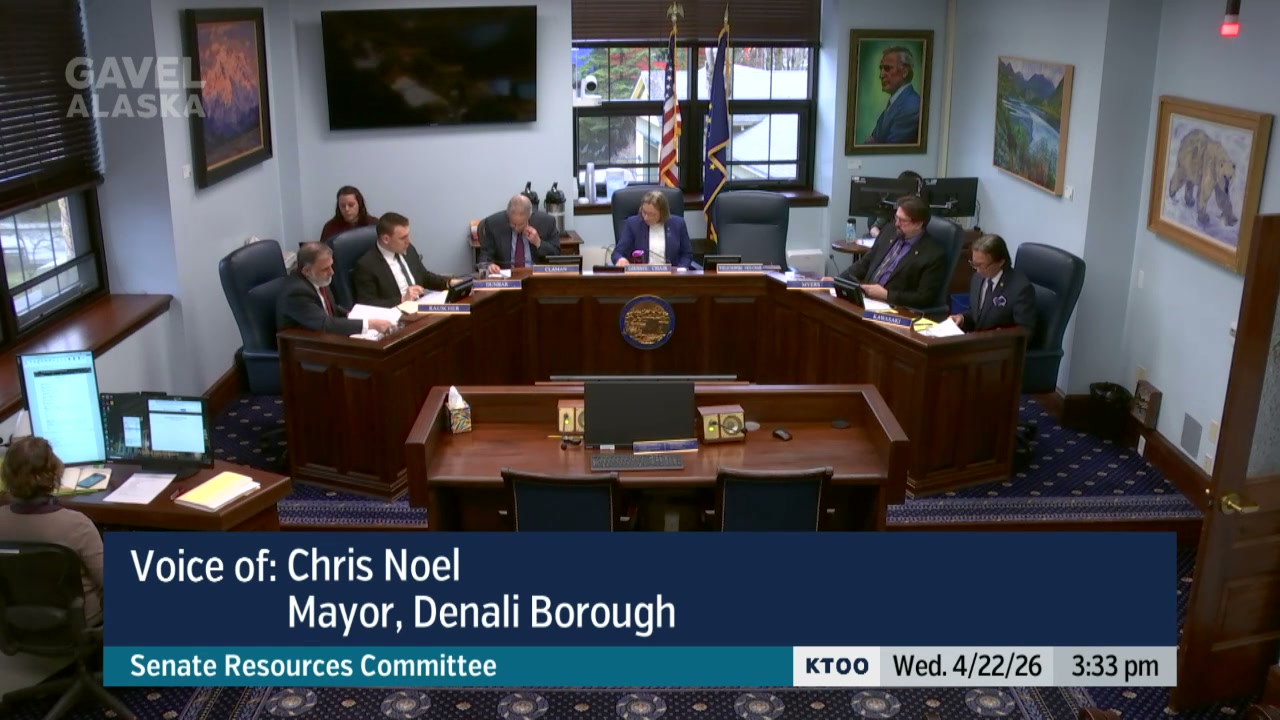
Frame from "Senate Resources, 4/22/26, 3:30pm" · Source
Denali Borough mayor opposes state control of pipeline tax payments
The mayor of Denali Borough told state senators Tuesday that the borough opposes a provision in Senate Bill 280 that would require pipeline tax payments to flow through legislative appropriation rather than directly to municipalities.
SB 280 would replace the traditional 20-mill property tax on pipeline infrastructure with a volumetric tax of 6 cents per thousand cubic feet of natural gas, with revenue split between the state and municipalities along the route. The bill was before the Senate Resources Committee for public testimony on the proposed Alaska LNG pipeline tax structure. Denali Borough is the only municipality along the proposed gas line route without current property tax authority, making the alternative revenue stream critical for the borough's ability to fund services without imposing new taxes on residents.
The Denali mayor joined leaders from four other boroughs who have urged changes to SB 280 to secure earlier, direct impact funding before construction begins. The concerns reflect broader municipal unease with the bill's structure, which has drawn testimony from mayors, city managers, and industry groups including the Alaska Oil and Gas Association.
The mayor said the borough does not support routing the Alternative Volumetric Tax or Community Impact Payments through the legislature. "We don't support the ABT or the Community Impact Payment flowing through the legislature subject to appropriation," the mayor said. "We just advocate for payments to go directly to the municipalities."
The mayor proposed an alternative approach: requiring the pipeline developer to implement a community impact fee program that municipalities could negotiate directly. "I just propose considering an alternative where the developer, you know, require the developer to implement some kind of community impact fee program. We could negotiate directly with them, and then I would, you know, I think we would encourage them to submit payments directly to municipalities prior to construction," the mayor said.
Timing emerged as a central concern. Construction could begin as soon as July 2026 and continue through November 2029, according to estimates the developer shared with the borough. But under SB 280's structure, tax payments would lag by a year because they are based on actual miles of pipe constructed. "With a lag from it being based on actual miles of pipe constructed, you know, then the payments would follow the following year," the mayor said. "That's going to lead to a delay when the impacts are going to be immediate."
The mayor noted that only a fraction of construction impacts in Denali Borough involve laying pipe. "Only a fraction of the impacts for here in the Denali Borough physically involve construction of pipe," the mayor said. "There's other things like, you know, camps, laydown yards, temporary access roads, improvements to the easement, things like that."
This article was drafted with AI assistance and reviewed by editors before publishing. Every claim can be verified against the original transcript. If you spot an error, let us know.
Related Coverage
Mayors Oppose Alaska LNG Tax Bill, Cite Revenue Concerns
Alaska News · 2w ago · 4 views · 90% match
Municipal League urges local control in Alaska LNG tax negotiations
Alaska News · 4d ago · 1 views · 87% match
Senate panel examines regulatory questions on gas pipeline tax plan
Alaska News · 6d ago · 9 views · 87% match
Oil industry opposes tax provisions in Alaska gas pipeline bill
Alaska News · 2h ago · 85% match
Senate unveils gas pipeline bill with $600M property tax, consumer protections
Alaska News · 4m ago · 82% match
Comments
Sign in to leave a comment.
No comments yet. Be the first to share your thoughts.