
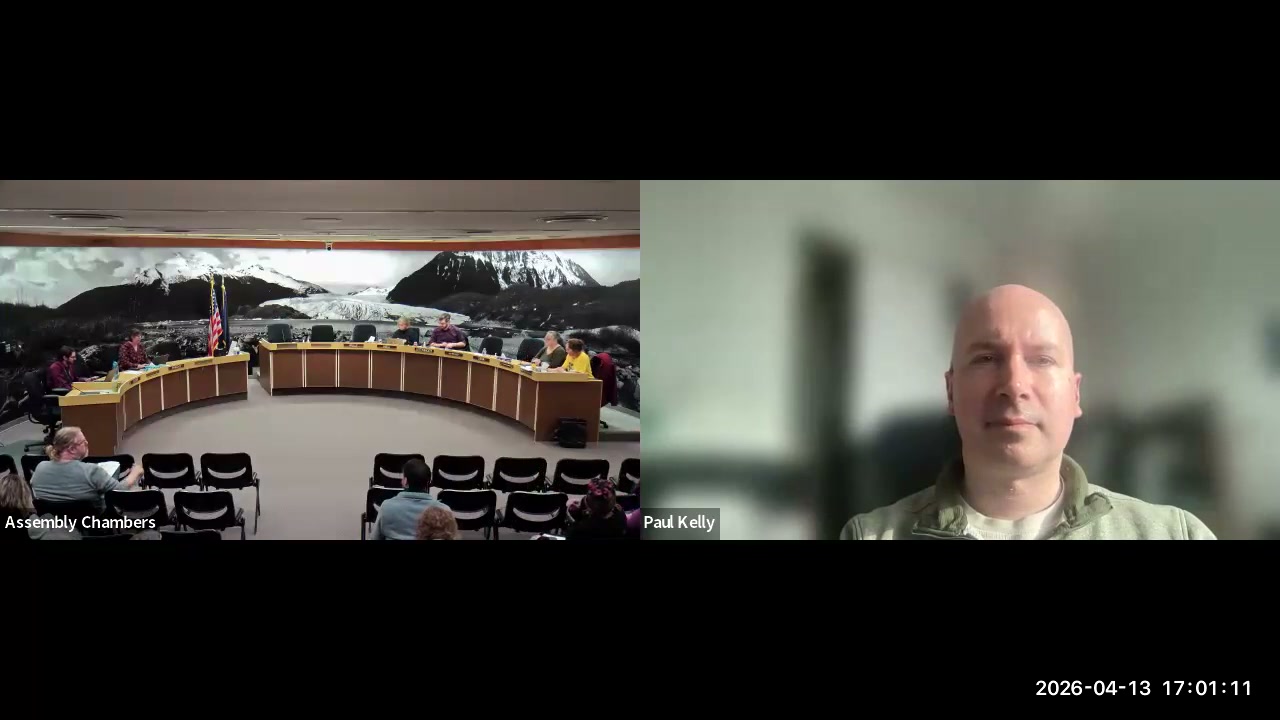
Frame from "April 13, 2026 CBJ Assembly Lands, Housing & Economic Development Committee Meeting" · Source
Juneau committee weighs limiting short-term rentals to one per owner
The Juneau Assembly Lands, Housing and Economic Development Committee reviewed a draft ordinance Sunday that would limit short-term rental ownership to one property per person, a significant policy shift from the current unlimited model.
The proposed ordinance would establish an annual registration fee and grandfather existing operators who own multiple properties, though those properties would become non-transferable. Juneau currently has 250 to 300 registered short-term rentals out of roughly 14,000 total housing units, according to city staff.
Committee members expressed divided views on whether short-term rentals significantly impact housing availability. One member cited workforce housing that sits idle during off-season months, arguing short-term rentals provide needed flexibility. Another questioned whether the data supports treating short-term rentals as a major contributor to housing shortages.
"I do not see this market, this very needed opportunity to house folks coming to our community, as being the problem with our long-term rental situation," Assembly Member Michelle Hale said, noting that 400 units at most represents a small fraction of the city's housing stock.
The draft ordinance would shift enforcement to a third-party vendor at an estimated cost of $30,000 to $40,000 annually. Committee members discussed whether registration fees could be structured to cover those costs or directed toward affordable housing programs.
Several members raised questions about how the ordinance would treat property management companies that operate rentals on behalf of multiple owners. The draft currently defines operators as property owners, not management firms.
The committee also discussed whether owner-occupied short-term rentals should be treated differently than investment properties, though the current draft makes no such distinction. One member suggested exploring whether registration fees could vary by zoning district to distinguish between properties in residential neighborhoods versus mixed-use areas.
The ordinance would take effect January 1, 2027, giving operators six months to comply. Committee members noted the effective date could create an incentive for new registrations before the cap takes effect.
Assembly Member Paul Kelly said he wanted to ensure the ordinance clearly distinguishes between property owners and operators who manage rentals for others.
The committee chair noted the proposal stems from work by a short-term rental task force that recommended the Assembly consider establishing a numeric limit for non-owner-occupied properties, though the task force did not specify what that number should be. The task force concluded its work in June 2024 and recommended grandfathering existing operators and clarifying owner-occupied rules.
This article was drafted with AI assistance and reviewed by editors before publishing. Every claim can be verified against the original transcript. If you spot an error, let us know.
Related Coverage
Senate panel advances property tax cap bill despite state warnings
Alaska News · 5d ago · 1 views · 76% match
Senate committee holds Senate Bill 259 on property tax caps
Alaska News · 4d ago · 2 views · 76% match
Senate panel advances property tax assessment cap bill
Alaska News · 1d ago · 2 views · 76% match
House Panel Considers Bills to Ease Alaska's Liquor Liability Insurance Crisis
Alaska News · 2w ago · 6 views · 73% match
Kodiak Borough Lands Committee develops framework to streamline land disposal
Alaska News · 1h ago · 2 views · 73% match
Comments
Sign in to leave a comment.
No comments yet. Be the first to share your thoughts.