
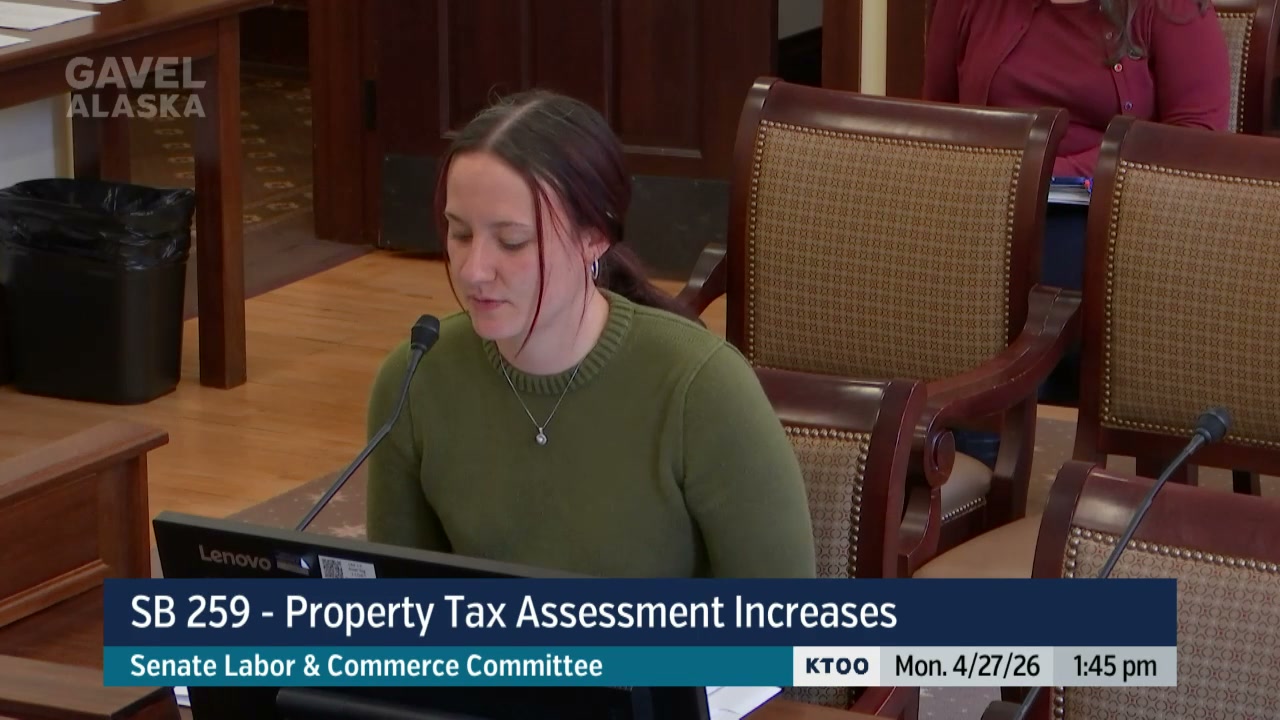
Frame from "Senate Labor & Commerce, 4/27/26, 1:30pm" · Source
Senate panel advances property tax assessment cap bill
The Alaska Senate Labor and Commerce Committee advanced legislation Monday that would let municipalities cap annual property tax assessment increases on owner-occupied homes, despite warnings from professional assessors that such limits create inequities.
Senate Bill 259 would give municipalities the option to cap yearly increases in assessed property values between 3 and 10 percent through local ordinance for property owned and occupied as a permanent place of abode by a resident. The bill requires assessors to adjust values to reflect actual market conditions every 10 years or when property changes hands.
The committee moved the bill forward with an indeterminate fiscal note after hearing testimony from both supporters and critics.
Aaron Landvik, president of the Alaska Association of Assessing Officers, testified that assessment caps are well studied across the country and create problems. "Over time, similar homes end up with very different tax burdens," Landvik said. "Longtime owners of rapidly appreciating properties receive a substantial subsidy, while new buyers and owners in slower-growing areas shoulder a larger share of the tax load."
Landvik pointed to California and Florida as examples where such disparities have persisted for decades. He urged the committee to consider alternatives including homestead exemptions, circuit breakers for seniors and fixed-income residents, and improved transparency requirements.
Ed Martin Jr. of Kenai also opposed the bill, arguing that mill rates rather than assessed values drive property tax increases. "It is not the place of the government to try to in some way artificially affect those values," Martin said. "The mill rate is the problem."
Committee Chair Jesse Bjorkman defended the legislation as a practical response after voters rejected mandatory sales disclosure. "It simply is a smoothing over time by which assessed values are allowed to rise so that they are consistent and expected by property owners and so that their property tax bills are something that is not a shock when they increase by thousands of dollars from year to year," Bjorkman said.
Bjorkman acknowledged that adjusting mill rates would be the textbook solution but said political realities make that approach unrealistic. "Everyone likes to puff up and kind of announce proudly that they have cut taxes, but nobody likes to raise taxes when additional roads need to be maintained or other infrastructure needs to be upheld," Bjorkman said.
The senator said the bill's 10-year true-up requirement distinguishes it from hard caps in other states and addresses equity concerns. "What tools are out there that can be employed optionally by municipalities to avoid there being a very significant revolt against the tax regime by which we collect monies to fund public safety, to maintain roads, and to provide money for schools," Bjorkman said. "It is predictable assessments that do not spike substantially, and that is precisely the reason for this bill."
This article was drafted with AI assistance and reviewed by editors before publishing. Every claim can be verified against the original transcript. If you spot an error, let us know.
Related Coverage
Senate panel advances property tax cap bill despite state warnings
Alaska News · 3d ago · 1 views · 96% match
Senate committee holds Senate Bill 259 on property tax caps
Alaska News · 3d ago · 2 views · 93% match
Senate panel examines regulatory questions on gas pipeline tax plan
Alaska News · 4d ago · 9 views · 82% match
Senate panel advances retirement bill despite $400M cost shift concern
Alaska News · 1w ago · 1 views · 81% match
Mayors Oppose Alaska LNG Tax Bill, Cite Revenue Concerns
Alaska News · 2w ago · 4 views · 81% match
Comments
Sign in to leave a comment.
No comments yet. Be the first to share your thoughts.