
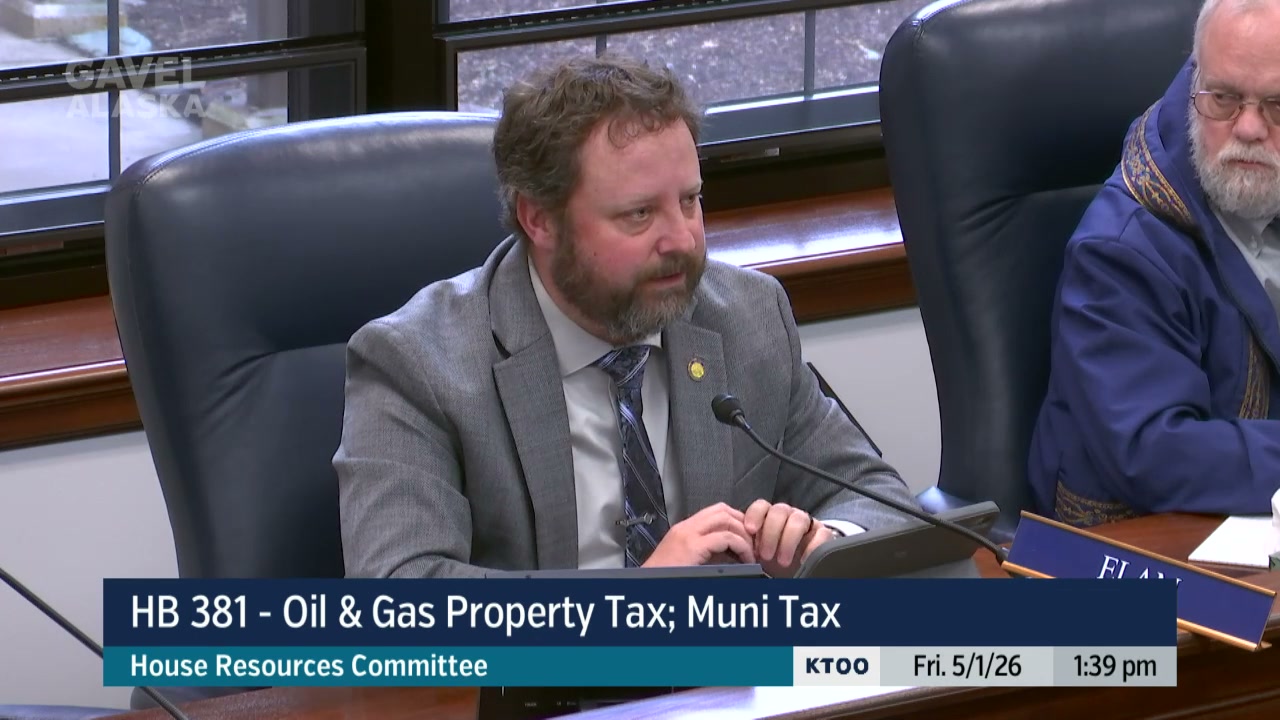
Frame from "House Resources, 5/1/26, 1pm" · Source
House panel ties Alaska gas line tax breaks to Fairbanks spur line
The House Resources Committee advanced a major change Friday to the governor's Alaska LNG tax bill. The new version makes tax incentives contingent on building a spur line to deliver affordable gas to Interior Alaska residents and military bases.
The committee substitute for House Bill 381 requires the project to construct a spur line to the Fairbanks North Star Borough as a condition for receiving tax benefits. The spur line would serve residential customers, Golden Valley Electric Association, Eielson Air Force Base, Fort Wainwright, and potential AI data centers.
Governor Dunleavy's original bill proposed replacing the existing property tax with a 6-cent per 1,000 cubic feet volumetric tax. Borough mayors and local governments raised concerns about projected local revenue losses over 36 years. The House committee version imposes a 20-cent total tax per 1,000 cubic feet split across facilities.
"This new committee substitute corrects that by conditioning those tax benefits on delivering real statewide value through getting Alaska gas to Alaska, Alaska gas to Alaskans at the Alaska price," Fairbanks North Star Borough Mayor Grier Hopkins said.
The spur line is estimated to cost roughly $150 million to $200 million. Included in the cost of the overall project, it would add only about 2 cents to the cost of gas once exports start, a House Resources Committee co-chair said.
Crucial to the Interior's support is language ensuring residents pay the same tariff as Southcentral customers by rolling spur line costs into the full system. Without that provision, Hopkins said, the cost of constructing the spur line would fall on some 3,500 Interior Gas Utility customers, making conversion uneconomical.
"If that language on lines 29 through 31 is not there, then we are not going to be looking at affordable gas here in the interior," Hopkins said. "That would be borne on the backs, that means the cost of constructing the spur line to just get gas to our infrastructure, distribution infrastructure here locally, would be borne on some 3,500 Natives, and that would make it unaffordable."
Without the spur line inclusion, gas rates for Interior residents could exceed $30 per thousand cubic feet, Hopkins said, compared to the current $24 to $25 per MCF residents pay. That would make conversion uneconomical for residential customers, Golden Valley Electric Association, or military installations.
Hopkins and project developer Glenfarne are negotiating an amendment to remove a hard construction deadline while ensuring permitting moves forward. The current language requires construction to begin within two years of the main line becoming operational. Hopkins said separating the spur timeline from the main line would prevent project delays from permitting obstacles outside Glenfarne's control.
This article was drafted with AI assistance and reviewed by editors before publishing. Every claim can be verified against the original transcript. If you spot an error, let us know.
Related Coverage
Alaska LNG Tax Bill Walks Tightrope Between Project Viability and Local Needs
Alaska News · 3d ago · 4 views · 87% match
Senate unveils gas pipeline bill with $600M property tax, consumer protections
Alaska News · 23h ago · 2 views · 87% match
Energy consultant: Alaska LNG tax bill could cut delivered cost by 20 cents
Alaska News · 2d ago · 2 views · 86% match
Senate panel examines regulatory questions on gas pipeline tax plan
Alaska News · 1w ago · 9 views · 85% match
Senate panel advances gas pipeline tax overhaul with $610M revenue target
Alaska News · 18h ago · 84% match
Comments
Sign in to leave a comment.
No comments yet. Be the first to share your thoughts.