
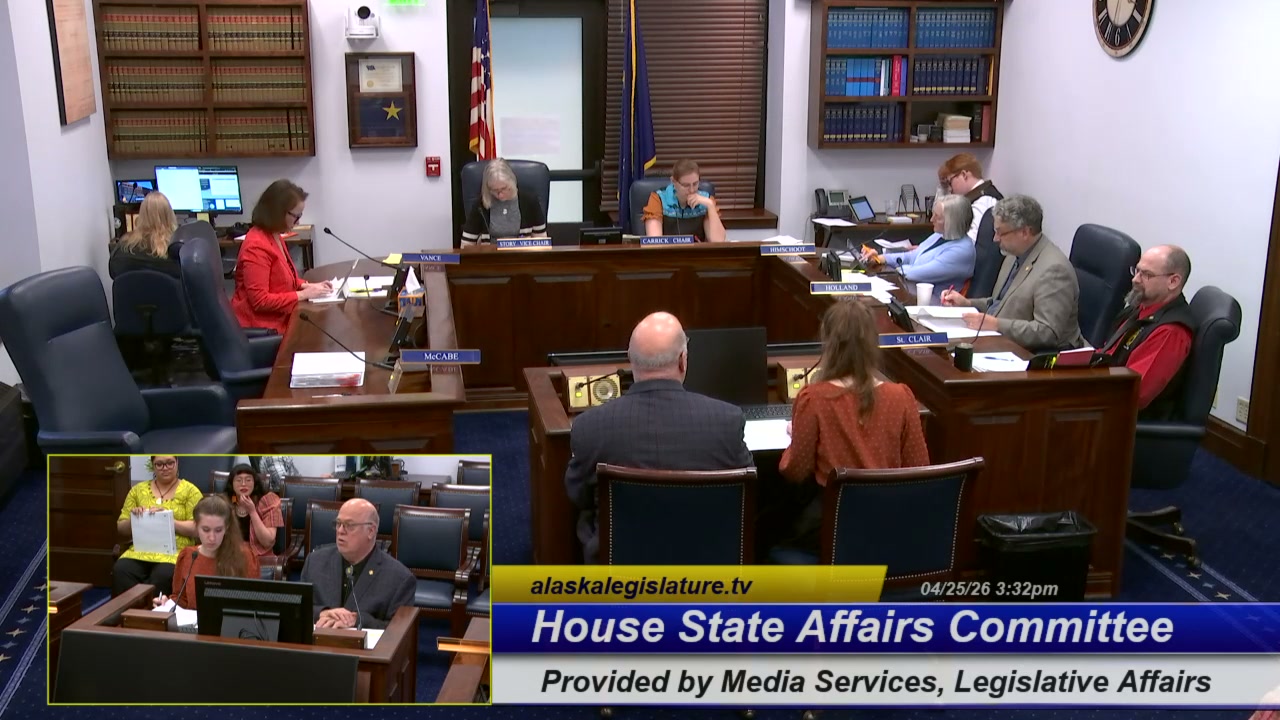
House panel hears bill requiring disclosure of out-of-state campaign funding
The House State Affairs Committee heard legislation Saturday that would require political groups funded mostly by out-of-state donors to clearly identify themselves in campaign communications.
House Bill 371 would mandate that independent expenditure groups receiving a majority of their money from non-residents disclose that funding source in advertisements and other political messages. The bill also would require such groups to maintain a physical Alaska address or appoint an in-state registered agent.
Representative Kevin McCabe, who introduced the measure, said the legislation addresses transparency gaps in Alaska's campaign finance system. Under current law, groups can spend unlimited amounts on political communications without revealing the geographic origin of their funding.
"This is not about limiting speech. It's about ensuring transparency so Alaskans can make informed decisions with full knowledge of who is trying to influence our elections," McCabe said.
The bill emerged from floor amendments McCabe proposed during the previous legislative session that drew broad support but were not adopted. Those amendments addressed what McCabe described as outdated statutes written in 1972, before the internet enabled small-dollar donations from across the country to flow into Alaska campaigns through platforms like Venmo and PayPal.
Alaska's campaign finance laws currently limit non-resident contributions to candidates: $20,000 for gubernatorial races, $5,000 for state senators, and $3,000 for state representatives. Groups and parties face a 10 percent cap on non-resident funding. But independent expenditure groups, which can spend unlimited amounts on communications that do not coordinate with candidates, face no such geographic restrictions.
Committee Chair Ashley Carrick noted that Alaska is viewed as inexpensive to influence compared to larger states. "Alaska, frankly, is seen as a cheap date by some of the outside influencers that are running independent expenditure groups, whether it be the NRA, it could be, you know, the environmentalists," Carrick said. "We live here, it's our state, and I think we need to be the major influencers."
The bill also would create new disclosure requirements for bundled contributions, when individuals pool donations through an intermediary to avoid appearing on public campaign finance reports. Under HB 371, candidates would have to report anyone who aggregates more than $10,000 in contributions during an election cycle.
McCabe said bundling allows donors to hide their identities while still exerting influence. "Maybe I wanted to give to your campaign, but I didn't want my name to be on the APOC list as contributing to your campaign. I could give it to somebody that was bundling together the contributions and then they would contribute it," he said.
This article was drafted with AI assistance and reviewed by editors before publishing. Every claim can be verified against the original transcript. If you spot an error, let us know.
Related Coverage
House panel hears bill to strengthen campaign finance disclosure
Alaska News · 2h ago · 97% match
House Finance weighs bill to standardize state payment timelines
Alaska News · 2w ago · 9 views · 77% match
Senate Finance hears corporate tax shift targeting online sales to Alaskans
Alaska News · 2d ago · 1 views · 76% match
House committee hears bill to eliminate tax discounts
Alaska News · 1d ago · 1 views · 76% match
Senate Finance hears tax modernization bill, sets aside for further review
Alaska News · 1d ago · 1 views · 76% match
Comments
Sign in to leave a comment.
No comments yet. Be the first to share your thoughts.