
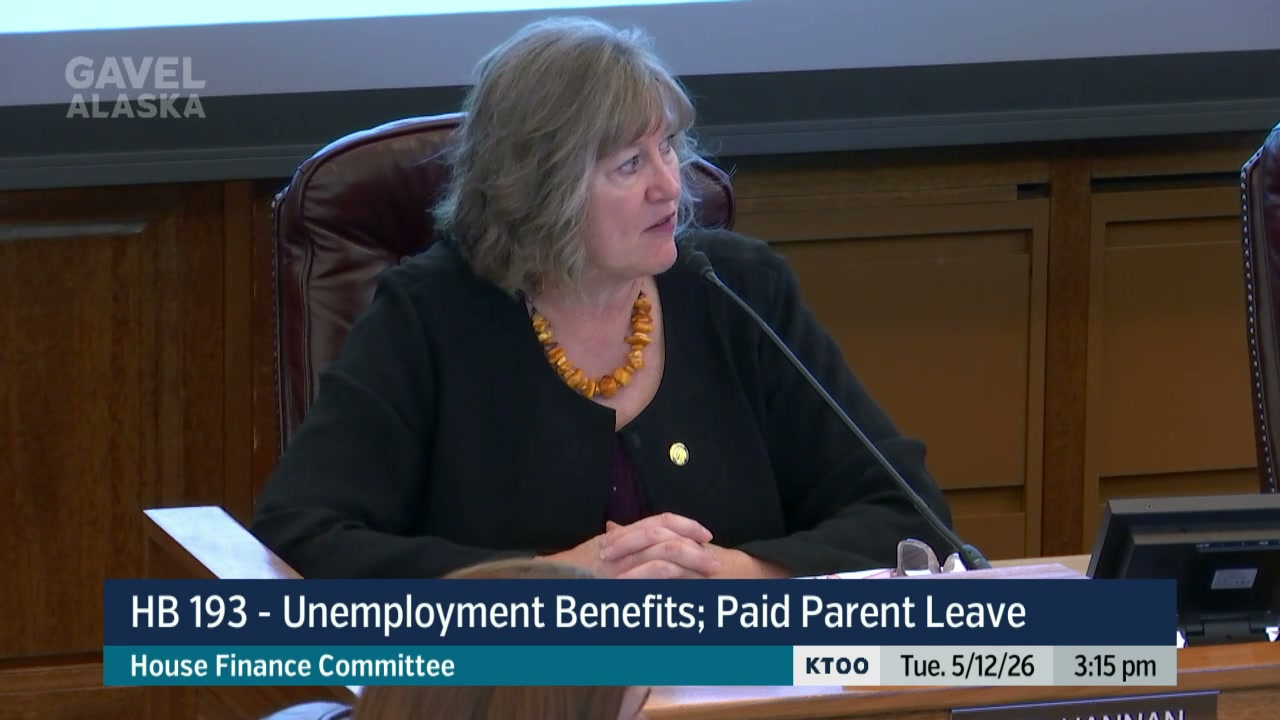
Frame from "House Finance, 5/12/26, 1:30pm" · Source
House Finance Advances Paid Parental Leave Bill
The Alaska House Finance Committee voted 7-4 Tuesday to advance a paid parental leave bill that would create a new payroll tax and provide up to 12 weeks of benefits. The bill heads to the House floor despite concerns about long-term funding and questions about whether small business exemptions violate equal protection.
House Bill 193 would require employees to contribute 0.15% of wages to a new paid parental leave fund starting January 1, 2027. Employers would contribute 0.2% to the program and 0.3% to the unemployment insurance trust fund. Benefits would not kick in until January 1, 2029, giving the fund two years to build up capital.
The committee capped benefits at 8 to 12 weeks, down from an earlier range of 8 to 26 weeks. It raised the maximum qualifying wage to $54,500.
Fund Projections Uncertain Beyond 2040
Paloma Harbour, director of the Division of Employment and Training Services, told the committee the unemployment insurance trust fund would need increased employer contributions starting in 2029. By 2033, some employers would stop paying into the parental leave program, though not all.
"Even out into fiscal year 2040, there would be some employers, employers in rate classes 1 through 7 that would still be contributing to the paid parental leave program," Harbour said.
Representative Will Stapp asked what the state would tell workers in 2042 if the fund ran dry. Harbour said the department did not run projections past 2040 because of uncertainty.
Small Business Exemption Raises Legal Questions
The bill exempts employers with fewer than 25 workers and seasonal employees from providing benefits. But employees at small firms would still pay into the program without being able to collect.
Representative Andy Josephson flagged the issue: "Under the bill, employees in firms, we will call them, of less than 25 would be contributing a portion of their income to paid parental leave. Is that right?"
Harbour confirmed that was correct.
A legal memo reviewed by the committee raised equal protection concerns. Representative Sara Hannan questioned whether the exemption created two separate classes of employees.
Representative Carolyn Hall, the bill's sponsor, defended the exemption as tied to legitimate state interests. Small businesses face harm when they cannot permanently fill positions left open during parental leave, she said. The different treatment is "purely economic and not based on a protected class status."
Representative Jeremy Bynum said the 25-employee threshold recognizes that larger employers have more workforce depth and administrative capacity to handle leave requests. Seasonal work is often short-term and project-specific, making mandatory paid leave disruptive, he said.
This article was drafted with AI assistance and reviewed by editors before publishing. Every claim can be verified against the original transcript. If you spot an error, let us know.
Related Coverage
House panel advances income tax on large pass-through businesses
Alaska News · 1w ago · 3 views · 82% match
House Finance Advances Education Funding Bill Despite Fiscal Concerns
Alaska News · 1w ago · 3 views · 82% match
Alaska House Panel Advances Bill to Speed Up State Contract Payments
Alaska News · 1mo ago · 3 views · 81% match
Senate panel advances retirement bill despite $400M cost shift concern
Alaska News · 3w ago · 1 views · 81% match
Alaska House Weighs $113M Education Funding Overhaul
Alaska News · 1w ago · 7 views · 80% match
Comments
Sign in to leave a comment.
No comments yet. Be the first to share your thoughts.