
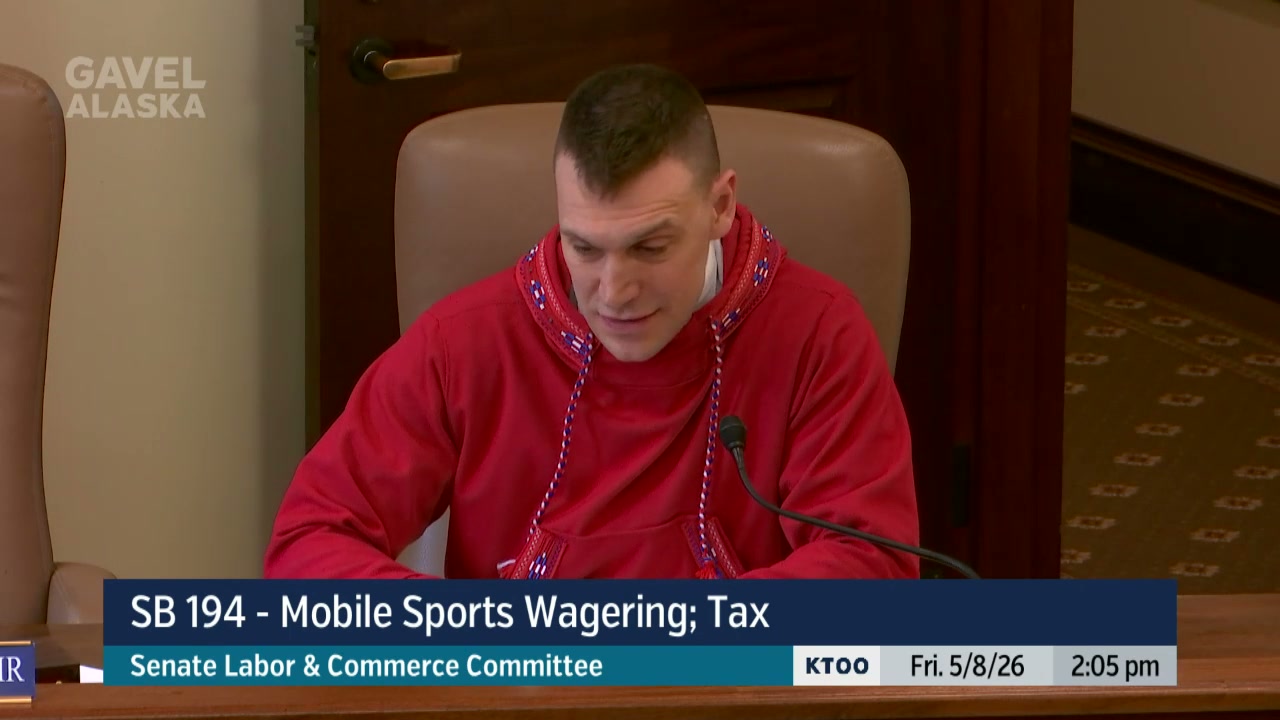
Frame from "Senate Labor & Commerce Committee" · Source
Alaska Senate committee advances sports betting bill with tax revenue promise
The Alaska Senate Labor and Commerce Committee heard testimony Friday on legislation that would legalize mobile sports betting and impose a 20 percent tax on operator revenue, potentially generating millions in new state revenue from an industry supporters say is already active through illegal offshore platforms.
Senate Bill 194, sponsored by Senator Mike Cronk, would authorize licensed operators to offer mobile sports wagering through approved digital platforms. The bill requires operators to maintain licenses in at least three other states and caps the number of Alaska licenses at 10, though that limit drew questions from committee members. The committee heard the bill but took no further action Friday.
"Simply put, the intent of this legislation is to legalize sports betting in Alaska while ensuring that it is properly regulated," Cronk said. "This bill aims to accomplish three major goals: converting consumers from the black market to the legal market, establishing consumer protections for sports wagering activities, and providing new ways to generate revenue for the state of Alaska."
An estimated $139 million in illegal sports betting wagers are placed in Alaska annually, according to testimony from Jennifer Anderson, director of state government affairs for FanDuel. The current fiscal note for the bill projects tax revenue with a median around $12 million and as high as $17 million annually.
The bill represents the latest in a series of attempts to legalize mobile sports wagering in Alaska. An identical SB 194 was introduced in the 33rd Legislature in 2024 and advanced with amendments in Senate Resources but died before the session ended. Earlier versions of sports betting legislation bearing the same bill number were introduced in 2017 and 2011 but failed to progress beyond introduction.
The bill would require operators to verify users are at least 21 years old and physically present in Alaska when placing bets, or in another state, territory, or jurisdiction with which the commissioner has entered into a mobile sports wagering agreement. Licensed platforms would be required to offer responsible gaming tools including deposit limits, time limits, and self-exclusion programs, along with connections to problem gambling resources.
Senator Forrest Dunbar questioned the proposed cap of 10 licenses, asking why the state would limit competition in a digital marketplace that does not face the physical constraints of brick-and-mortar businesses.
"Why cap the number of licenses at 10? Why create something that might result in a secondary market?" Dunbar said. "If you cap it at 10, those 10 companies will be very profitable. I have no question. If I was FanDuel, I would want it capped because I would want to buy one of these very expensive ones and prevent competition. But why cap it at 10?"
This article was drafted with AI assistance and reviewed by editors before publishing. Every claim can be verified against the original transcript. If you spot an error, let us know.
Related Coverage
House Committee Hears Divided Testimony on Electronic Pull-Tab Bill
Alaska News · 1d ago · 3 views · 80% match
Senate panel advances property tax cap bill despite state warnings
Alaska News · 1w ago · 3 views · 79% match
House panel advances income tax on large pass-through businesses
Alaska News · 1w ago · 3 views · 79% match
House panel hears tax proposal for Alaska LNG project
Alaska News · 3d ago · 2 views · 79% match
Senate panel advances property tax assessment cap bill
Alaska News · 1w ago · 2 views · 79% match
Comments
Sign in to leave a comment.
No comments yet. Be the first to share your thoughts.