
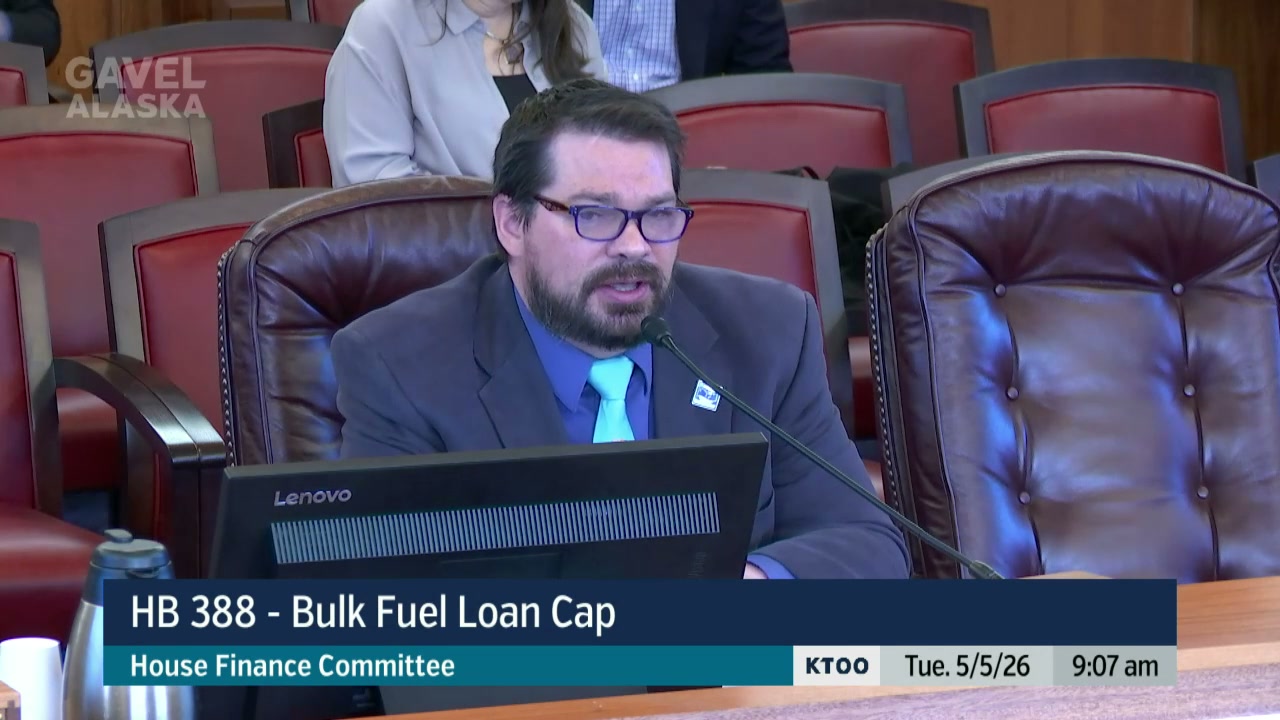
Frame from "HFIN-260505-0900" · Source
Alaska House panel considers doubling bulk fuel loan cap amid price crisis
The Alaska House Finance Committee heard testimony Tuesday on legislation to double the maximum bulk fuel loan available to rural communities as fuel prices surge and supply shortages threaten western Alaska.
House Bill 388 would raise the cap on the Bulk Fuel Revolving Loan Fund from $750,000 to $1.5 million per borrower. The program serves communities under 2,000 population, providing short-term financing for bulk fuel purchases that borrowers repay within 12 months.
Sandra Moller, director of the Division of Community and Regional Affairs, told the committee fuel prices have increased $3 to $4 per gallon compared to last year. Some communities are seeing 100 percent price increases. Last winter, gasoline prices ranged from $3.65 in Southeast Alaska to as high as $11.50 in the Northern Interior, she said.
"If there is a $5 increase times 90 million gallons, that is $450 million," Moller said, citing a University of Alaska study. "That shows the amount of impact that we are looking at. We currently think it is in the $3 range, so that is a little higher."
Global supply disruptions add urgency to the price crisis. Co-Chair Neal Foster referenced concerns about fuel availability in western Alaska.
"A letter recently came out saying that there was the possibility that 140 million gallons that go into western Alaska may or may not be there, or maybe it is going to be a partial," Foster said. "And what does that mean for small rural communities that rely on that for heating, but not only heating, but also the electricity to run power plants."
The program currently holds about $22 million in capital. Moller presented two scenarios for additional funding needs. Under one scenario, if all current borrowers reached the new $1.5 million cap, the fund would need $25 million in additional capitalization for a total of $47 million.
"In Scenario B, we took the average loan amount, which is about $350,000, we increased it 100 percent for all those borrowers, and that is what these $25 million would represent," Moller said.
The program served 77 to 78 borrowers last year, the highest number in its history and a significant increase from 54 applicants three years ago. Moller said the division expects that number to grow but cannot predict by how much. The program maintains a 99.5 percent collection rate.
Mike Poston, director of sales for Vitus Energy, told the committee his company is referring more customers to the state loan program this year. Vitus transports fuel to western Alaska but does not finance purchases.
"When we compare prices that we were charging last year to the ones this year, that 100 percent increase, that is a real number," Poston said. "The number of borrowers that are going to need more money because of the cap is going up."
This article was drafted with AI assistance and reviewed by editors before publishing. Every claim can be verified against the original transcript. If you spot an error, let us know.
Related Coverage
Alaska lawmakers hear warnings of rural fuel crisis, weigh loan program expansion
Alaska News · 1w ago · 9 views · 92% match
Remote Alaska villages pay $6.63 per gallon as fuel costs strain budgets
Alaska News · 2w ago · 2 views · 82% match
House Panel Considers Bills to Ease Alaska's Liquor Liability Insurance Crisis
Alaska News · 3w ago · 7 views · 81% match
House panel ties Alaska gas line tax breaks to Fairbanks spur line
Alaska News · 3d ago · 5 views · 80% match
Alaska residential schools seek doubled stipends to cover rising costs
Alaska News · 19h ago · 80% match
Comments
Sign in to leave a comment.
No comments yet. Be the first to share your thoughts.