
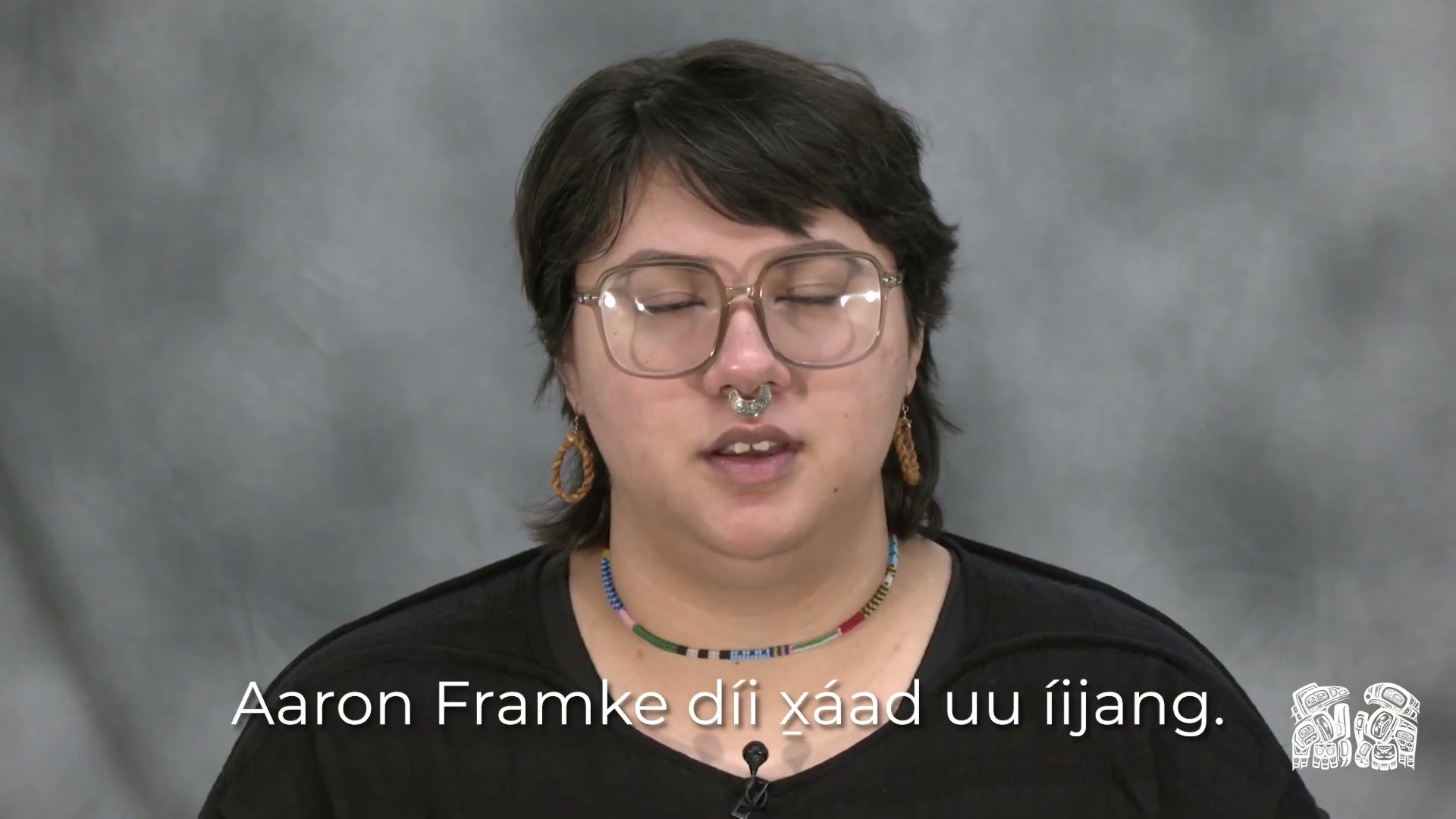
Frame from "Learn How to Introduce Yourself in Xaad Kíl" · Source
Language Lesson Teaches Traditional Haida Self-Introduction
A language instructor demonstrated how to introduce oneself in Xaad Kíl, the Haida language, walking through the traditional format that begins with maternal grandparents and emphasizes matrilineal family structure.
The lesson covered the specific phrases used to identify family members, with different terms depending on whether relatives are living or deceased. The traditional introduction follows a set pattern that reflects Haida cultural values and social organization.
"So I just did my haad'kil introduction, and now I'm going to help you make yours, and we'll go part by part," the instructor said. "To start out, we'll always start with our maternal grandmother. So we'll say her name and then 'di naan u'eejoong.'"
The format begins with the maternal grandmother, using the phrase "di naan u'eejoong" if she is living. "And if she has passed, then we'll say Her name: di naanu ii jin," the instructor said. The grandfather follows with "di chin uu ii jung" if living, or "di chin uu ii jin" if deceased. The mother is introduced as "di ao uu ii jung," while the father's introduction differs by gender of the speaker: "di-hot u-i-jung" for female speakers and "di-hung u-i-jung" for male speakers.
"Then after we introduce our grandparents and our parents, we'll introduce ourselves by saying our name and then 'hinu di-kyeong,'" the instructor said.
The lesson included instruction on identifying moiety affiliation, one of two clans in Haida social structure. "If you're of the Eagle moiety, then you'll say, 'Gats'ak'us gustudikwalagang,'" the instructor said. "And if you're of the Raven moiety, you'll say, 'Gyal'us gustudikwalagang.'"
The instructor provided Haida place names for Alaska communities. Craig is K'oustlai in Xaad Kíl. "If you're from Heidelberg, you could say 'Hikta Hundlai,'" the instructor said. "'Gits'hawn' if you're from Ketchikan." Klawock is Sławak, and Juneau is Stautl Pluugwan Khandlai in the Haida language. Those from the lower 48 states can say T'agwa Pluugai.
After stating their place of origin with "stoosh eejung," speakers can introduce where they currently live using "aish oosh naagang."
The traditional introduction concludes with an expression of gratitude. "And then you'll always want to end by saying thank you, so we'll end with a 'haw'aa,'" the instructor said.
The lesson preserved linguistic traditions that encode Haida social structure, including the matrilineal system in which clan membership passes through the mother's line. The format reflects the importance of family connections and geographic identity in Haida culture.
This article was drafted with AI assistance and reviewed by editors before publishing. Every claim can be verified against the original transcript. If you spot an error, let us know.
Related Coverage
Tlingit & Haida building two education campuses on Prince of Wales
Alaska News · 1d ago · 1 views · 71% match
Generations Southeast brings CDL simulator training to Juneau, Prince of Wales
Alaska News · 13h ago · 4 views · 67% match
Toksook Bay documentary on suicide prevention screened for Alaska lawmakers
Alaska News · 6d ago · 2 views · 66% match
House panel advances tribal victim advocate confidentiality bill
Alaska News · 1d ago · 2 views · 65% match
Wild ice skating grows from isolated hobby to organized Alaska community
Alaska News · 6d ago · 2 views · 65% match
Comments
Sign in to leave a comment.
No comments yet. Be the first to share your thoughts.