
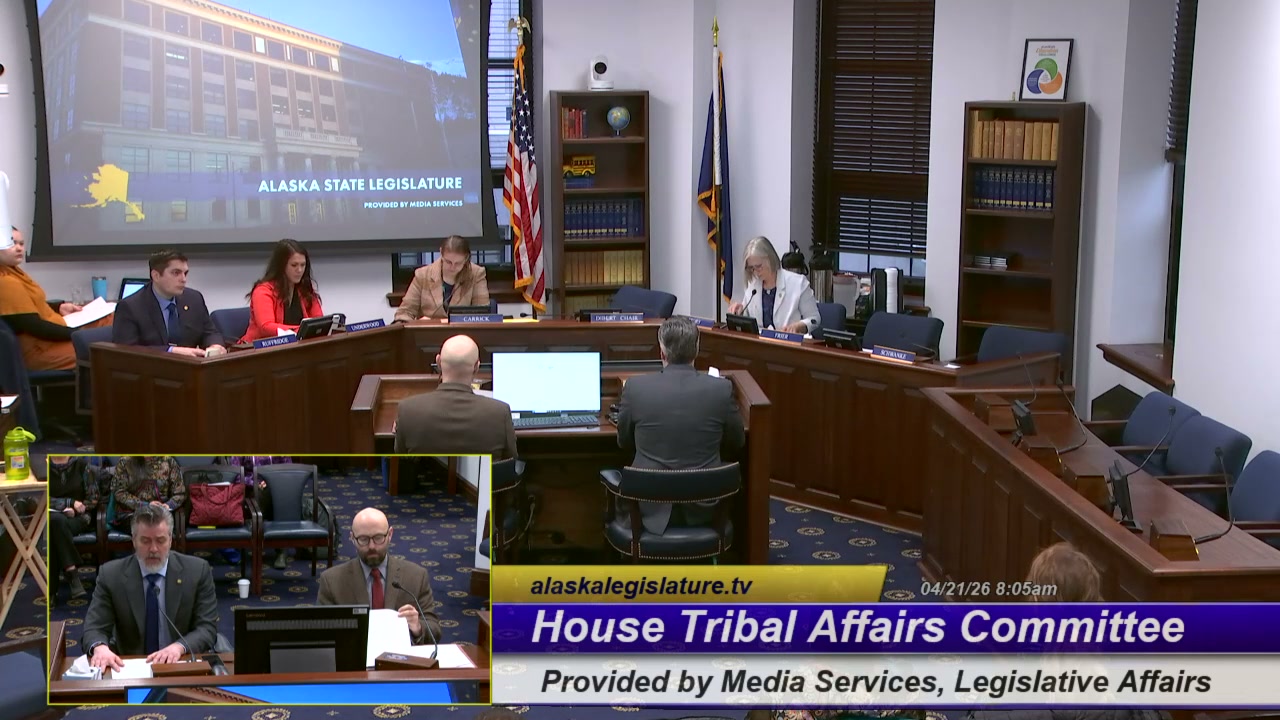
Frame from "House Tribal Affairs, 4/21/26, 8am" · Source
House panel hears bill to extend confidentiality to tribal victim advocates
The Alaska House Tribal Affairs Committee heard a bill Tuesday that would close a legal gap leaving Alaska Native domestic violence and sexual assault survivors without confidentiality protections when they seek help from tribal organizations.
House Bill 384 would add two words to state statute defining victim counseling centers: "or tribal." The change would extend the same confidentiality protections already given to survivors served by nonprofits, local governments, and military organizations.
"Tribal governments are not included in the current definition of victim counseling center, meaning victims who receive care from a tribal counseling center lack the same confidentiality protection afforded those served by a nonprofit, a local government, or a military-affiliated organization," said Representative Andrew Gray, the bill's sponsor. "HB 384 remedies this failure with the addition of two words: or tribal."
Under current law, victims who receive care from tribal counseling centers lack the confidentiality protection that shields communications between survivors and advocates from being disclosed in court proceedings. Without statutory protection, advocates' notes and confidential communications can be subpoenaed by opposing counsel and included in discovery. Those records may contain safety plans, confidential information about survivors, and safe locations.
Rick Haskins Garcia, director of law and policy for the Alaska Native Women's Resource Center, told the committee that tribal governments have become essential frontline providers of victim services across Alaska. Each of the state's 229 federally recognized tribes has the authority to create victim services programs. Many are doing that work on an as-needed basis or through established programs.
Garcia described a recent example where a tribal Sexual Assault Response Team in the Interior could not enter into a memorandum of understanding with the Department of Public Safety specifically because tribal advocates lack statutory confidentiality protections. The Department of Law and Alaska Department of Safety concluded last summer that the statutory void prevented the collaboration.
"The reality of the situation is for survivors that are experiencing domestic violence and sexual assault until we are able in Alaska to build up our tribal justice systems, many of those cases are being prosecuted either in our state criminal system or our state civil system," Garcia said. "And with the lack of confidentiality for our advocates, it is going to create a chilling effect."
Dylan Hitchcock Lopez, staff to Representative Gray and in-house counsel, explained that Alaska's constitutional right to privacy does not provide the same protections as the confidentiality statutes governing criminal and civil proceedings. Those statutes are narrowly tailored to balance victims' privacy interests against defendants' Sixth Amendment rights to discovery.
This article was drafted with AI assistance and reviewed by editors before publishing. Every claim can be verified against the original transcript. If you spot an error, let us know.
Related Coverage
House panel advances tribal victim advocate confidentiality bill
Alaska News · 8h ago · 2 views · 95% match
House Judiciary advances bill extending confidentiality to tribal advocates
Alaska News · 2d ago · 3 views · 94% match
Senate panel hears data center safeguards, tribal education bill
Alaska News · 5d ago · 1 views · 77% match
House Judiciary Confirms Four Governor Appointees to State Boards
Alaska News · 2w ago · 4 views · 76% match
Alaska's tribal school compact bill navigates sovereignty and public education law
Alaska News · 2d ago · 1 views · 76% match
Comments
Sign in to leave a comment.
No comments yet. Be the first to share your thoughts.