
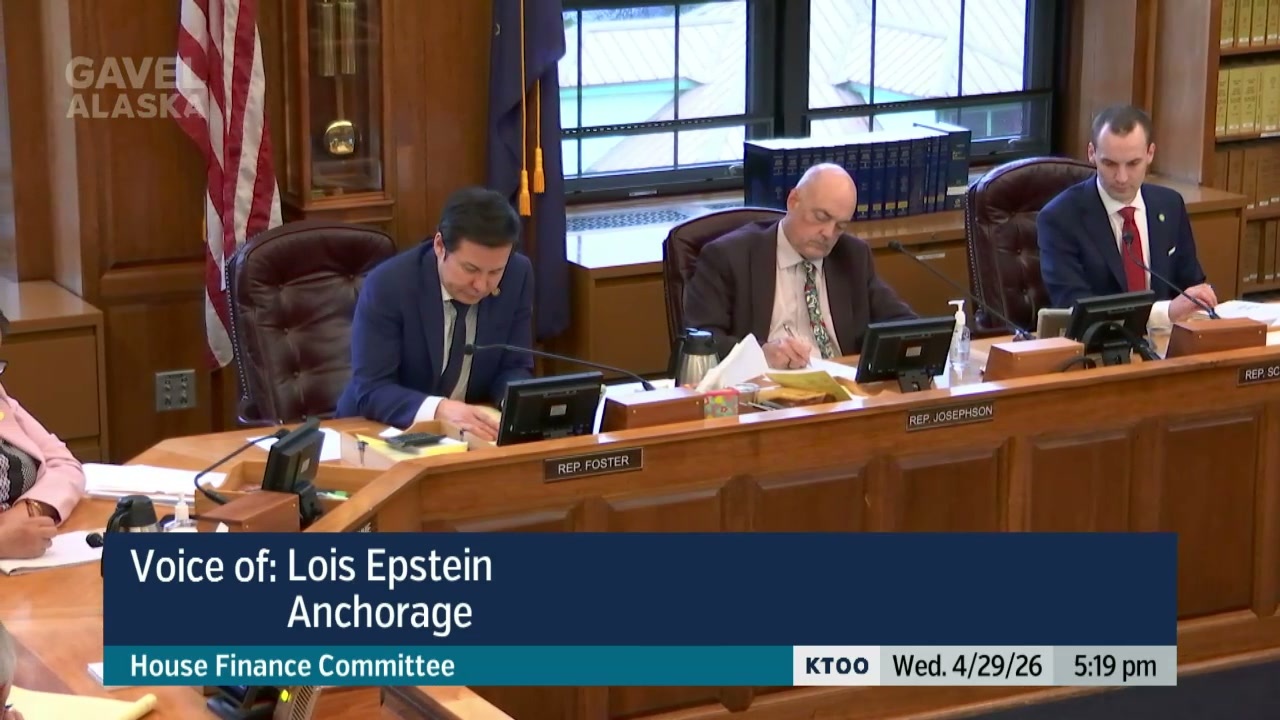
Frame from "HFIN-260429-1630" · Source
House Finance hears divided testimony on $95M West Susitna road allocation
The House Finance Committee heard nearly two hours of public testimony April 29 on Senate Bill 214, the capital budget appropriations bill. Testifiers addressed multiple funding priorities, including a proposed $95 million appropriation for the West Susitna Access Road, restoration of homeless assistance program funding, support for the Arctic Winter Games, and municipal infrastructure needs.
The West Susitna road funding drew the most divided testimony. The appropriation would cover the first 22 miles of a planned 100-mile route from Big Lake to the West Susitna mining district. Lois Epstein, an Alaska-licensed engineer, told the committee she analyzed a 2014 state reconnaissance study and inflated its per-mile cost estimates to 2025 dollars using recognized indexes. "This means that the cost for the full 100-mile road, largely intended to subsidize mining companies that pay the state relatively little in revenue and offer few long-term jobs, would range from $800 million to $1.26 billion," Epstein said.
Opponents said the road would primarily benefit mining interests while threatening salmon habitat, indigenous cultural sites and an existing recreation-based economy. Karen Garvey said the project would cross 182 streams, with 171 having culverts and only 83 designed for fish passage. "Many, many streams out there are designated as fish salmon rivers," Garvey said. "And there are lots of wetlands, which of course would have critical habitat."
Thane Piscoia, vice president of Alexander Creek, told the committee that federal environmental reviews remain incomplete. "The environmental assessment has not been released. The Section 404 wetlands permit has not been issued. Section 106 historic preservation review is still in programmatic consultation," Piscoia said.
Angela Wade, tribal historic preservation officer for Chickaloon Village, said her team documented nearly 700 culturally modified trees within a 20-foot corridor of the proposed route. "I walked the whole 22-plus miles of the corridor," Wade said. "Even though DOT will claim it is unwalkable, and I know there are landforms and features out there that need protecting culturally."
Several testifiers emphasized the economic value of the region's existing uses. Adam Cuthrell, owner of Fishhound Expeditions, said sport fishing alone generated over $50 million for the Mat-Su Valley in 2019, compared to $7 million from mining. "People choose to travel and spend money in the West Zoo because it is wild and free from massive industrial mines," Cuthrell said.
Bob Butera, a civil engineer who worked on the 2019 reconnaissance study, described the project's engineering challenges. The route would require 11 bridges, including a 2,200-foot span across the Susitna River that would be 700 feet longer than the Glenn Highway's Knik River crossing. "Every dollar spent on the West Susitna Access Project is money taken from construction operations and maintenance of the basic transportation needs that serve the majority of local residents," Butera said.
This article was drafted with AI assistance and reviewed by editors before publishing. Every claim can be verified against the original transcript. If you spot an error, let us know.
Related Coverage
House Finance cuts West Susitna road funding from capital budget
Alaska News · 6d ago · 9 views · 89% match
Alaska House Finance Rejects Cemetery, School, Energy Amendments
Alaska News · 2h ago · 1 views · 81% match
House Finance begins review of Alaska LNG tax bill with competing rate proposals
Alaska News · 1h ago · 80% match
House Finance hears divided testimony on pharmacist prescribing bill
Alaska News · 1h ago · 79% match
State seeks public comment on West Susitna Road historic sites plan
Alaska News · 2w ago · 2 views · 79% match
Comments
Sign in to leave a comment.
No comments yet. Be the first to share your thoughts.