
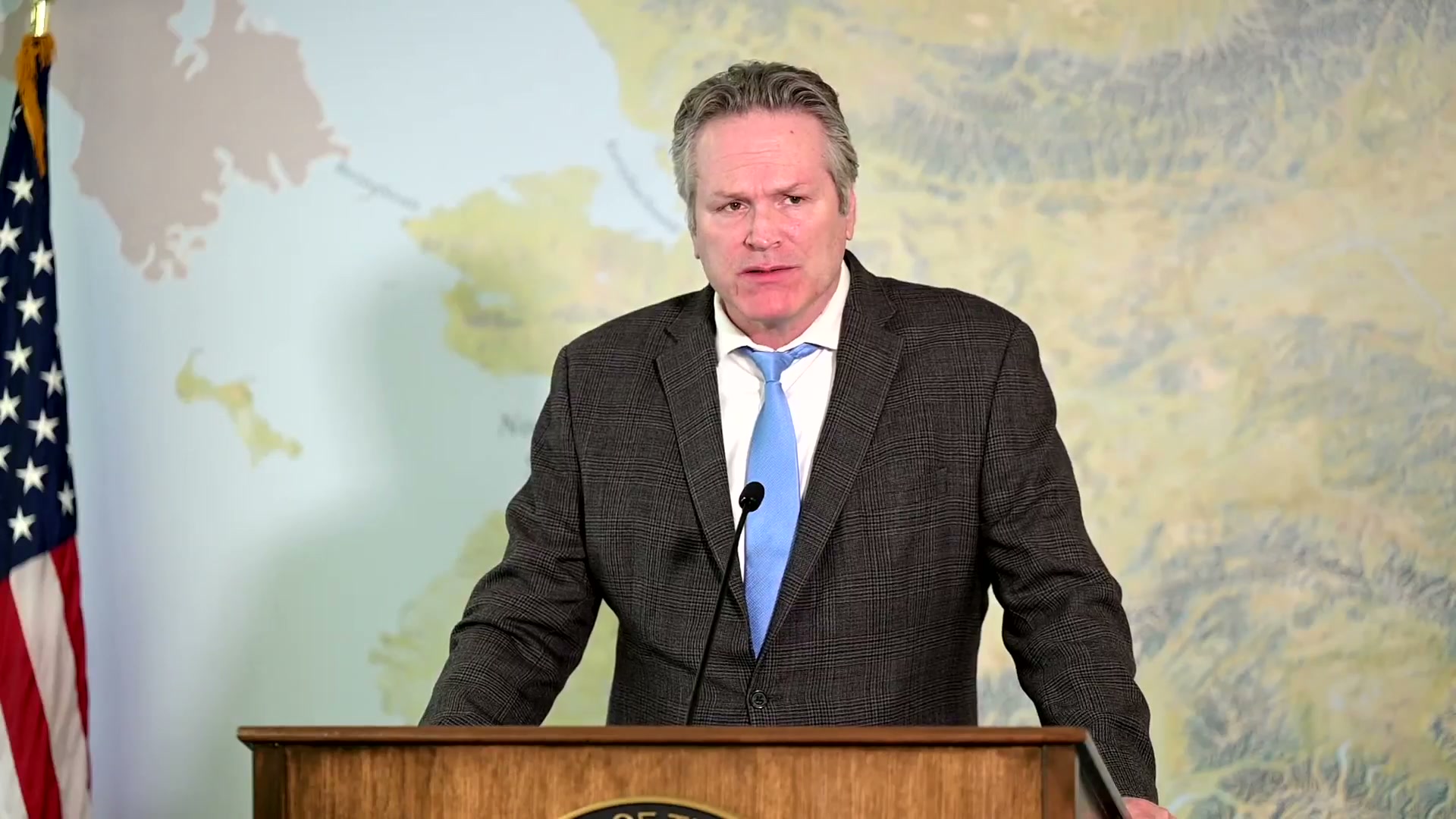
Frame from "Press Conference: LNG Project" · Source
Dunleavy says Alaska gas pipeline depends on property tax overhaul
Governor Mike Dunleavy called Monday for the Alaska Legislature to pass a payment-in-lieu-of-taxes bill within three weeks. He warned that the current property tax structure makes what he described as the largest project in state history unfinanceable.
The governor framed the proposed tax overhaul as crucial to advancing a $44 billion to $50 billion liquefied natural gas pipeline from the North Slope to the Kenai Peninsula. Without the change, he said, Alaska cannot compete with lower-cost states like Texas for the investment needed to build the 800-mile project. Local governments warn the proposal could sharply reduce their property tax base.
"If you were to say to me, Dunleavy, what's the most important thing that can happen in this session? It's this PILT by far, bar none," Dunleavy said. "This would be the largest project in Alaska history, probably the largest in the Arctic, in the Pacific."
Dunleavy introduced legislation in March to replace Alaska's 20-mill property tax on oil and gas infrastructure with a volumetric throughput tax. His original proposal set the rate at 6 cents per thousand cubic feet of gas after the project reaches full capacity.
The House Resources Committee amended the bill in late April to triple that rate to 20 cents per thousand cubic feet. The increase would be split among treatment, pipeline, and export facilities. The committee also added requirements for a spur line to Fairbanks and community benefit agreements. The higher rate and conditions were added to address concerns from local governments, which stand to lose up to 90 percent of their property tax revenue under the governor's plan.
The governor said Monday that a rate "much above" 6 cents would make the project unfinanceable. "If you go above, much above that, you're probably not going to get a project that's financeable," he said. "Somebody comes in with a 20-cent throughput tax, it's not going to be financeable."
The conflict over tax rates reflects a central tension in the legislative debate. Local governments depend on property tax revenue from oil and gas infrastructure. The governor's proposal would sharply reduce those receipts. Legislators have debated alternatives including higher throughput taxes and impact payments of up to $800 million to offset infrastructure costs borne by local communities.
Dunleavy argued that Alaska's current property tax is among the highest in the nation and puts the state at a severe disadvantage. "If you were to compare the price and the cost of building an 800-mile pipeline in Alaska versus an 800-mile pipeline in Texas, the cost is nearly half as much in Texas," he said.
Texas benefits from interstate highways, large permanent labor pools, and proximity to pipe manufacturing, he said. Alaska faces higher costs for shipping equipment and materials north.
This article was drafted with AI assistance and reviewed by editors before publishing. Every claim can be verified against the original transcript. If you spot an error, let us know.
Related Coverage
Alaska LNG Tax Bill Walks Tightrope Between Project Viability and Local Needs
Alaska News · 6d ago · 5 views · 84% match
Municipal League urges local control in Alaska LNG tax negotiations
Alaska News · 1w ago · 1 views · 83% match
Senate panel advances gas pipeline tax overhaul with $610M revenue target
Alaska News · 3d ago · 1 views · 83% match
Senate unveils gas pipeline bill with $600M property tax, consumer protections
Alaska News · 4d ago · 4 views · 83% match
Senate panel examines regulatory questions on gas pipeline tax plan
Alaska News · 1w ago · 10 views · 83% match
Comments
Sign in to leave a comment.
No comments yet. Be the first to share your thoughts.