
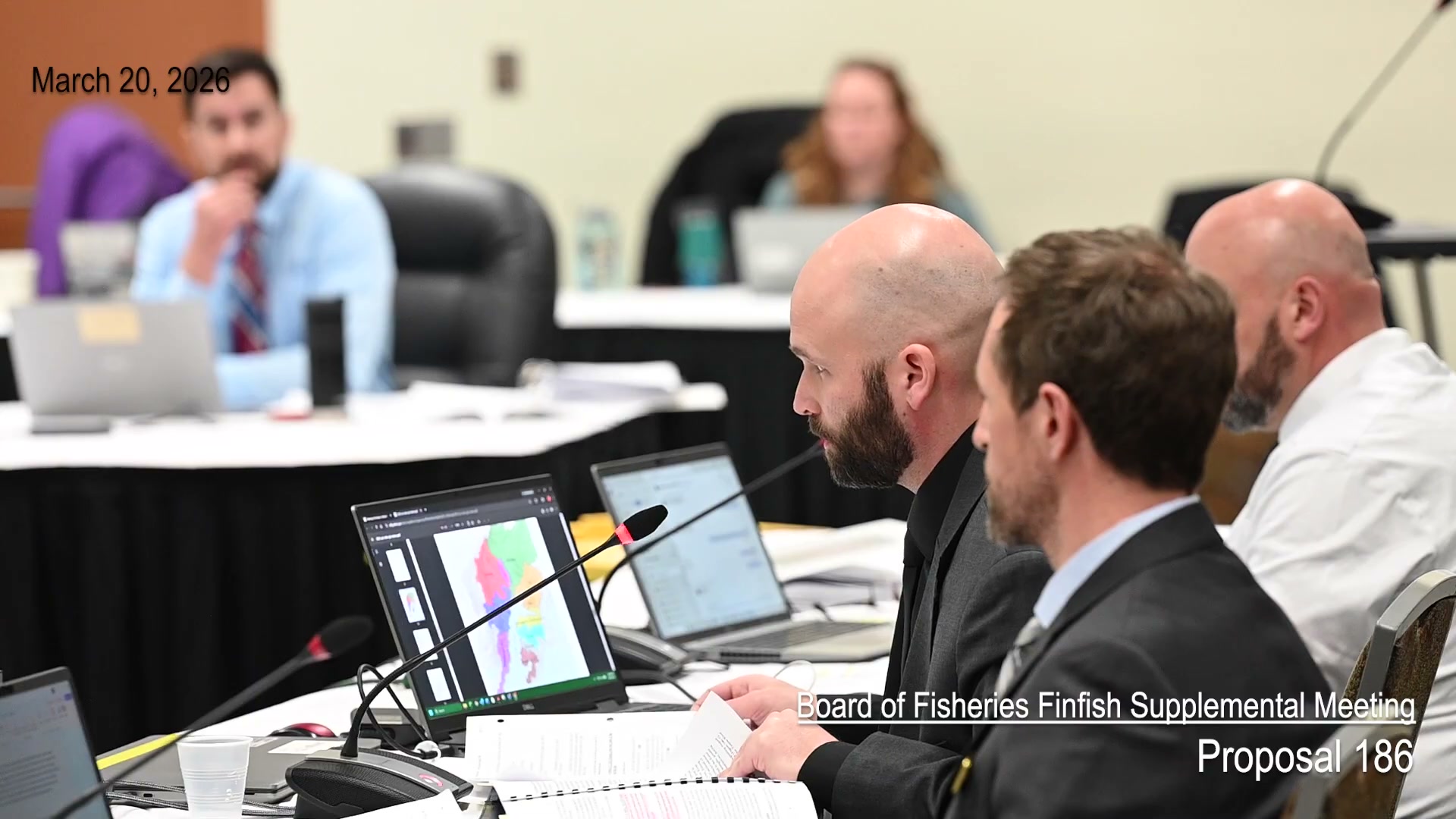
Frame from "Alaska Board of Fisheries Finfish Supplemental Meeting on March 20, 2026 - Proposal 186 Deliberation" · Source
Board restricts Cook Inlet drift gillnet fishery to protect coho salmon
The Alaska Board of Fisheries voted Friday to sharply restrict the Cook Inlet drift gillnet fishery to protect northern Cook Inlet coho salmon populations that have failed to meet escapement goals for years.
The board approved substitute language 4-2 that limits drift gillnet fishing to expanded Kenai and Kasilof sections only, establishes Monday and Thursday fishing windows of 12 hours each, and creates a 2-mile buffer from the Kenai Peninsula shoreline. The changes eliminate Area 2 from state waters and restrict additional fishing time to runs exceeding 2.3 million sockeye salmon in the Kenai River.
The limited entry fishery has approximately 355 participants and has documented bycatch impacts on marine mammals including beluga whales, harbor seals, Dall's porpoise, harbor porpoise, and Steller sea lions.
Federal fishery management for commercial salmon fishing in the Cook Inlet exclusive economic zone was established in 2023, affecting the drift gillnet fishery and closing a portion of historically used fishing area while allowing continued operation in state waters.
Conservation concerns drive action
The Deshka River has not met its coho escapement goal in six years, and the Little Susitna River has missed its goal for three years, despite sport fishery closures in those systems. New genetics data revealed that 90 percent of coho caught by the drift fleet are northern-bound fish, undermining the effectiveness of conservation corridors that managers had relied on to pass fish north.
A board member said the problem is Northern Cook Inlet coho numbers have declined with increased use of Central District drift gillnet fishery to harvest large runs of Kenai and Kasilof sockeye in recent years. Coho escapement goals are not being achieved despite significant sport fishery restrictions and closures in area rivers.
The commercial drift fleet caught between 85,000 and 88,000 coho in 2024 while harvesting a record 3.5 million sockeye salmon worth $30 million in ex-vessel value, double the 10-year average.
A board member said in this last year, the Cook Inlet drifters caught 87,000 coho. Drifters had their best year in 30 years with catching 3.5 million reds.
Colton Lipka, the Upper Cook Inlet Regional Management Coordinator for Commercial Fisheries, said the department has concerns about consistently achieving coho escapement goals and has managed all fisheries conservatively to allow passage of coho to northern Cook Inlet drainages. He said increased drift gillnet fishing opportunity in years with large Kenai and Kasilof sockeye runs makes coho conservation efforts harder.
Patrick Fowler, the sportfish management coordinator for Cook Inlet, characterized coho abundance in northern Cook Inlet as below average. Fish Creek met its escapement goal in two of the last three years, and McRoberts Creek met its goal in each of the last three years, but overall abundance remains below historical levels.
This article was drafted with AI assistance and reviewed by editors before publishing. Every claim can be verified against the original transcript. If you spot an error, let us know.
Related Coverage
Board Restricts Fishing Gear to Protect Chinook in Chignik, Area M
Alaska News · 3d ago · 2 views · 86% match
Board Cuts Area M June Salmon Fishing Time 30% to Protect Yukon-Bound Chum
Alaska News · 3d ago · 2 views · 84% match
Alaska Board Rejects 25% Hatchery Production Cut After Heated Debate
Alaska News · 4d ago · 1 views · 80% match
Board Chair Survives Ethics Challenge Over Village Corporation Ties
Alaska News · 2d ago · 4 views · 78% match
Board of Fisheries Opens Statewide Meeting With Stock Concern Action Plans
Alaska News · 3d ago · 2 views · 77% match
Comments
Sign in to leave a comment.
No comments yet. Be the first to share your thoughts.