
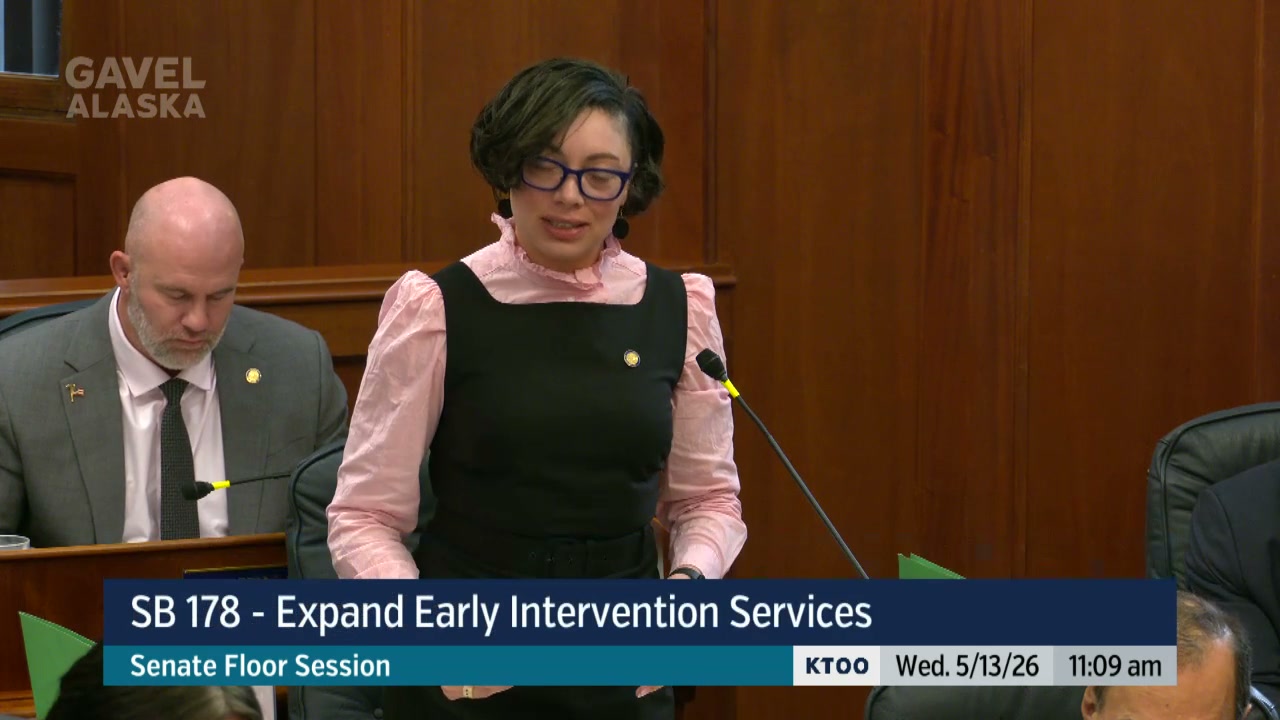
Frame from "SFLR-20260513-1100" · Source
Alaska Senate passes bill to expand early intervention for delayed children
The Alaska Senate voted 20-0 Wednesday to expand access to early intervention services for young children with developmental delays, lowering the eligibility threshold from 50 percent to 25 percent.
Senate Bill 178 changes the criteria for Alaska's Infant Learning Program, which provides therapy services for children from birth to age 3. The bill aligns the state's early intervention standards with federal special education requirements, which already use the 25 percent threshold for school-age children.
Senator Loki Tobin, who co-chairs the Alaska Children's Caucus, called the bill a top priority. "Right now, the state has an eligibility criteria that sets the developmental delay from 0 to 3 at 50 percent," Tobin said. "That means a family has to see their child struggling until it hits a certain threshold before they are eligible for services."
Tobin said early intervention reduces the need for more intensive services later. She cited research showing the state saves $2.05 to $17.07 for every dollar spent on early intervention.
"By providing these early intervention services, often to infants, we are saving approximately $2.05 to $17.07 for every dollar spent on interventions," Tobin said. "We know that 46 percent of children who exit the Infant Learning Program at age 3 do not require special education services when they reach kindergarten."
That translates to an average savings of $229,071 per child over the course of their K-12 education, Tobin said. The estimated potential savings statewide is $38.9 million annually.
The bill will take two to three years to fully implement, and the state will break even on its investment in seven to 10 years, according to Tobin.
Alaska currently has the most restrictive eligibility criteria in the nation for early intervention services. The 25 percent threshold brings the state in line with other states that follow evidence-based practices, Tobin said.
"Many of Alaska's most vulnerable and at-risk children are ineligible and precluded from accessing services due to the stringent eligibility criteria that has long been established by the state," Tobin said. "Expanding eligibility access will ensure our state's most vulnerable children have access to essential developmental services."
Tobin urged members to support the bill. "It helps struggling families and it serves vulnerable children," she said.
Senate President Gary Stevens announced the vote: "20 Yeas, 0 nays. And so by a vote of 20 yeas, 0 nays, CS for Senate Bill 178 Finance has passed the Senate."
Following passage, the Senate adopted the bill's effective date clause by unanimous consent.
This article was drafted with AI assistance and reviewed by editors before publishing. Every claim can be verified against the original transcript. If you spot an error, let us know.
Related Coverage
Alaska House committee advances bill to expand early intervention eligibility
Alaska News · 1mo ago · 17 views · 91% match
Brain science experts brief legislators on early childhood development
Alaska News · 2w ago · 5 views · 80% match
State seeks proposals for new early intervention funding formula
Alaska News · 2d ago · 2 views · 79% match
Senate Passes $2.47B Capital Budget Focused on School Repairs
Alaska News · 1w ago · 1 views · 78% match
State seeks vision specialists for early intervention program statewide
Alaska News · 1w ago · 1 views · 78% match
Comments
Sign in to leave a comment.
No comments yet. Be the first to share your thoughts.