
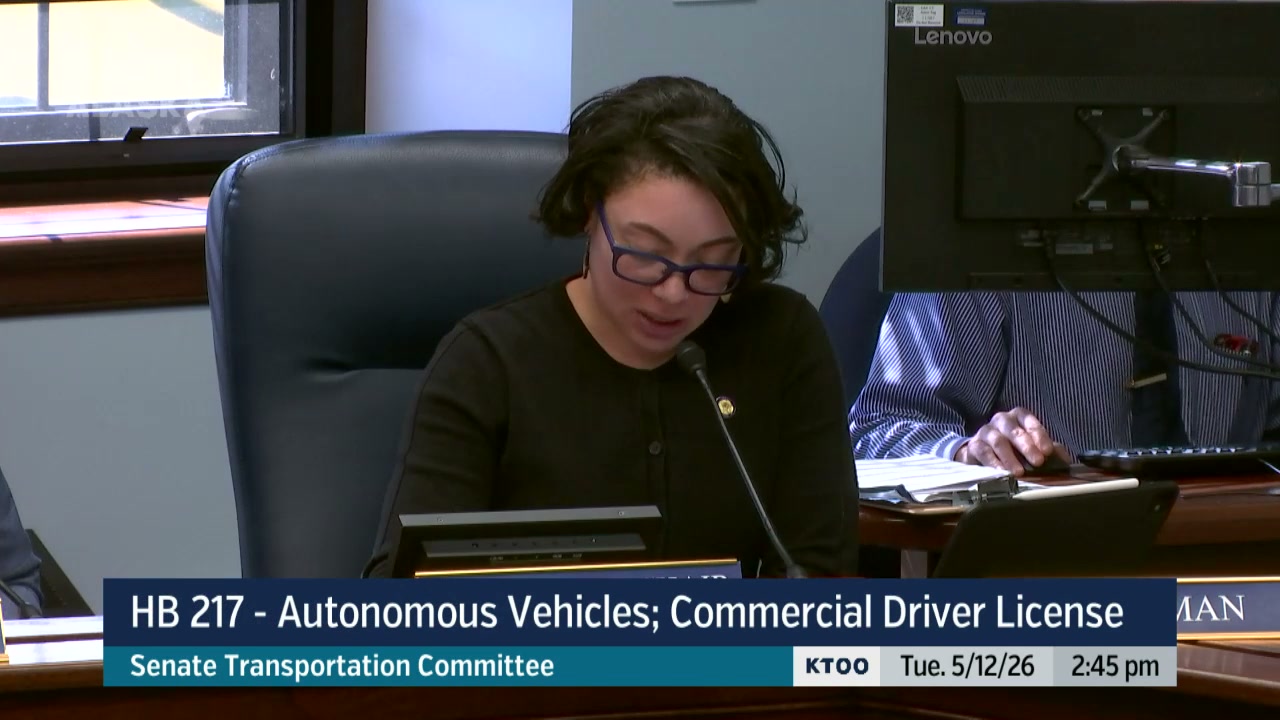
Frame from "STRA-260512-1330" · Source
Alaska Senate panel advances autonomous vehicle restrictions despite industry opposition
The Alaska Senate Transportation Committee advanced a bill Tuesday requiring human safety operators in commercial autonomous vehicles, despite strong opposition from technology industry representatives who warned the measure would make Alaska a national outlier.
The committee substitute for House Bill 217 prohibits autonomous vehicles registered in Alaska from transporting commerce or goods unless the transport is for personal, non-commercial use, has a gross weight of 10,000 pounds or less, and is designed to transport not more than 16 passengers, including the driver. Commercial autonomous vehicles over that weight must have a human safety operator physically present who can monitor and intervene in the vehicle's performance. The bill also establishes accident liability rules, presuming the human safety operator liable unless clear evidence points to software, hardware, or modifications as the cause.
The bill now moves to the Senate State Affairs Committee, though no hearing date was announced.
Representative Ashley Carrick, chair of the House Transportation Committee and the bill's sponsor, defended the measure as a reasonable guardrail for Alaska's unique conditions during the committee's second hearing on the legislation. "Our weather and road conditions can change at a moment's notice, and autonomous vehicles may be able to function with little to no issue in states like California, but Alaska does look different," Carrick said. She emphasized the bill would keep road users safe and help preserve jobs in Alaska's trucking industry.
Carrick also clarified that the current committee substitute covers personally owned autonomous vehicles. "The current draft of this bill would require the person to be present as a human safety operator," she said, using the example of someone sending their Tesla to the grocery store without being in the vehicle.
Griffin Sukeo, staff to Representative Carrick, explained the committee substitute's key provisions to the Senate panel. "An autonomous vehicle registered in the state may not engage in the transport of commerce or goods unless the transport is for personal, non-commercial use and has a gross weight of 10,000 pounds or less and is designed to transport not more than 16 passengers, including the driver," Sukeo said.
The bill drew testimony from multiple technology industry representatives who warned that Alaska would become a national outlier if the measure becomes law. Blake Calvert, public affairs manager at Kodiak AI, an autonomous trucking developer, told the committee the restrictions would effectively ban the technology.
"HB 217, which, as previously noted, would make Alaska the first and only state in the country to ban autonomous trucks," Calvert said.
Calvert pointed to workforce challenges in Alaska's trucking industry as a reason to allow autonomous vehicle development. "According to the Alaska Trucking Association's 2025 Fast Facts, the qualified driver shortage in Alaska was the number 2 issue facing the trucking industry in the state," he said.
This article was drafted with AI assistance and reviewed by editors before publishing. Every claim can be verified against the original transcript. If you spot an error, let us know.
Related Coverage
Alaska bill would require human operators in autonomous freight trucks
Alaska News · 1w ago · 2 views · 93% match
Alaska Senate panel hears bill requiring human operators in commercial autonomous vehicles
Alaska News · 2w ago · 2 views · 92% match
Alaska considers ban on driverless commercial trucks amid safety debate
Alaska News · 3w ago · 14 views · 92% match
Senate panel hears autonomous vehicle bill requiring human operators
Alaska News · 2w ago · 2 views · 90% match
House advances bills on autonomous vehicles, nurse training, interior design
Alaska News · 1w ago · 5 views · 80% match
Comments
Sign in to leave a comment.
No comments yet. Be the first to share your thoughts.