
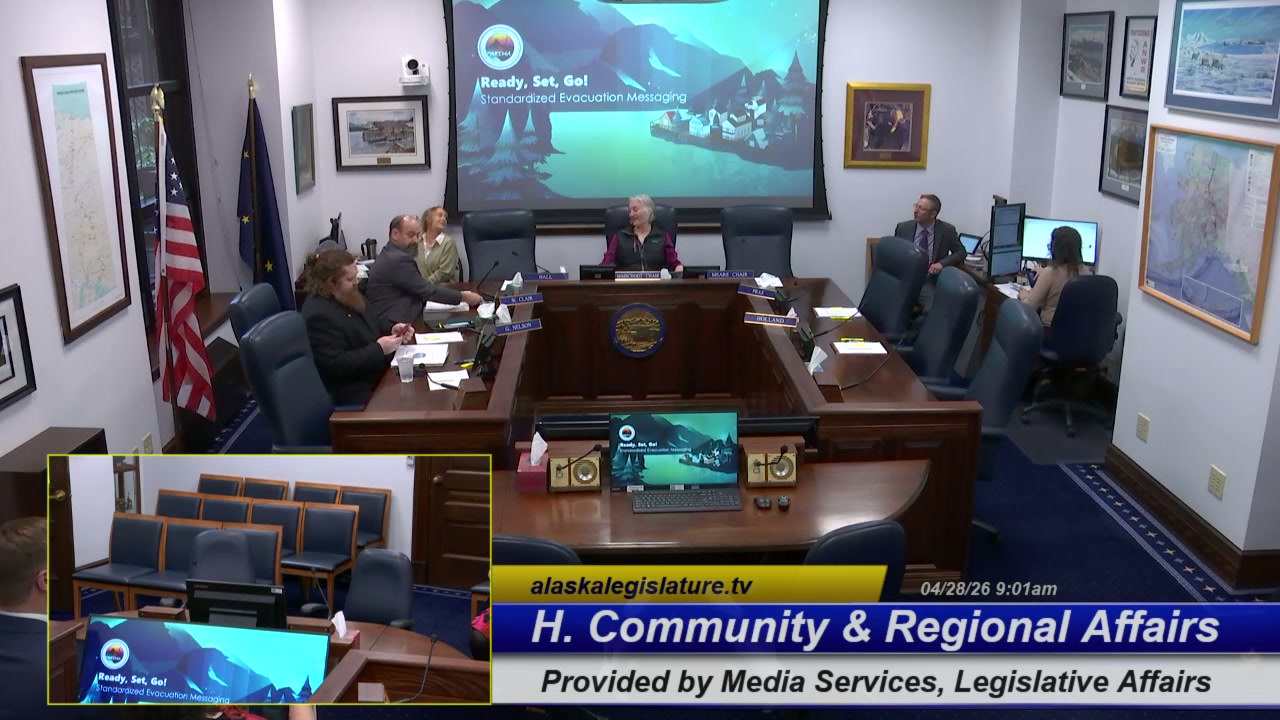
Frame from "House Community & Regional Affairs, 4/28/26, 8am" · Source
Alaska moves to standardize wildfire evacuation alerts statewide
The Alaska House Community and Regional Affairs Committee heard testimony Tuesday on legislation to establish uniform evacuation alert levels statewide. Emergency managers say the bill addresses confusion that arose during the 2022 Clear Fire, when inconsistent color codes left residents uncertain about danger zones.
Senate Bill 192 would codify a three-tier system already informally adopted across Alaska: Level 1 Ready (green), Level 2 Set (yellow), and Level 3 Go (red). The bill applies to all hazards under the Alaska Disaster Act, including wildfires, floods, tsunamis, and landslides. The Republican-sponsored measure was read a third time in the Senate on April 24, 2026, and is now advancing through the House.
A committee member said Senate Bill 192 was introduced at the request of emergency managers across the state. The system is already in place, and emergency managers want to codify it so Alaska has a standardized system for the future.
The 2022 Clear Fire highlighted the need for standardization when operational maps showed green areas next to red fire perimeters. The public could not tell which zones were closed or evacuated. Since then, emergency response agencies including the Alaska Emergency Managers Association, Alaska Fire Chiefs Association, and the state Division of Forestry have informally aligned on red designations for closed areas. The Kenai Peninsula Borough formally adopted the system by resolution four years ago.
Brenda Ahlberg, emergency manager for the Kenai Peninsula Borough and spokesperson for the Alaska Emergency Managers Association, walked the committee through the three-tier framework. Level 1 Ready asks residents to prepare evacuation plans and supplies. Level 2 Set signals that residents with mobility challenges, livestock, or recreational vehicles should begin evacuating, as should those in areas with limited escape routes.
Ahlberg said Level 2 Set indicates that people have an opportunity now to evacuate if they have mobility challenges, livestock, recreational vehicles, or other large personal items that need more time to leave. That also applies to long-distance escape routes or limited escape routes in a neighborhood.
Level 3 Go means immediate evacuation with no time for packing.
Ahlberg said the system is modeled after the International Association of Fire Chiefs and has been adopted across the Pacific Northwest. Before the Kenai Peninsula Borough created its local program, she evaluated California, Oregon, Washington, and Idaho.
Several committee members asked how the system would apply beyond wildfire season. Ahlberg confirmed the bill covers all hazards and emphasized the importance of building relationships with community leaders during non-emergency periods, particularly in rural areas where internet access is limited.
This article was drafted with AI assistance and reviewed by editors before publishing. Every claim can be verified against the original transcript. If you spot an error, let us know.
Related Coverage
Senate Resources advances three bills on agriculture, evacuations, invasive species
Alaska News · 3d ago · 1 views · 79% match
House committee advances bill recognizing dispatchers as first responders
Alaska News · 2w ago · 2 views · 77% match
House committee hears bill to reclassify emergency dispatchers as first responders
Alaska News · 2d ago · 1 views · 76% match
Wildlife refuge bill faces pushback over jet ski ban, firearm restrictions
Alaska News · 2w ago · 9 views · 75% match
House committee hears bill to reclassify emergency dispatchers as first responders
Alaska News · 2d ago · 1 views · 75% match
Comments
Sign in to leave a comment.
No comments yet. Be the first to share your thoughts.