
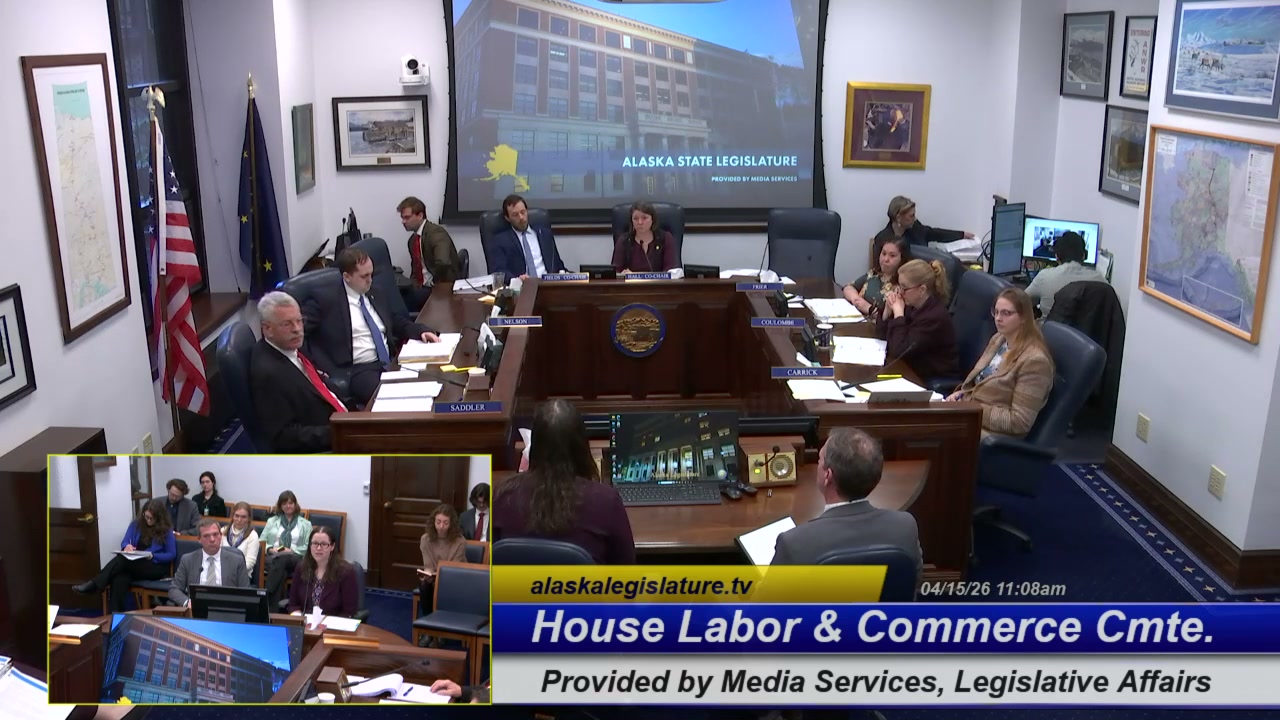
House committee hears bill to reclassify emergency dispatchers as first responders
The Alaska House Labor and Commerce Committee heard testimony Tuesday on legislation that would reclassify emergency dispatchers as first responders and allow them to retire after 20 years of service instead of 30.
House Bill 234 would move emergency dispatchers who work for police and fire departments and state trooper offices into the same retirement category as peace officers and firefighters under the Public Employees' Retirement System. The change would affect a relatively small number of state employees. Anchorage has the largest cluster with 10. But supporters say the reclassification addresses severe mental health challenges unique to the profession.
"Today, our emergency dispatchers are highly trained to provide critical pre-arrival instructions to individuals experiencing often traumatic events," Representative Carolyn Hall told the committee. "They deliver life-saving instructions before other first responders arrive, quickly calm people experiencing the worst day of their lives, obtain an accurate address and critical details, give instructions, and coordinate emergency responders within a few minutes of receiving that call."
The bill would also define emergency medical dispatchers as first responders trained as public safety communicators. That designation would open dispatch centers to federal SAFER grants and additional training funding.
Shane Westcott with the Alaska Professional Firefighters told the committee that dispatchers face unique trauma because they lack the closure that comes with in-person emergency response. "When I go to a patient, I get to see the patient. I have an in-person interaction with that person. I get to bring them to the hospital and pass them on to a continuation of care," Westcott said. "What these dispatchers go through when they answer a phone, when someone's screaming in their ear calling for help and needing assistance, answering that call and dealing with it and getting the appropriate resources to them in a few moments, coaching them through CPR or coaching them through this catastrophic event that they're going through, to then hang up the phone and take the next call, there is no closure."
Westcott said the lack of closure causes long-term PTSD effects that justify earlier retirement eligibility.
For Tier 3 members of the retirement system, the bill would raise employee contributions from 6.75 percent to 7.5 percent and adjust pension calculations from a highest five-year average to a highest three-year average. For Tier 4 members in the defined contribution plan, employee contribution rates would not change, but dispatchers would become exempt from early withdrawal penalties at age 50 or after 25 years of service. The most notable change for Tier 4 members would be access to medical coverage at any age after 25 years of service, instead of needing to reach age 65 with 10 years of service or fulfill 30 years of service.
This article was drafted with AI assistance and reviewed by editors before publishing. Every claim can be verified against the original transcript. If you spot an error, let us know.
Related Coverage
House committee hears bill to reclassify emergency dispatchers as first responders
Alaska News · 2h ago · 1 views · 99% match
House committee advances bill recognizing dispatchers as first responders
Alaska News · 1w ago · 2 views · 93% match
Alaska lawmakers urge federal reclassification of 911 dispatchers
Alaska News · 1d ago · 1 views · 90% match
Senate Committee Hears Testimony on Nurse Licensure Compact Bill
Alaska News · 2w ago · 2 views · 77% match
Senate Finance hears bill expanding civil rights protections to nonprofits
Alaska News · 14h ago · 1 views · 77% match
Comments
Sign in to leave a comment.
No comments yet. Be the first to share your thoughts.