
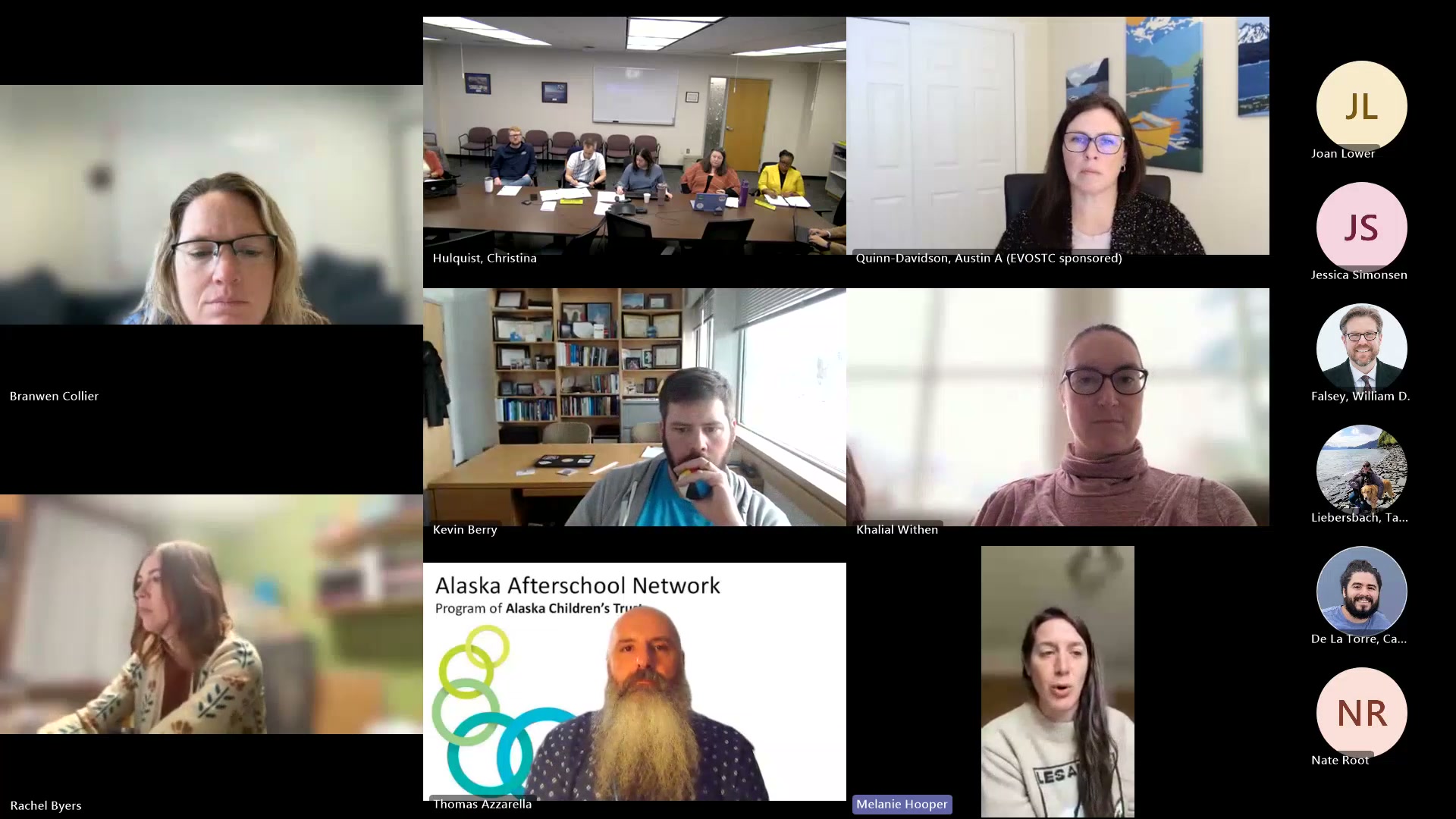
Frame from "ACCEE Fund Board Meeting 2026-04-15 Meeting Recording" · Source
ACCEE Fund faces $2M budget gap as revenue projections drop for 2027
The Anchorage Child Care and Early Education Fund Board learned Tuesday that projected revenue for 2027 has dropped to $5.2 million, down from the $7 million the board budgeted for 2026.
The $2 million gap corresponds to an Anchorage School District grant the fund has absorbed for the past two years. Board members are awaiting a decision from the mayor's office on whether that grant will remain in the ACCEE Fund or move back to the Alcohol Tax Fund. That decision will determine whether the board can continue funding all current childcare programs.
"We do know we have reduced funds going into 2027 from what our projections were initially," a staff member told the board. "So keeping the projections of what 2026 was, we're looking at $5.2 million. I think we built a budget around $7 million going into 2026."
The staff member described the ASD grant as "the elephant in the room" and said the $2 million shortfall "could make or break whether or not we do all those other programs."
The board chair said the fund was able to absorb the ASD grant for the past two years because of unspent dollars from prior years and higher than expected revenue. Those reserves have now been depleted.
"We were able to absorb ASC for the past 2 years," the chair said. "So again, historically, remember we had that 1 year of funding from '24 rolling to '25. And then we also had other years with unspent dollars."
The chair said the board will ask the mayor for clarity when she attends the May meeting, but predicted the board may not receive a definitive answer. The board plans to develop dual budget scenarios for 2027, one that includes ASD funding and one that does not.
Melanie Hooper, president and CEO of Campfire Alaska, told the board the funding uncertainty affects program sustainability and parent fees. "Our parent fees only cover about 70% of the actual cost to deliver program," Hooper said. "And one of the things actually that was really significant this year is in our budget season in November and December, we were able to make a decision to hold parent fees down from an increase for the first time in 5 years because we could plan on year 2 of the ACE funds operating grants."
Hooper said new programs take years to reach sustainable enrollment levels. "Every time we open a new program, it's taking approximately 4 years to build to a sustainable enrollment where the enrollment is at a level where it can self-sustain and cover the direct operating costs of that program," she said.
She also described an affordability gap for middle income families. "What we're hearing from families on surveys and just direct feedback to us is the middle is getting squeezed out of affordable care," Hooper said. "So if you meet the child care assistance and you're able to navigate that very complex process for families, you have some supports and subsidies. And if you are high income households, you can afford it, but the middle is really where we're seeing, I think, the gap in service."
This article was drafted with AI assistance and reviewed by editors before publishing. Every claim can be verified against the original transcript. If you spot an error, let us know.
Related Coverage
House panel questions education fund proposal with no guaranteed revenue
Alaska News · 1d ago · 1 views · 75% match
House panel debates $113M education funding formula shift
Alaska News · 2d ago · 2 views · 73% match
Borough Assembly Questions Property Tax Cap as Assessments Rise
Alaska News · 18m ago · 73% match
House Finance considers multi-year school funding averaging bill
Alaska News · 1d ago · 1 views · 73% match
Mayors Oppose Alaska LNG Tax Bill, Cite Revenue Concerns
Alaska News · 2w ago · 4 views · 73% match
Comments
Sign in to leave a comment.
No comments yet. Be the first to share your thoughts.