State Defends Transboundary Mining Oversight as Stakeholders Demand Stronger Protections
by Alaska NewsMay 8, 2026(8h ago)5 min read3 viewsJuneau
Share
Alaska Department of Fish and Game Commissioner Doug Vincent-Lang told the House State Affairs Committee that water quality monitoring programs have not detected signs of British Columbia mining projects impacting transboundary waters in the United States.
The testimony came during a presentation on transboundary mining requested by Vice Chair Story. The issue centers on mining development in British Columbia watersheds that flow into Southeast Alaska, including the Taku, Stikine, Unuk, and Alsek rivers.
Alaska News previously reported that the U.S. State Department and EPA held consultations in Southeast Alaska on transboundary mine threats in 2016. Alaska state leaders pressed Secretary of State Rex Tillerson in 2017 to urge Canada to protect Southeast Alaska fisheries from upstream pollution. In 2023, Southeast Alaska legislators again urged federal intervention after meeting with B.C. officials.
Vincent-Lang said the state and British Columbia established a bilateral working group in 2015 under the Walker administration that continues under Governor Dunleavy. The group meets twice yearly at the commissioner level, with monthly staff meetings to share information on specific projects.
"DC and BC water quality monitoring programs to date have not detected any sign of BC mining projects impacting transboundary waters in the United States," Vincent-Lang said. "In fact, DC reviewed more than 15,000 data points on the Taku River this year and was unable to detect a signature that certain pollutants were present above natural conditions."
The commissioner said British Columbia has adopted bonding requirements mirroring Alaska's after state pressure. Steve Buckley, chief of the Mining Section at the Department of Natural Resources, said Alaska holds over $1 billion in bonds for state mining operations and that British Columbia now operates under similar reclamation standards.
Vincent-Lang cited a mine failure at Eagle Mine in the Upper Yukon last year where Canadian officials took control within two days using the new bonding requirements.
But stakeholders painted a different picture of state engagement.
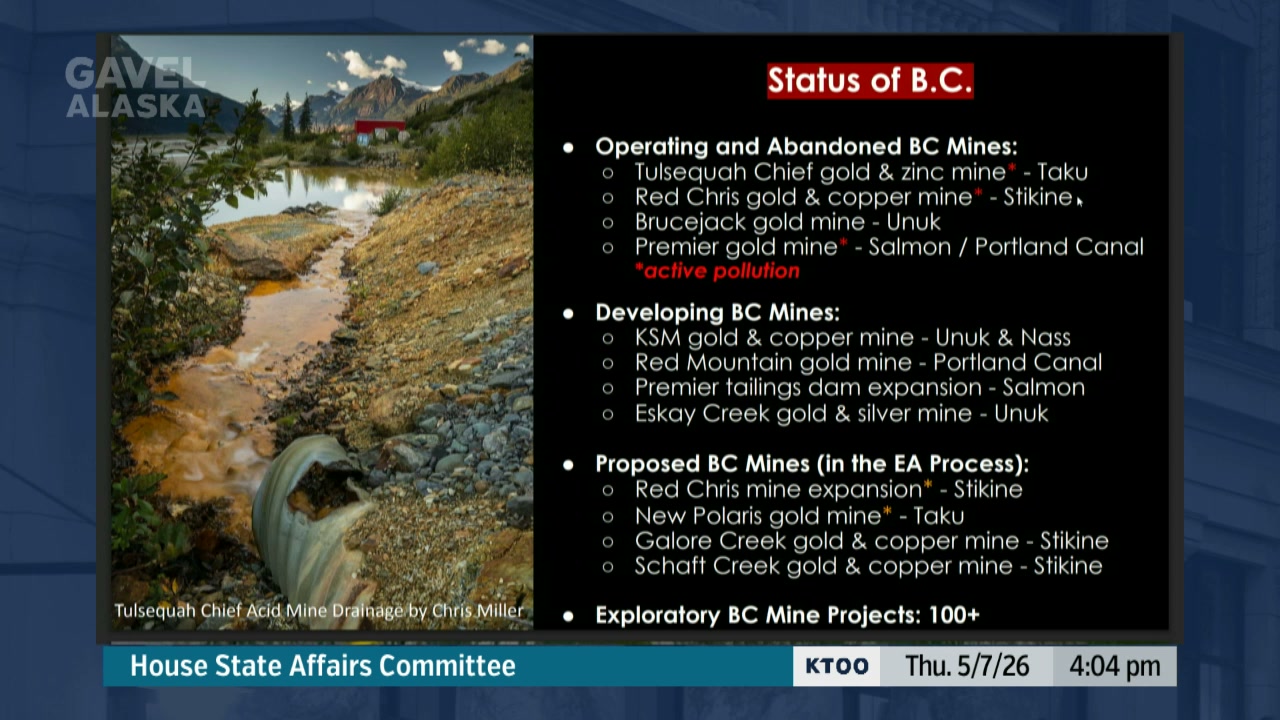
Brianna Walker, director of Salmon Beyond Borders, said the Dunleavy administration has largely been publicly silent about British Columbia's mining boom upstream. She said three large-scale B.C. mines with earthen tailings dams are currently operating along transboundary rivers.
Walker said pollution events have occurred on the B.C. side of the border at the Red Chris Mine in the Stikine and the Premier Mine in the Salmon River, along with the abandoned Tulsequah Chief Mine. The Premier Mine, less than 20 miles from the Alaska border, has a permit that allows it to discharge contaminants above allowable levels indefinitely, she said.
This article was drafted with AI assistance and reviewed by editors before publishing. Every claim can be verified against the original transcript. If you spot an error, let us know.
"The pollution events that I am referencing occurred on the B.C. side of the border," Walker said, clarifying that state officials were speaking to samples taken on the U.S. side.
Walker said British Columbia Premier David Eby announced plans last week to fast-track permitting for six transboundary mining projects. She criticized the state for not submitting formal public comments on proposed B.C. mine projects and for inadequate tribal consultation.
Paulette Moreno, sixth vice president of the Central Council of Tlingit and Haida Indian Tribes of Alaska, said engagement with British Columbia is limited and the state does not consistently submit technical comments on major projects.
"If the Dunleavy administration is going to say that it has it under control, it must demonstrate through action, transparency, and partnership with tribes," Moreno said. "Right now, it is not."
Dr. David Chambers of the Center for Science and Public Participation said the 2015 Memorandum of Understanding between Alaska and British Columbia has proved ineffective from a practical perspective. He said the Alaska Department of Natural Resources does not commit the personnel and financial resources necessary to actively participate in cooperating agency meetings where mine design and environmental reviews are discussed.
"If you are not in those agency meetings to participate in the discussions of project alternatives and to propose and defend changes to those alternatives, there is very little chance of influencing or changing the decisions that come from those meetings," Chambers said.
Brian Lynch, representing Rivers Without Borders and a retired Alaska Department of Fish and Game biologist, urged the state to use the Pacific Salmon Treaty process to address transboundary mining threats. He said the Pacific Salmon Commission should add transboundary mining discussions to its annual meetings because the commission has jurisdiction over salmon stocks in these rivers.
Lynch highlighted the Kerr-Sulphurets-Mitchell mine project in the Unuk River watershed, which he said would produce approximately 1,400 metric tons of overburden and tailings waste for every metric ton of metal extracted. The cumulative waste over the mine's life could reach between 4.5 and 5 billion metric tons, he said.
Linda Behnken, executive director of Alaska Longline Fishermen's Association, said her organization's members depend on transboundary rivers that support all five species of Pacific salmon. According to Behnken's testimony, commercial fisheries generate over $800 million in annual economic impact in Southeast Alaska and support up to 15 percent of regional employment.
"To our knowledge, no state agency under Governor Dunleavy has submitted any public comments on any proposed BC mine along Alaska's BC shared rivers," Behnken said.
The long-delayed cleanup of the Tulsequah Chief Mine emerged as a focal point. Vincent-Lang said the abandoned mine has been a sore point in every meeting with Canadian officials, but court issues prevented action for years. Those issues have now been resolved, and officials plan a summer site visit to assess cleanup progress.
Vincent-Lang said he believes the issue is best handled between state and provincial levels rather than involving federal governments in Ottawa and Washington.
"I believe it is best handled between the state of Alaska and provincial levels because that is where the technical expertise is rather than getting this into Ottawa and D.C.," Vincent-Lang said. "I firmly believe that we have good working relationships with the Canadian government both in the Yukon as well as the British Columbia provinces and territory of Yukon."
His position contrasts with repeated calls by Alaska leaders, lawmakers, and tribes for U.S. federal involvement. Most recently, Tlingit and Haida applauded U.S. Senators Lisa Murkowski and Dan Sullivan's letter to federal officials on transboundary mining and called for enforceable treaty protections and Indigenous participation in oversight.
The Department of Fish and Game received a three-year, $318,000 grant from the Environmental Protection Agency this fiscal year to support aquatic biomonitoring on four major transboundary river systems. The project will document existing environmental conditions and generate baseline datasets for comparison.
Over 20 percent of the transboundary watersheds are currently staked with Canadian mining claims, according to testimony. British Columbia is incentivizing over 100 mine projects in the region, most of which are gold mines.
Chair Carrick summarized the hearing by noting that while state departments reported minimal current impacts, downstream concerns remain significant and questions persist about preparedness for a major accident.
Stakeholders called on the state to submit formal comments on B.C. mine projects, advocate for stronger safeguards and financial assurances, and support creation of a binding international agreement for transboundary salmon watersheds.
Stay informed. Support what matters.
Free, permanent access to local news you can verify. Subscribe to support Alaska News and go ad-free.

Comments
Sign in to leave a comment.
No comments yet. Be the first to share your thoughts.