
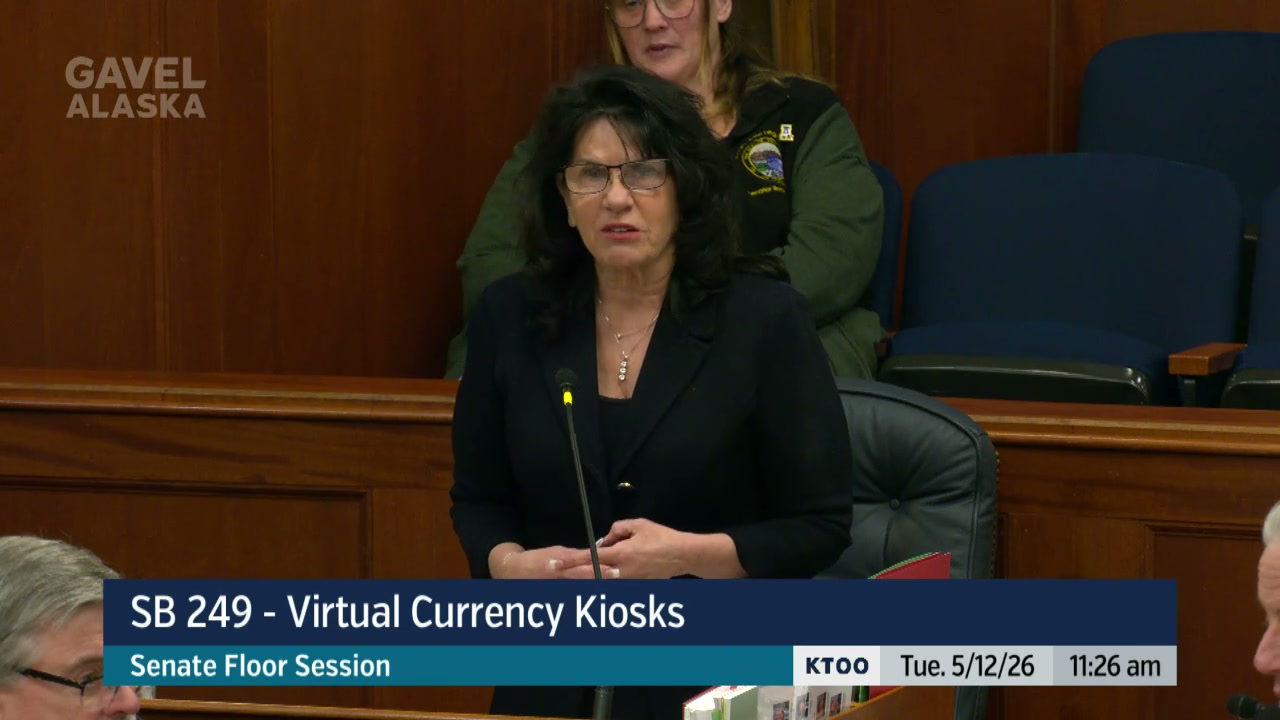
Frame from "SFLR-20260512-1100" · Source
Senate passes cryptocurrency kiosk consumer protection bill unanimously
The Alaska Senate voted 20-0 Tuesday to pass legislation requiring consumer protections for cryptocurrency kiosks after Alaskans lost more than $26 million to online fraud last year.
Senate Bill 249 requires kiosk operators to obtain money transmitter licenses, verify customer identification, and post fraud warnings. The bill sets a $1,500 daily transaction limit and a $10,500 monthly cap, figures that split the difference between industry requests and consumer advocacy groups. Seniors accounted for roughly one-third of fraud losses in 2024, according to testimony on the bill.
Senator Cathy Tilton carried the bill on the Senate floor and shared that her own mother lost a year's worth of house payments to an AI voice scam that directed her to a cryptocurrency kiosk. The scammer used artificial intelligence to mimic Tilton's voice, convincing her mother she was helping her daughter in an emergency.
Floor remarks in support of the bill noted that in 2024 alone, Alaskans lost more than $26 million to online fraud and that seniors have accounted for roughly a third of the losses. The virtual currency kiosk has become the scammers' favorite tool because the transactions are instant, irreversible, and largely untraceable.
The bill requires operators to obtain money transmitter licenses through the Department of Commerce, display conspicuous on-screen and posted notices about common scams, and verify government-issued photo identification. Violations would be treated as unfair or deceptive trade practices, the same standard applied to bank ATMs.
The transaction limits represent a compromise. AARP had pushed for a $1,000 daily cap, while kiosk operators sought $2,000. The $10,500 monthly limit matches the federal reporting threshold for money transmitters. Supporters noted that underbanked and unbanked Alaskans who legitimately use cryptocurrency kiosks typically conduct transactions of $400 to $500.
The bill also caps fees and requires operators to refund fees if a transaction is later determined to be fraudulent. Kiosks must use blockchain analytics to block known fraud patterns.
The Senate returned the bill to second reading to adopt a conforming amendment before final passage. Tilton offered the amendment to align the bill's definitions with Senate Bill 86, separate legislation addressing money transmission and virtual currency. The amendment ensures the two bills will not create conflicting definitions in state statute when they take effect.
Senator Scott Kawasaki spoke in support of the bill and asked to be shown as a co-sponsor on the floor.
Remarks in support of the bill emphasized that seniors have spent decades building their life savings and deserve the same financial guardrails in the digital age that every other sector has. The bill passed judiciary with strong bipartisan support. It has a zero fiscal note and protects Alaskans without killing innovation.
This article was drafted with AI assistance and reviewed by editors before publishing. Every claim can be verified against the original transcript. If you spot an error, let us know.
Related Coverage
Alaska House passes gold, silver legal tender bill unanimously
Alaska News · 6d ago · 11 views · 78% match
House committee hears bill to update Alaska commercial law for cryptocurrency
Alaska News · 2d ago · 3 views · 77% match
Alaska Senate passes bill to ease classic car import registration
Alaska News · 1w ago · 1 views · 77% match
Alaska House passes dementia training bill for nursing aides
Alaska News · 1w ago · 2 views · 77% match
House passes bill requiring transparency at psychiatric hospitals for minors
Alaska News · 1w ago · 2 views · 76% match
Comments
Sign in to leave a comment.
No comments yet. Be the first to share your thoughts.