
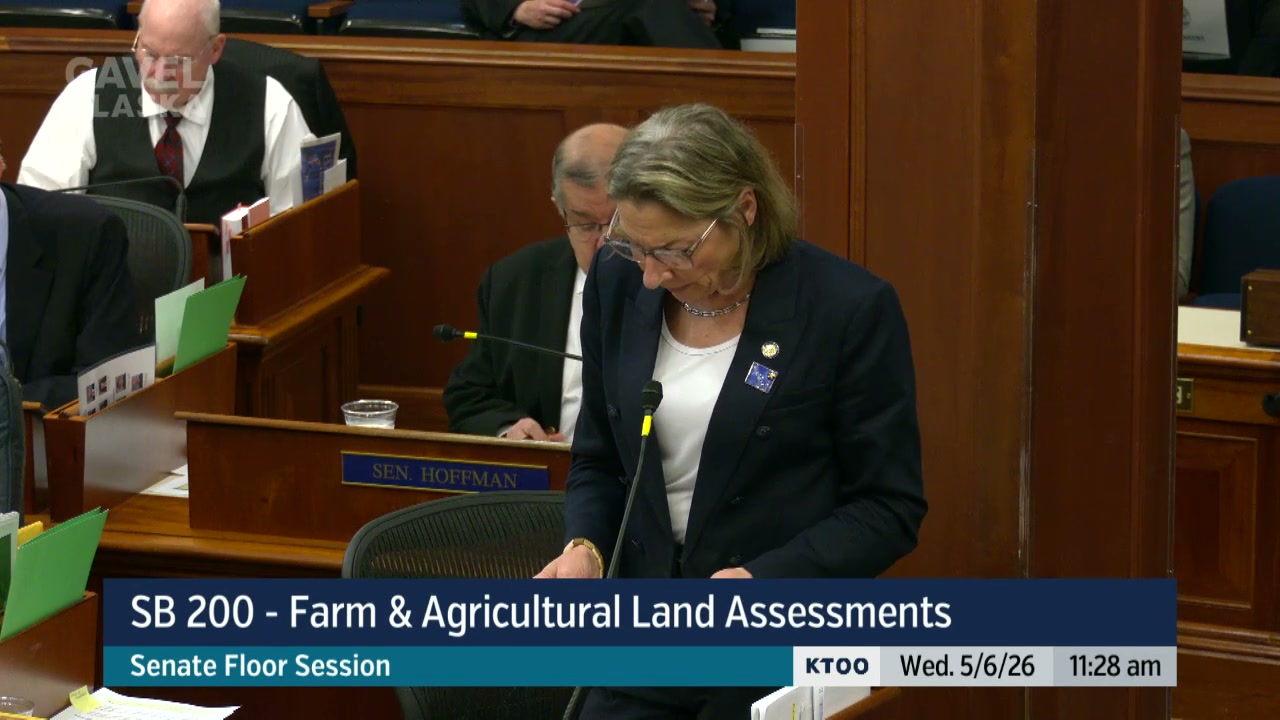
Frame from "SFLR-20260506-1100" · Source
Senate Passes Budget Balanced at $73 Oil, Rejects House's $320M Deficit Plan
The Alaska Senate adopted a Finance Committee substitute for the state operating budget Wednesday that balances at $73 per barrel oil with a $47.5 million surplus, setting up negotiations with the House over a plan that would require a $320 million draw from the Constitutional Budget Reserve.
The Senate Finance Committee substitute for House Bill 263 advanced to third reading with differences in education funding, dividend amounts, and energy relief that will be resolved in conference committee in the final weeks of the legislative session. The Senate's $73-per-barrel framework matches the oil price assumption the Senate used in 2023 when it balanced the fiscal year 2024 operating budget at the same price with an $84.2 million surplus.
"The Senate operating budget, when combined with spending agreements for the capital budget, balances the budget on a $73 a barrel oil, with $47.5 million left over for next year's supplemental," Senator Bert Hoffman said. "The other bodies' budget, when combined with spending agreements for the capital budget, has close to a $320 million deficit at $75 a barrel oil."
The Senate budget provides a $1,000 Permanent Fund Dividend plus $150 in energy relief payments, totaling $1,150 per Alaskan. The House had approved a $1,500 dividend with no separate energy payment. The Senate approach funds energy relief and community assistance while offering a smaller dividend and rejecting House social service additions.
"In the permanent fund, we have added a permanent fund dividend of $1,000 at a cost of $674 million," Hoffman said. "The House had $1,500."
"In addition to $1,000 the Permanent Fund Dividend we have added $150 in energy relief payments using FY26 revenues of $96 million," Hoffman said. "We have included $29.1 million in FY27 to go out to grants to school districts to help defray high fuel costs. We have doubled the FY27 base payment of $20 million for community assistance to assist communities across the state of Alaska with high costs of energy."
Education funding differs significantly between the two versions. The Senate used $111 million in fiscal year 2026 funds for one-time grants outside the Base Student Allocation formula, plus $29.1 million in fiscal year 2027 for school district energy relief grants, for a total of $140.1 million. The House had used $147.6 million in fiscal year 2027 funds for BSA grants and $10.9 million for public transportation, totaling $158.5 million.
"We added $29.1 million to school district grants for the purposes of energy relief," Hoffman said. "The House added $147.6 million of outstanding outside the formula for the BSA and $10.9 million for public transportation, totaling $158.5 million."
The Senate also doubled community assistance funding to help municipalities cope with high energy costs. "We have added $20 million from the general fund to make additional community assistance base payments in fiscal year 2025 with the intent of helping communities with higher cost of fuel and shipping," Hoffman said.
This article was drafted with AI assistance and reviewed by editors before publishing. Every claim can be verified against the original transcript. If you spot an error, let us know.
Comments
Sign in to leave a comment.
No comments yet. Be the first to share your thoughts.