
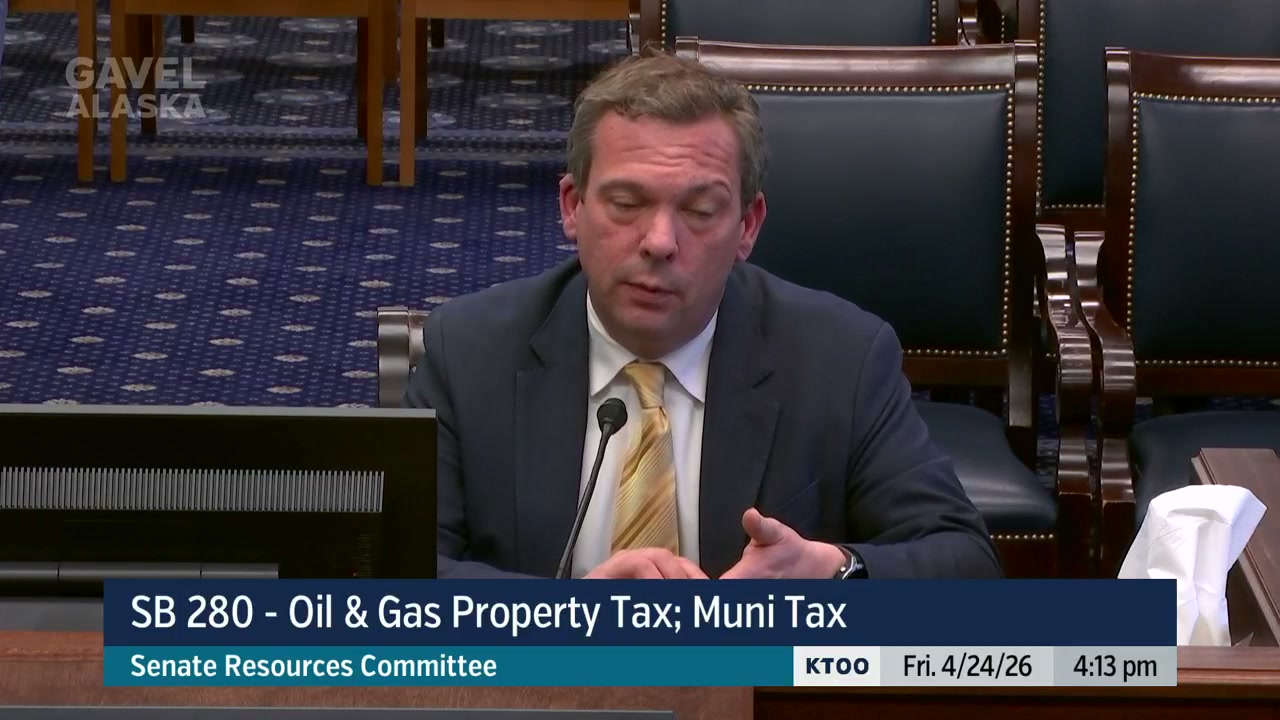
Frame from "Senate Resources Committee" · Source
Senate panel examines price controls, federal authority on gas pipeline
The Alaska Senate Resources Committee examined legal questions Friday about proposed price controls on natural gas and federal regulatory jurisdiction over a pipeline project, with lawmakers weighing whether legislative oversight could conflict with federal authority.
The Alaska LNG project has pursued a phased development approach to address the Cook Inlet energy crisis. Frank Richards, testifying on behalf of the project, explained that developers engaged with the Federal Energy Regulatory Commission about moving forward with authorizations and implementation plans for a phased approach to provide gas to Alaskans because of the Cook Inlet energy crisis. The Cook Inlet basin, which has supplied natural gas to Southcentral Alaska for decades, faces declining production from aging fields, creating supply concerns that have driven interest in bringing North Slope gas to the region. FERC approved the integrated Alaska LNG project in 2020 under its Section 3 authority for export facilities, treating the 807-mile pipeline and liquefaction plant as a single project designed for phased construction.
Federal law grants FERC authority over natural gas exports and interstate commerce, but the Natural Gas Act also preserves state authority in areas not directly conflicting with federal wholesale rate authority, according to committee counsel. State antitrust lawsuits targeting excessive retail rates are not preempted even when underlying conduct affects wholesale pricing. In April 2015, the U.S. Supreme Court affirmed by a 7-2 vote that state law antitrust claims are not preempted by the Natural Gas Act, establishing precedent for state regulatory authority in natural gas matters.
Committee counsel warned that price caps in the current committee substitute of Senate Bill 280 limiting utilities to charging no more than $12 per thousand cubic feet before an LNG export plant opens and $5 after it begins operation may conflict with federal authority over interstate commerce. The Federal Energy Regulatory Commission maintains jurisdiction over natural gas pricing under the Natural Gas Act, raising questions about whether state-imposed price controls would survive legal challenge.
The price targets originated from public statements by state officials about expected costs for Alaska consumers. Southcentral Alaska currently pays $10 to $13 per thousand cubic feet for natural gas. Phase 1 of the Alaska LNG project, a pipeline from the North Slope to Anchorage without the export facility, could increase costs to $16 to $18, representing a 60 percent to 80 percent price increase.
Richards said the price controls could discourage information sharing between the state and project developer Glenfarn. Reading the bill and seeing that there are price structures in place, it does not allow the market to respond, Richards said.
This article was drafted with AI assistance and reviewed by editors before publishing. Every claim can be verified against the original transcript. If you spot an error, let us know.
Comments
Sign in to leave a comment.
No comments yet. Be the first to share your thoughts.