AI-powered community news covering local government, public meetings, and community issues across Alaska.
Alaska
Senate Finance hears omnibus crime bill targeting AI child porn, raising age of consent | Alaska News
Senate Finance hears omnibus crime bill targeting AI child porn, raising age of consent
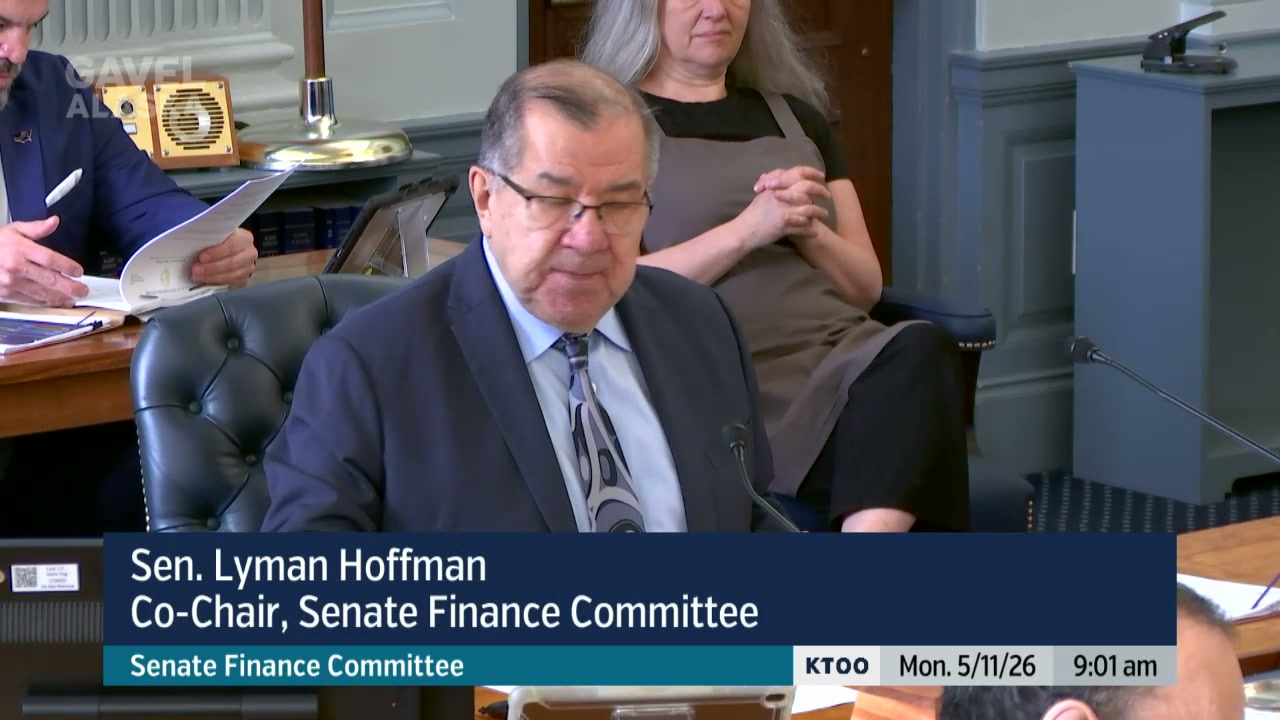
Frame from "Senate Finance, 5/11/26, 9am" · Source
PublishedAI
Senate Finance hears omnibus crime bill targeting AI child porn, raising age of consent
by Alaska NewsMay 12, 2026(2h ago)6 min readState Capitol, Juneau
Share
The Senate Finance Committee heard testimony Monday on an omnibus public safety bill that supporters said would close gaps in Alaska law by criminalizing AI-generated child sexual abuse material and raising the age of consent for sex crimes to 18.
Representative Chuck Kopp's House Bill 239 consolidates multiple crime bills into one package. The bill contains just over 80 amendments to current statutes. House Bill 101 and Senate Bill 247 account for roughly 73 percent of the bill's volume, according to testimony. House Bill 101 raises the protected age for child sex crimes from 16 to 18. Senate Bill 247 creates new felony offenses for AI-generated child sexual abuse material.
"Law enforcement has highlighted that you start with a real image and then you digitize it and you can create all kinds of things that play into the sexual addictions in this area that are hard to stop and hard to prosecute because our law does not address AI-generated distribution and possession," Kopp said.
The bill would raise the age threshold from 16 to 18 for over 24 criminal offenses, including sex trafficking, sexual abuse of a minor, and sexual assault. The change includes a close-in-age exception. Sixteen- and 17-year-olds would remain protected from offenders more than six years older, but the bill would not criminalize consensual sexual relationships between young people closer in age.
"We are not looking at trying to get kids in trouble for this. We are trying to protect them from predators," Kopp said in response to questions from Senator James Kaufman about the six-year age gap.
Kopp said the change closes what advocates describe as a sex trafficking loophole. Under current law, he said, a 17-year-old could legally consent to being trafficked for sex, leaving law enforcement unable to intervene. Most of the bill sections touching these offenses are conforming amendments to reflect the new protected status of young people under 18, Kopp told the committee.
The AI-generated child sexual abuse material provisions track Senate Bill 247, which passed the Senate Community and Regional Affairs Committee and was heard in Judiciary before being incorporated into the omnibus. Federal law already prohibits AI-generated CSAM, treating it the same as real CSAM without requiring the depicted minor to exist. Alaska is one of five states plus the District of Columbia without a state provision criminalizing AI-generated or computer-edited CSAM. The bill would align Alaska with 45 other states that have enacted such laws.
The bill also criminalizes the creation or distribution of forged digital likenesses and AI-generated sexual depictions without consent, including explicit images involving minors. It expands existing revenge porn statutes to include AI-generated content and classifies such distribution as a class A misdemeanor. The bill also ties the new AI-generated CSAM offenses to existing licensing consequences, including prohibitions for teaching certificates and school bus driver credentials.
This article was drafted with AI assistance and reviewed by editors before publishing. Every claim can be verified against the original transcript. If you spot an error, let us know.
Teresa Worble, director for policy and advocacy at the Alaska Children's Trust, told the committee that the National Center for Missing and Exploited Children received 4,700 reports of AI-related material in 2023. That number grew to 67,000 in 2024. In the first half of 2025 alone, the center received more than 400,000 such reports.
"These are not emerging threats on the horizon. They are happening now in our communities to our children," Worble said.
A 2024 case involving an Army soldier stationed at Joint Base Elmendorf-Richardson was prosecuted under federal law because Alaska lacked the legal framework.
Testimony raised concerns about the AI language. One participant cited FBI guidance and said that some AI images are illegal only when a real child is used. The participant asked whether lawmakers are more interested in putting people away rather than finding and protecting actual victims.
The legislation also includes rape kit reform, establishing a digital tracking system that allows victims to monitor where their kit is in the processing pipeline and what testing results show. It sets timelines for sexual assault response teams to process evidence, for law enforcement to submit evidence to labs, and for labs to complete testing.
Other provisions address hit-and-run fatalities, healthcare worker sexual assault, and mail theft. The bill would elevate failure to render aid in fatal accidents from a class B felony to a class A felony, raising the sentencing range from one to three years to two to four years for first-time offenders. The healthcare worker sexual assault provision makes it a crime for healthcare workers to engage in sexual penetration or sexual contact with a patient during professional treatment regardless of the victim's awareness, keeping such conduct in first-degree sexual assault territory. The omnibus also adds tribal victim counseling centers as authorized recipients of state and federal grants, criminalizes airbag fraud, allows record sealing for certain marijuana convictions, and authorizes the Commissioner of Corrections to release seriously or terminally ill prisoners to electronic monitoring if they pose no threat to the public and the release saves the state money. The bill also adds possession, viewing, or accessing of obscene material depicting sexual contact with animals as a new category of animal cruelty.
Kopp cautioned the committee that legislative legal staff had flagged a provision transferring the Controlled Substances Advisory Committee from the Department of Law to the Department of Commerce as a possible violation of the single-subject rule because it is an administrative transfer of housing an agency.
Senator Jesse Kiehl reviewed fiscal notes from multiple agencies. The Alaska Court System submitted a fiscal note showing a general fund cost of $369,200 and two permanent full-time positions. The Department of Administration's Public Defender Agency showed a cost of $536,000 for two permanent full-time positions. The Department of Law submitted fiscal notes totaling $441,800 in year one for Criminal Justice Litigation and $325,900 for Criminal Appeals and Special Litigation, both supporting additional attorney positions. The Department of Public Safety submitted multiple fiscal notes. Alaska State Troopers, the Bureau of Investigation, and Victim Services Admin and Support each submitted zero fiscal notes, indicating they could absorb the additional work with existing resources. The Criminal Justice Information Systems Program showed a cost of $144,400 in year one for one full-time position. Laboratory services showed $209,000 for one permanent full-time position related to sexual assault kit processing and tracking. The Department of Corrections submitted an indeterminate fiscal note, stating the bill would increase both the likelihood of incarceration and length of stay for certain offenders but providing no cost estimate.
The committee heard invited testimony from Jamie Ann Hesselquist, a victim-survivor who testified in support of provisions addressing healthcare worker sexual assault. Hesselquist described being assaulted by physical therapist Jeffrey Foltz, who was acquitted because Alaska law required that victims be unaware the assault was happening for it to qualify as sexual assault.
"Knowing that harmful things are happening to your body does not mean that you consent to them," Hesselquist said. "Awareness is not consent. Freezing is not consent. And trusting your healthcare provider is not consent."
Kelly Trent testified by phone about the death of her son Chase Bowersen, who was killed in a hit-and-run on the Glenn Highway in January 2021. The driver who killed him received a sentence of 2.5 years for criminally negligent homicide and leaving the scene, serving only a few weeks in jail after credit for time already served.
"Failure to render aid cannot go without consequences," Trent said. "Hitting a human being with a vehicle and then making the choice to leave them there and not call for help is horrendous."
Committee members asked no questions of Representative Kopp during the presentation. The committee set the bill aside for further consideration.
Stay informed. Support what matters.
Free, permanent access to local news you can verify. Subscribe to support Alaska News and go ad-free.

Comments
Sign in to leave a comment.
No comments yet. Be the first to share your thoughts.