AI-powered community news covering local government, public meetings, and community issues across Alaska.
Alaska
Senate Finance advances pension bill with municipal opt-in provision | Alaska News
Senate Finance advances pension bill with municipal opt-in provision
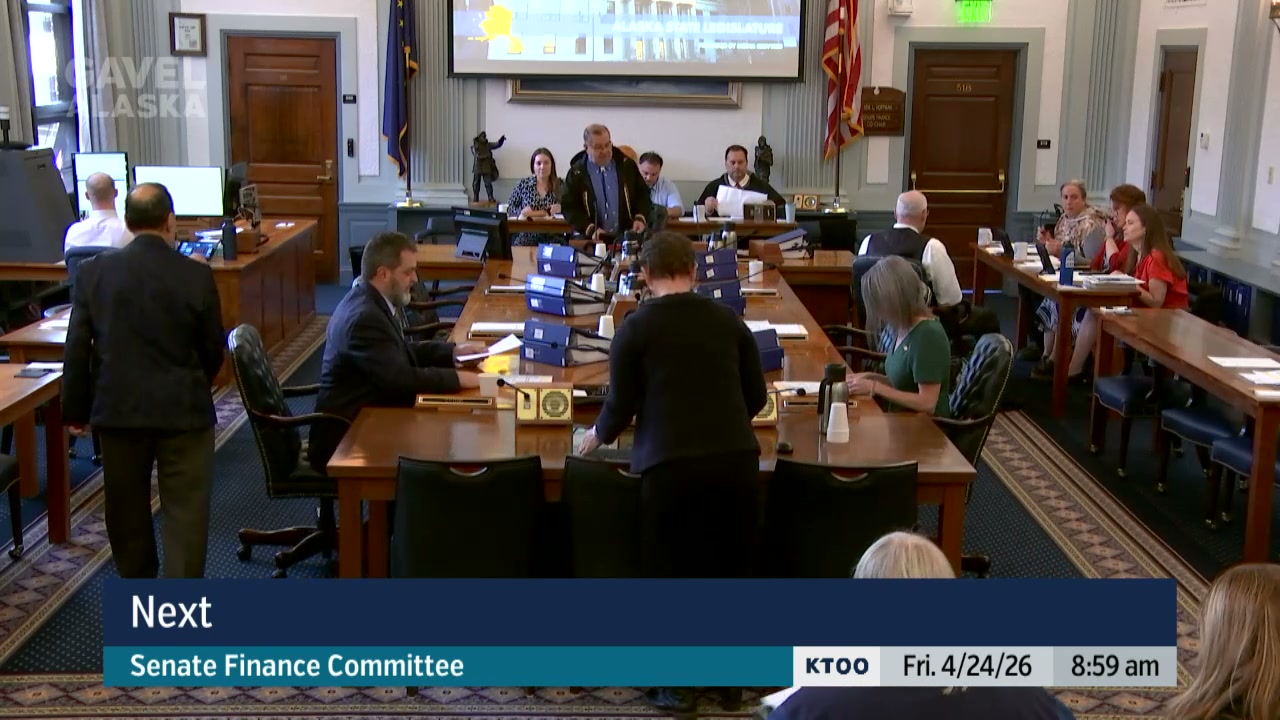
Frame from "Senate Finance, 4/24/26, 9am" · Source
PublishedAI
Senate Finance advances pension bill with municipal opt-in provision
by Alaska NewsMay 11, 2026(1h ago)5 min readSenate Finance
Share
The Alaska Senate Finance Committee voted 5-2 on April 24 to advance a bill creating a new defined benefit pension option for public employees, but only after adopting an amendment that lets municipalities choose whether to participate.
The committee approved House Bill 78 with an amendment requiring non-state employers to decide between July 1 and Sept. 30, 2026, whether to offer the new pension tier to their employees. The change came after testimony from local government leaders who said the bill's proposed increase in the employer contribution cap from 22 percent to 24 percent would strain local budgets already facing deficits and rising costs.
The bill creates a new defined benefit retirement tier and allows certain current employees in the defined contribution system to convert to the new pension plan. Alaska closed its pension system to new hires in 2006 and moved to defined contribution accounts. Supporters say the change is needed to recruit and retain teachers, troopers and other public workers who now leave Alaska for states offering traditional pensions.
Several city managers and mayors testified that the proposed increase in the employer contribution cap would create significant budget pressures.
John Leach, municipal administrator for Sitka, said the increase would cost his community between $400,000 and $500,000 annually. Sitka entered budget planning with a $900,000 deficit and already eliminated two positions to close the gap.
"A cap increase of this magnitude would force us to cut four to five additional positions from a workforce already operating below minimum staffing levels," Leach said.
Beth Weldon, mayor of Juneau, said the change would cost her city roughly $1 million per year and the school district another $300,000. She asked the committee to preserve the existing 22 percent cap that has been in place since 2006.
"That framework grew out of difficult decisions made in 2005 and 2006, when the Legislature closed the defined benefit system to new hires," Weldon said. "Local governments across Alaska, including Juneau, have planned their budgets for nearly two decades based on the 22 percent employer cap."
Weldon said Juneau supports creating a defined benefit option to help recruit and retain employees, but asked that legacy costs remain a state responsibility. She said the city would accept a higher cap for the new tier only if existing tiers remain at 22 percent.
Nils Andreassen, executive director of the Alaska Municipal League, said housing authorities would pay $600,000 more statewide under the amendment, and school districts would face $7 million in additional costs. He said some employers would have to reduce health insurance benefits or cut positions to absorb the increase.
This article was drafted with AI assistance and reviewed by editors before publishing. Every claim can be verified against the original transcript. If you spot an error, let us know.
"The only way to take into account the condition of employers and the variability is to give them choice," Andreassen said.
Lori Strickland, city manager of Bethel, said increasing the employer contribution rate while other retirement changes are being considered makes it difficult for municipalities to understand and plan for long-term financial impacts. She asked the Legislature to provide municipalities flexibility to opt in or out based on their specific needs.
John Hargis, superintendent of the Lower Yukon School District, testified in support of the underlying bill. He said rural Alaska faces constant teacher turnover because the state cannot compete with other states offering pensions.
"Since the pension was eliminated in 2006, we have seen a consistent pattern. Educators come for a few years and then they leave, and when we ask why, the answer is clear. Alaska is not competitive for a long-term career without a defined benefit," Hargis said.
He said hundreds of teaching positions remain unfilled statewide. The lack of a pension makes it difficult to attract experienced educators to remote communities.
The committee adopted Amendment 1, sponsored by Sen. Bert Stedman, which requires non-state employers to decide between July 1 and Sept. 30, 2026, whether to offer the new defined benefit plan to their employees. Employers who opt in would contribute at a rate of 24 percent of base salaries for employees who participate in the new plan.
Employees of participating employers would have from Oct. 1, 2026, to Jan. 1, 2027, to decide whether to convert to the defined benefit plan. State employees currently in the defined contribution plan would have from July 1, 2026, to Jan. 1, 2027, to make that decision.
Sen. Lyman Hoffman, who co-chairs the committee, said the opt-in approach gives municipalities flexibility to decide whether they can afford the additional benefits.
"By opting in, I think it reverses the role so that it gives much more flexibility for those communities to make this decision whether or not they can actually afford the additional benefits that are being offered to their employees," Hoffman said.
Sen. Jesse Kiehl objected to the amendment. He raised concerns about how the opt-in structure would work for public safety employees who move between state and municipal employers.
"How would this work for a state trooper who is being recruited by their local municipality, but that municipality has opted out?" Kiehl asked.
Kiehl maintained his objection and forced a roll call vote. The committee voted 5-2 to adopt the amendment. Sens. Cronk, Kaufman, Hoffman, Olson and Stedman voted yes. Sens. Kiehl and Merrick voted no.
Before the final vote on the amended bill, Stedman noted that state statute requires an analysis of long-term and short-term costs to the state and the impact on the actuarial soundness of the fund before a bill affecting retirement systems is reported to the Rules Committee.
Sen. Mike Kaufman raised concerns about the long-term obligations the bill creates.
"It puts a framework into statute that future legislators can incrementally sweeten up because of political pressure to make the system more beneficial for the recipients," Kaufman said. "That is a big hazard that is easy to fall into."
Kaufman said the bill creates guaranteed payments without guaranteed income and noted that another bill, Senate Bill 55, directly addresses the retirement gap for public employees.
The committee then voted 5-2 to advance the amended bill to the Senate Rules Committee. Sens. Kiehl, Merrick, Hoffman, Olson and Stedman voted yes. Sens. Cronk and Kaufman voted no.
According to committee discussion, the state currently pays more than $200 million annually to cover the difference between the 22 percent employer cap and the actual cost of the existing pension system. The current employer rate is approximately 27.5 percent.
The bill now moves to the Senate Rules Committee.
Stay informed. Support what matters.
Free, permanent access to local news you can verify. Subscribe to support Alaska News and go ad-free.

Comments
Sign in to leave a comment.
No comments yet. Be the first to share your thoughts.