
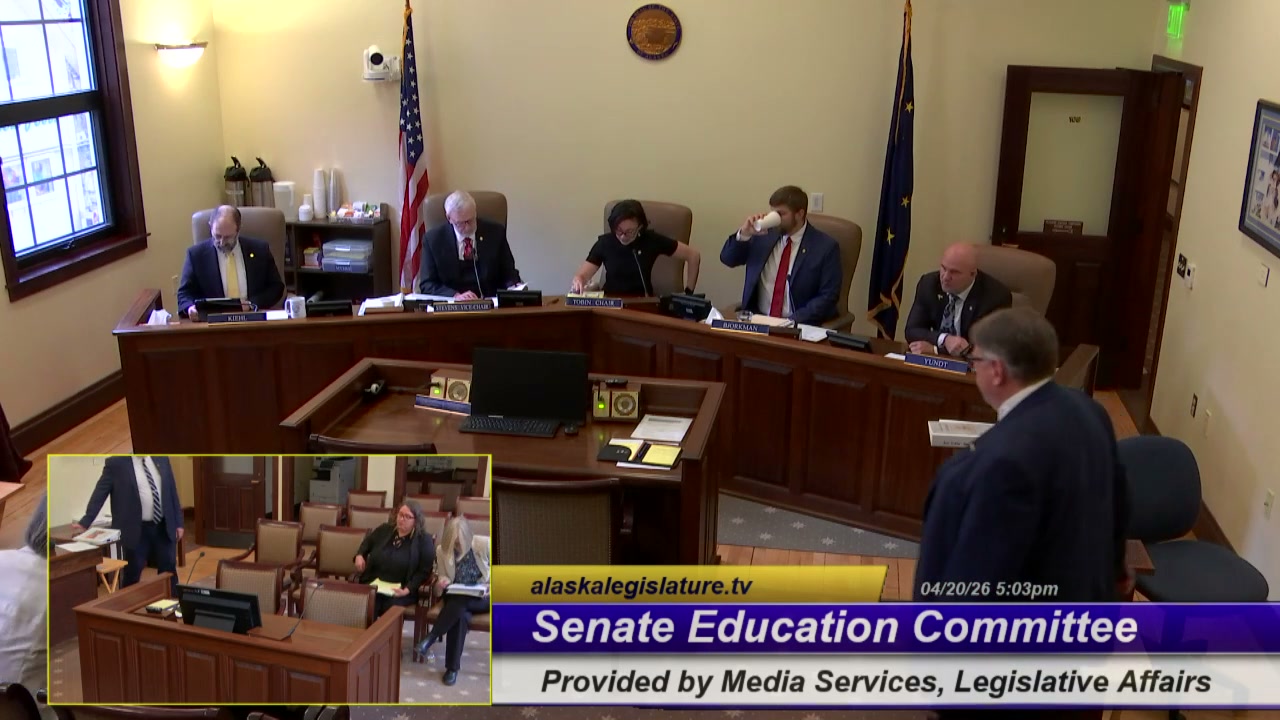
Frame from "Senate Education, 4/20/26, 3:30pm" · Source
Senate Education Committee advances teacher loan repayment pilot program
The Alaska Senate Education Committee voted Monday to advance a bill creating a student loan repayment pilot program for public school teachers in high-need subject areas.
The committee adopted a committee substitute for House Bill 28 and moved the measure forward with individual recommendations. The bill targets teachers in special education, English as a second language, science, technology, engineering, and mathematics.
Under the program, the Alaska Commission on Postsecondary Education would award grants equal to one-third of a teacher's outstanding student loan balance each year, up to $5,000 annually for a maximum of three years. Teachers must first exhaust all other federal and state student loan repayment programs before qualifying.
Representative Andi Story, the bill's sponsor, thanked the committee for its work on the measure. "I wanted to thank you for your understanding of the importance of filling our significant teacher vacancies and recognizing how employer-sponsored student loan repayment programs have emerged as a top tool for recruiting and retaining workers in other states and can help with our teacher shortage here," Story said.
The House passed the bill on May 20, 2025, before it moved to the Senate. The committee substitute removed language that would have allowed state employees to participate in the program. It also eliminated a cap of 125 grant recipients that appeared in the original version, which proposed up to $24,000 in relief over three years at $8,000 annually.
Mike Mason, staff to Senator Lukey Gail Tobin, explained that the program would operate for three years and require a report to the legislature by December 31, 2028, on its effects on teacher recruitment and retention. The program would sunset on June 1, 2030.
The committee adopted Amendment 1, which increased per-pupil student transportation funding by 10 percent. The amendment also reduced a proposed one-time energy cost relief payment to school districts from $58.7 million to $43.87 million, subject to appropriation.
Story praised the transportation and energy provisions. "One of them, adjusting student transportation funding so districts will have funds for transportation and can focus their funds on the students. And their teachers. I think it's also really important the one-time school energy cost relief payment will also be extremely beneficial, I think, to help retain teachers and keep the focus on students," she said.
Mason said the amendment would remove conditional language from House Bill 57, passed in 2025, that tied reading proficiency grants and increased career and technical education funding to passage of a digital business tax. Removing that condition would allow approximately $9.7 million in career and technical education funding and $21.8 million in reading proficiency money to go forward for the FY27 school year.
This article was drafted with AI assistance and reviewed by editors before publishing. Every claim can be verified against the original transcript. If you spot an error, let us know.
Comments
Sign in to leave a comment.
No comments yet. Be the first to share your thoughts.