
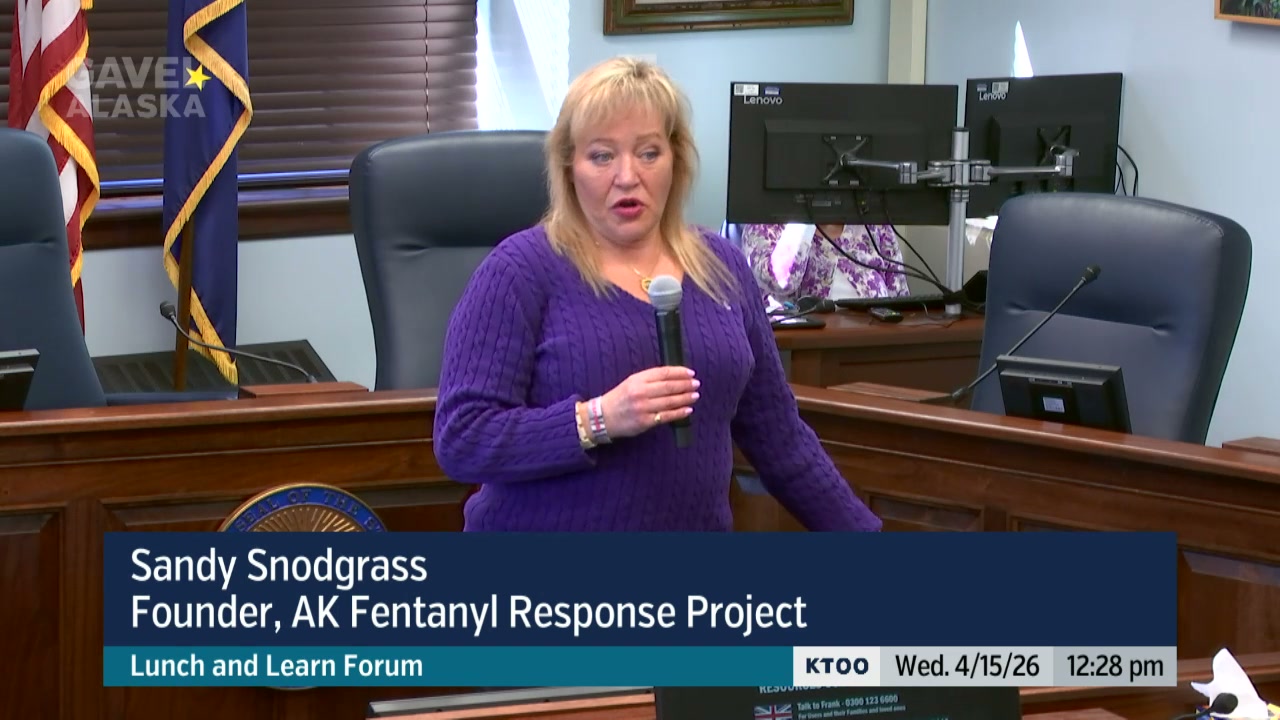
Psychologist who lost son to fentanyl urges Alaska lawmakers to support prevention
A clinical psychologist who lost her son to fentanyl poisoning told Alaska lawmakers Thursday that demand reduction through education is the only way to stop the drug from killing more young people.
Sandy Snodgrass, founder of the Alaska Fentanyl Response Project, presented at a legislative Lunch and Learn session in Juneau. She has traveled to Alaska schools teaching students about fentanyl dangers since her 22-year-old son Bruce died from fentanyl poisoning in October 2021.
"You can never die from an illicit drug if you never try an illicit drug," Snodgrass said. "That is a very difficult message to get through to people and young people."
Snodgrass stood in the Oval Office in December when the president signed Bruce's Law, federal legislation that provides new tools for organizations to address the fentanyl crisis. The law passed as one of only 35 bills approved by Congress that year.
Bruce Snodgrass was found dead behind a Wells Fargo drive-through in Anchorage, less than a mile from his family's home. He had left the house on his mountain bike on a Thursday afternoon. His body was recovered two days later by a dog walker.
"He was not able to call out for help," Snodgrass said. "I found out later that it was 100 percent fentanyl that he received that day. Somehow dropped dead where he stood and could not call out for help."
The presentation included a 13-minute documentary called "Poisoning in Alaska" created with law enforcement support. The film shows Anchorage police responding to overdose calls and interviews with officers, victims' family members and people affected by the crisis.
According to statistics presented in the documentary, Alaska recorded almost 2,000 overdoses statewide in 2023, with about 1,200 in Anchorage alone. Of those, approximately 340 were fatal statewide and 220 in Anchorage. The Alaska Department of Health reported that overdose deaths decreased from 357 in 2023 to 339 in 2024. Fentanyl was involved in 73 percent of Alaska's overdose deaths in 2024, with Anchorage having the highest regional rate.
Snodgrass said the crisis has worsened with the introduction of carfentanil, a synthetic opioid even more potent than fentanyl. While a lethal dose of fentanyl is about 10 grains of table salt, carfentanil can kill with just two to three grains. She said five Anchorage families have lost loved ones to carfentanil since October.
Rural Alaska communities face particular danger because of high drug prices that attract traffickers. Snodgrass compared the economics to food costs, noting that an egg that costs a dollar in Anchorage sells for $10 in Chevak. The same pricing applies to illicit drugs.
The DEA has seized thousands of pills at a time in backpacks on planes headed to rural communities. In Togiak, a village of 800 people, agents intercepted 3,000 pills in a single seizure. Bush pilots have become a first line of defense by reporting suspicious passengers to state troopers.
This article was drafted with AI assistance and reviewed by editors before publishing. Every claim can be verified against the original transcript. If you spot an error, let us know.
Related Coverage
Toksook Bay documentary on suicide prevention screened for Alaska lawmakers
Alaska News · 2h ago · 1 views · 76% match
Senate panel considers tougher penalties for fatal hit-and-run crashes
Alaska News · 1w ago · 3 views · 75% match
Alaska Senate Panel Weighs Tougher Hit-and-Run Penalties
Alaska News · 1w ago · 7 views · 73% match
House Finance Advances Mental Health Education Guidelines for Schools
Alaska News · 16h ago · 1 views · 73% match
Alaska Advances Mental Health Education Guidelines Without Mandates
Alaska News · 15h ago · 1 views · 73% match
Comments
Sign in to leave a comment.
No comments yet. Be the first to share your thoughts.