
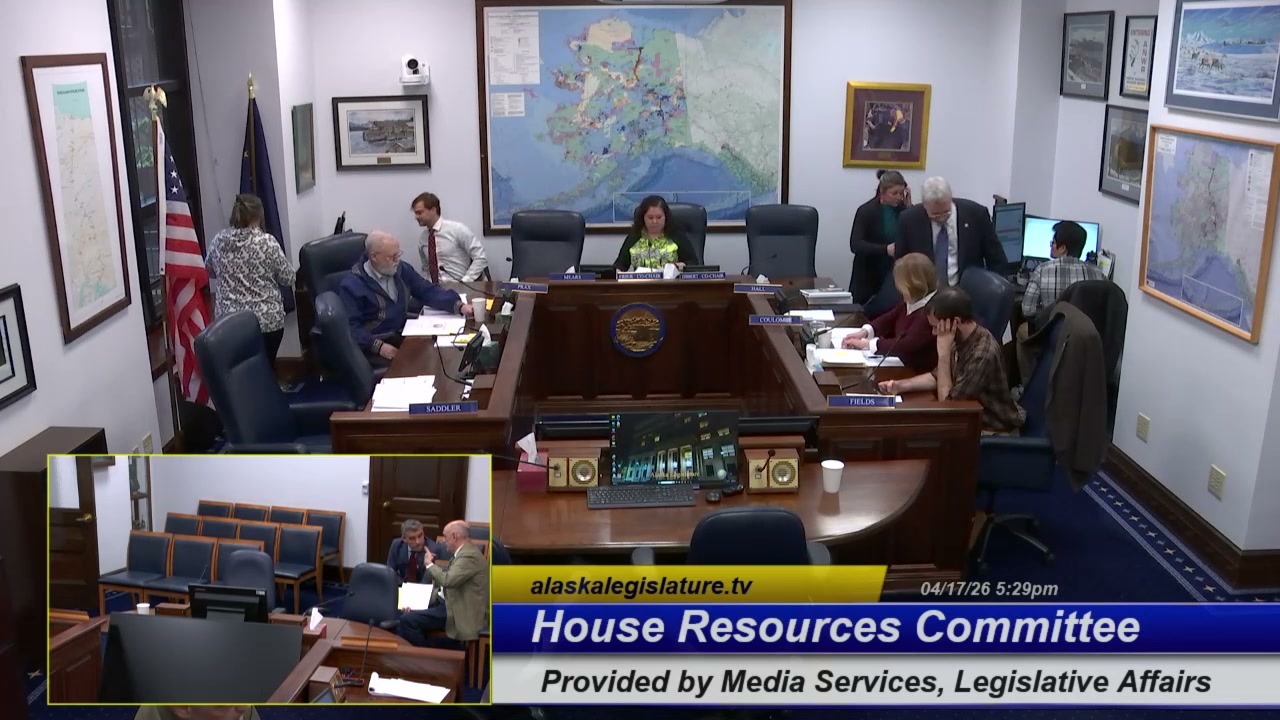
Frame from "House Resources, 4/17/26, 5:30pm" · Source
House Resources Committee Rejects Wildlife Refuge Amendments
The Alaska House Resources Committee considered and rejected most amendments Friday to a sweeping bill reorganizing the state's conservation areas. The committee advanced the legislation on a 5-3 vote after hours of debate over habitat protections and public access.
The committee voted on more than two dozen amendments to House Bill 321. Most failed on 4-5 party-line votes. Two amendments were adopted. The bill reclassifies the state's game refuges and critical habitat areas as wildlife refuges while maintaining game sanctuaries as a separate category. It creates uniform definitions and management standards statewide.
Representatives Colon, Sadler, and others proposed amendments arguing the legislation would restrict public access to hunting and fishing areas. Representative Colon said the consolidation would impose stricter rules on areas currently managed as game refuges. "When you combine the two, if it's a game refuge now, it's getting stricter on use," she said. "If it's a critical habitat now, technically it could be getting a little looser on use."
The committee rejected Amendment 11, which would have removed language requiring notification to the state commissioner before the use, lease, or disposal of land under state jurisdiction within refuges. The amendment sought to delete references to private ownership from the notification provision. The amendment failed 4-5 after Representative Josephson said the bill actually narrows the focus to state-owned lands only, excluding private property from new restrictions.
Joe Meehan, a staff member working on the bill, said the legislation redefines existing refuges and critical habitat areas to include only state-owned land. "We purposely did that to exclude the authority of Fish and Game land management authority over private lands," he said.
The committee also defeated Amendment 17, which would have changed the bill's purpose statement from protecting and preserving habitats to conserving them. Representative Sadler argued the word "conserve" better reflects Alaska's mandate to use resources while protecting them. "There's a difference between conservation and preservation," he said. "A conservationist wants to use them while protecting them as well."
Meehan said the change would put public use on equal footing with habitat protection. "Changing protect and preserve to conserve does lower the intent of protecting, maintaining habitats, as opposed to conserve, which is a slightly lower bar for protecting habitats," he said.
Representative Josephson said the amendment would prioritize public use over habitat protection. "This amendment is more extreme than the previous amendment because it would put a protection of habitat and fish and wildlife populations secondary to public use," he said. "So public use would always come first, and protection of habitat second."
This article was drafted with AI assistance and reviewed by editors before publishing. Every claim can be verified against the original transcript. If you spot an error, let us know.
Comments
Sign in to leave a comment.
No comments yet. Be the first to share your thoughts.