
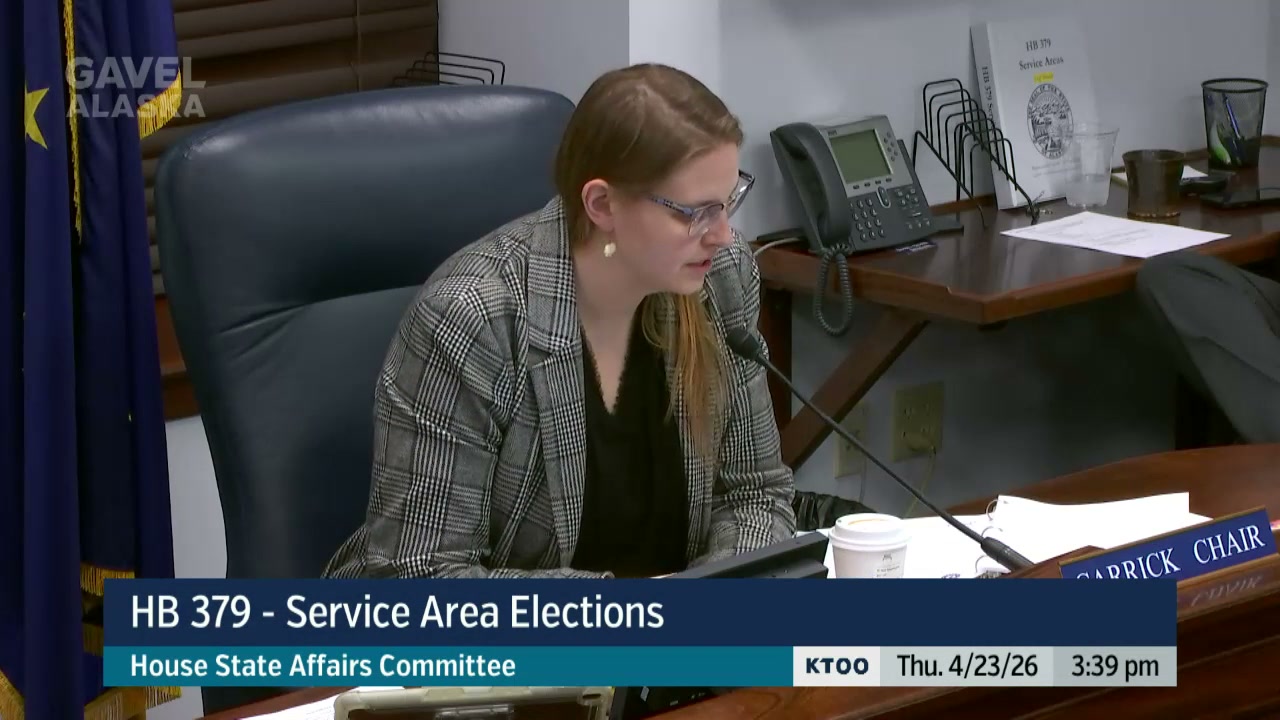
Frame from "House State Affairs, 4/23/26, 3:15pm" · Source
House panel hears Fairbanks road service area reform proposal
The House State Affairs Committee held its first hearing Thursday on legislation that would give second-class boroughs more flexibility to adjust road service area boundaries without requiring two concurrent elections.
House Bill 379, carried by committee Chair Representative Carrick at the request of the Fairbanks North Star Borough, addresses challenges that prevent local governments from effectively delivering road maintenance services in areas like Fairbanks, which operates 103 separate road service areas. Under current law, expanding a service area requires two concurrent elections. One in the neighborhood seeking service and another in the existing service area agreeing to accept them. Both must pass.
"We have been struggling to have those both elections successful simultaneously," Fairbanks North Star Borough Mayor Greer Hopkins said, testifying remotely from overseas. "Only about 40 percent of those elections have actually been successful."
The bill would preserve voter approval as the default rule for major changes but provide prospective flexibility for service areas created after July 1, 2026. It would not affect any of the 103 existing road service areas in Fairbanks or existing service areas in second-class boroughs elsewhere in Alaska.
Hopkins described how the dual-election requirement has left some residents without road maintenance even when they want to tax themselves for the service. He cited Campus Acres, a neighborhood that tried twice to join existing service areas but failed when the receiving service areas voted no. This happened even though accepting the dense neighborhood would have brought more tax revenue per mile of road. The Alaska Constitution discourages creating new service areas when existing ones could provide the service, leaving neighborhoods like Campus Acres in a bind when existing service areas refuse to expand.
"These people would need to go against the wishes of the Alaska State Constitution and start creating more service areas on top of the 103 that we already have," Hopkins said.
The legislation previously moved through the House Community and Regional Affairs Committee. Stuart Relay, staff to Chair Carrick, said the bill "reinforces the principle of maximum local self-government embedded in the Constitution."
The bill has two main sections. It would give second-class boroughs the power to abolish, replace or alter service areas created after the July 1, 2026 effective date. It would also allow consolidation of two or more service areas created after that date.
Hopkins explained that from 1972 to 2004, the state shared revenue with service areas based on road mileage, which led to rapid creation of new service areas. Seventy-four formed in the 1980s alone. The revenue-sharing formula created an incentive to form new service areas to capture state grants, contributing to the fragmentation that now complicates service delivery. Since those grants ended, 49 road service area elections have been held, and 60 percent failed.
This article was drafted with AI assistance and reviewed by editors before publishing. Every claim can be verified against the original transcript. If you spot an error, let us know.
Comments
Sign in to leave a comment.
No comments yet. Be the first to share your thoughts.