
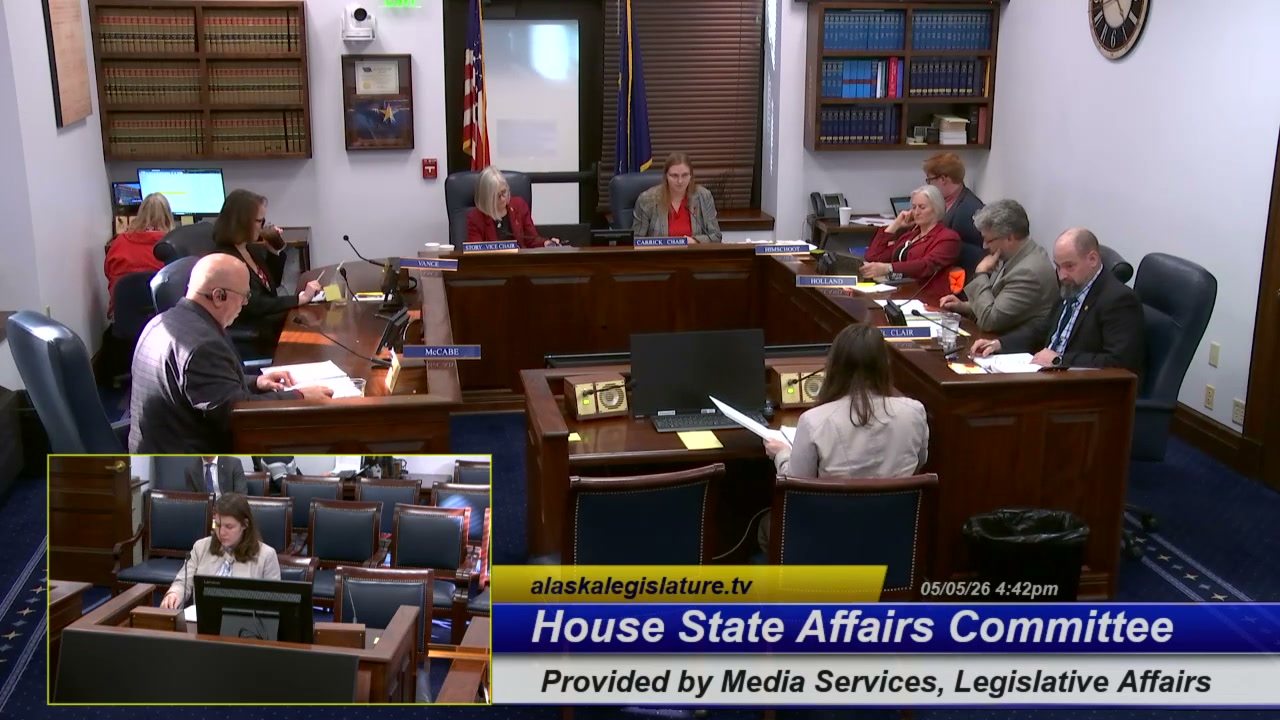
Frame from "HSTA-260505-1515" · Source
House panel advances daylight saving time bill with Western Alaska carve-out
The House State Affairs Committee advanced a modified daylight saving time bill Tuesday that would place Western Alaska in a different time zone than the rest of the state if Alaska joins Pacific Standard Time.
The committee substitute for Senate Bill 26 would petition the U.S. Department of Transportation to move most of Alaska to Pacific Standard Time while keeping areas west of the 155th meridian in a separate zone. If the federal agency does not approve the petition by January 1, 2028, Alaska would default to Alaska Standard Time year-round. Either way, the state would stop changing clocks twice a year starting March 11, 2028.
The issue has generated more public testimony and emails than any other matter before the legislature this year, Committee Chair Ashley Carrick said. The committee substitute attempts to balance widespread support for ending clock changes with concerns from Western Alaska communities about being pushed further from solar noon.
"This committee substitute tries to strike a balance where we maybe do what is most advantageous or, dare I say popular, but I hate to use that word here," Carrick said. "But we are also trying to strike a balance where we are addressing the concerns that were brought forward."
The two-time-zone approach emerged after the committee heard testimony on both SB 26 and a competing bill, House Bill 229. Strong proponents of the original bill suggested the Western Alaska carve-out after hearing public testimony, Kerry Crocker said. Crocker is staff to bill sponsor Senator Kelly Merrick.
Representative Ky Holland explained the bill's conditional structure. If the Department of Transportation approves Alaska's petition to join Pacific Standard Time, the 155th meridian line would create the new time zone boundary. That line runs roughly through the middle of the state, west of Bethel and the Alaska Peninsula. If the petition fails or is withdrawn, Alaska would remain on Alaska Standard Time without moving the existing time zone line, which currently sits far out in the Western Aleutian Islands.
"This will affect hundreds of thousands of people and tens of thousands of businesses," Holland said. "This is not a trivial change. Have a major impact down the road. And personally, I am more comfortable with having that process that this would create than simply having us try and here roll the dice and come up with one answer or the other."
If the bill passes, the Department of Transportation would conduct public hearings around the state and make its decision based on convenience of commerce, Crocker said. The agency has indicated it would move forward with the review process.
Representative Sarah Vance expressed concern about dividing the state into multiple time zones. She noted that Alaska previously unified its time zones for government services, schools, and travel. She questioned whether the benefits outweighed the risks.
This article was drafted with AI assistance and reviewed by editors before publishing. Every claim can be verified against the original transcript. If you spot an error, let us know.
Related Coverage
House panel advances retirement savings program with PFD deposit option
Alaska News · 22h ago · 2 views · 78% match
House panel advances income tax on large pass-through businesses
Alaska News · 5d ago · 3 views · 78% match
House panel advances travel insurance consumer protection bill
Alaska News · 1w ago · 2 views · 78% match
Alaska House panel advances penny rounding bill amid federal mint halt
Alaska News · 4d ago · 2 views · 78% match
Alaska House panel advances free school meals for reduced-price students
Alaska News · 3w ago · 2 views · 77% match
Comments
Sign in to leave a comment.
No comments yet. Be the first to share your thoughts.