House panel advances bill to fast-track utility easements in state parks
by Alaska NewsMay 8, 2026(8h ago)5 min readJuneau, Alaska
Share
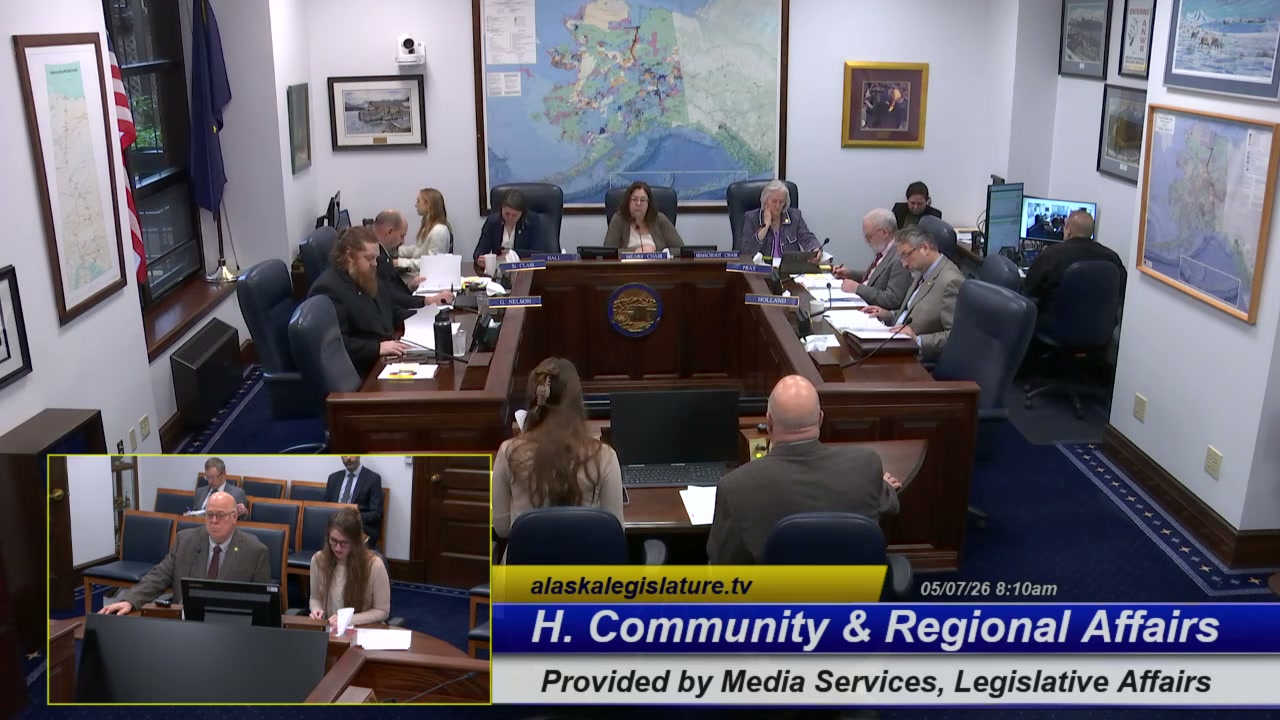
The Alaska House Community and Regional Affairs Committee advanced legislation Thursday that would streamline replacement of aging underwater power lines in state parks while raising questions about how broadly the state could permit new utility projects through park land.
The committee adopted a committee substitute for House Bill 220, which addresses easements and rights-of-way on state park land. The bill targets immediate problems at Nancy Lake State Park and Kachemak Bay State Park, where decades-old utility infrastructure needs replacement but cannot be upgraded under current regulations. The legislation also requires the Department of Natural Resources to grant easements for private property access through state parks if there is no undue impact, though Thursday's hearing focused primarily on the utility provisions.
"Right now, the Nancy Lake State Park and the Kachemak Bay State Park have some aging infrastructure that was either not permitted under an easement properly or not given a proper easement that need to be replaced," said Representative Kevin McCabe, the bill's sponsor. "And frankly, the Park Service, Director Geese, and I cannot remember the guy's name, but there is an email from his representative in the valley that said this is going to have to be changed legislatively."
More than 40 families at Nancy Lake rely on underwater power lines that are over 40 years old and beyond their service life. When the cables develop pinholes, repairs can take five hours or longer if ice covers the lake, leaving homes without heat during Alaska winters.
"The frequency of outages has increased over the years," said Mike Klawitter, president of the Nancy Lake Homeowners Association. "And as you can probably picture too, at breakup time, which we are going through now, freeze-up time in the fall, and with winter ice conditions over 50 inches thick this winter, it is very difficult for line crews to try and repair underwater lines in those kind of circumstances."
The committee substitute narrowed the bill to apply exclusively to state park units and added intent language aimed at preventing large-scale development. It creates a two-tiered system. The Department of Natural Resources would be required to grant easements for operation, maintenance, upgrade, removal or replacement of existing public utility facilities within 90 days of receiving a completed application. The committee substitute includes language stating that if the department misses that deadline, the easement would be automatically approved, though committee members raised concerns about that provision.
The bill also creates new authority for the department to grant easements for installation of new utility facilities and infrastructure, provided statutory criteria are met. That provision drew scrutiny from committee members concerned about opening state parks to large-scale development.
This article was drafted with AI assistance and reviewed by editors before publishing. Every claim can be verified against the original transcript. If you spot an error, let us know.
"I am just curious how we are constraining how big a project this is," said Representative Ky Holland. "The 'may' seems to be when it says, you know, 'may allow a project for a public utility,' seems to open up the door to a huge, large project, depending upon the eye of the beholder."
Holland said he fully supported the bill's provisions for maintaining and replacing existing infrastructure but remained uncertain about the scope of new development authority being granted.
"Where things, I think, are still a little gray for me is the scope of what this new shall grant opportunity is and how that will be used in the future," Holland said.
Co-Chair Rebecca Himschoot echoed those concerns. "I do come back to the concerns that Representative Holland was talking about," Himschoot said. "How do we decide what is big and what is little? And I want to trust our state parks people to make those determinations and to be reasonable about it, but I think we have to be really thoughtful."
McCabe said the intent was not to authorize large projects like liquefied natural gas pipelines through parks. The Department of Natural Resources would retain overarching permitting authority, he said, with the bill simply allowing the parks division to participate in that process.
Co-Chair Donna Mears raised concerns about two provisions in the bill: the automatic issuance of permits after 90 days and language allowing GPS-based surveys instead of traditional cadastral surveys.
"One is an automatic issuance of permits," Mears said. "I started off my career as a regulator, and, you know, things can happen. And that practice of automatic issuance of permits is not a path I want to go down at all, regardless of the type and scale of the project."
Mears said she had amendments prepared to remove both provisions but wanted to continue working with the Department of Natural Resources on the surveying standards question. The committee set an amendment deadline of Monday, May 12 at noon.
Matt Wedeking, deputy director for the Division of Parks and Outdoor Recreation, confirmed that state parks currently has no authority to grant utility easements. He explained that in 2015 the legislature recognized that parks lacked this authority and rewrote certain park statutes to incorporate natural gas pipelines in Denali State Park and Nancy Lake.
The committee asked Wedeking to provide written follow-up on whether existing DNR staff could handle easement requests within 90 days and whether the department has other processes with automatic issuance of permits. Wedeking said he could not think of one off the top of his head but would check and respond in writing.
Members also discussed public input processes. Wedeking said current special use permits and commercial use permits do not include a public process portion, and that would be something the legislature would have to consider.
Representative Gene Nelson said he supported the full bill and believed existing restrictions would prevent abuse of the new authority. He noted that the bill requires the department to provide written reasons for any denial and includes language stating that easements remain subject to other laws.
"I do not see this as an open door for mass power lines," Nelson said. "I understand the concern, but I think that those are already addressed."
The committee adopted the committee substitute after Co-Chair Himschoot moved to adopt it and Mears objected for purposes of discussion. After hearing presentations and questions, Mears removed her objection and the substitute was adopted without further objection.
With the legislative session nearing its end, Mears said next week would be the last opportunity for the committee to meet this session.
Stay informed. Support what matters.
Free, permanent access to local news you can verify. Subscribe to support Alaska News and go ad-free.

Comments
Sign in to leave a comment.
No comments yet. Be the first to share your thoughts.