
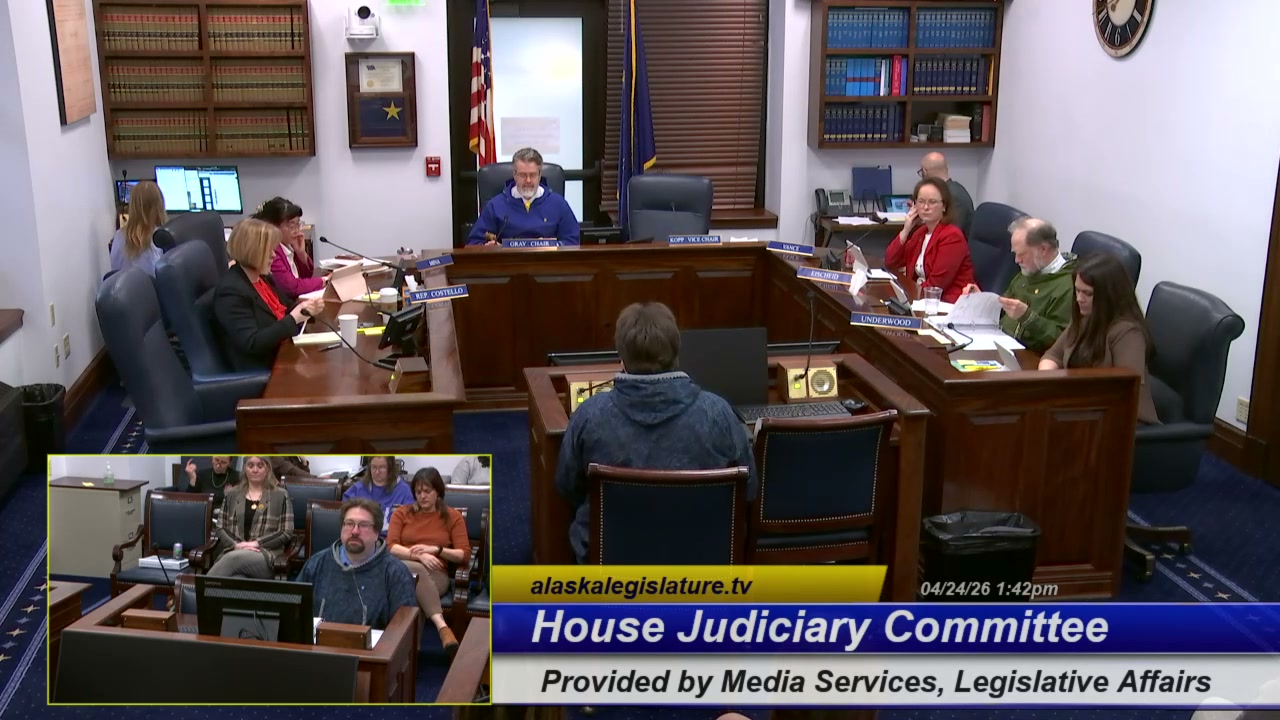
Frame from "HJUD-260424-1300" · Source
House Judiciary rejects consumer data privacy bill after 3-3 vote
The House Judiciary Committee failed to adopt a committee substitute for a consumer data privacy bill Friday after members split 3-3 on whether to advance the measure as a working document.
The committee substitute for House Bill 367, the Alaska Data Privacy Act, would have created a data broker registry and given Alaskans new rights to control how companies collect, share, and sell their personal information. The substitute failed to be adopted after a 3-3 vote. Representatives Sarah Vance, Mia Costello, and Julie Underwood voted no. Representatives Andrew Gray, Aisha Eichide, and Donna Mena voted yes.
Rep. Andy Story, the bill's sponsor, said the legislation addresses a constitutional privacy right that is currently being violated. The bill would limit data collection to what is reasonably necessary to provide a requested service. It would require companies to let Alaskans know when their data is being collected. It would create stronger protections for youth and sensitive information.
"Personal data is collected, shared, and analyzed and sold in many ways that people never see and often do not understand what is being done with their personal data," Story said. "It is powerful, valuable, and influential."
The committee substitute fully redrafted the original bill. Story's staff member Kaylee Holm explained that the original version was modeled on California's privacy law. The substitute switched to a framework used by Virginia, Washington, Colorado, and Connecticut. The change was meant to reduce administrative burden on the state and make it easier for businesses to comply.
"We heard from businesses, we have heard from the committee," Holm said. "A lot of the questions that were asked at that very first committee hearing were considered when writing this bill."
The substitute removed a 3 percent fee on data processors that resembled a tax. It eliminated mandatory rulemaking by the Attorney General. It added a data broker registry and lowered the threshold for the number of consumers a business engages with compared to the original version. It created specific exemptions for government and tribal entities. The bill would also prohibit the sale or use of data for individuals 17 or younger and limit targeted advertising and profiling of minors.
Chair Andrew Gray's committee aide, Dylan Hitchcock Lopez, said the goal was to provide clarity and avoid conflicts with federal law. The bill exempts data already covered by comprehensive federal laws like HIPAA.
"The idea here is to provide clarity so that there is not a direct conflict of laws issue," Hitchcock Lopez said.
Costello raised concerns about giving the Attorney General broad authority to write regulations after the law takes effect. She said she was uncomfortable with the legislature handing over responsibility to the executive branch.
This article was drafted with AI assistance and reviewed by editors before publishing. Every claim can be verified against the original transcript. If you spot an error, let us know.
Comments
Sign in to leave a comment.
No comments yet. Be the first to share your thoughts.